
Pulp Fiction, 1928 · page 8 of 99
Amazing Stories — page 8: what you’re looking at
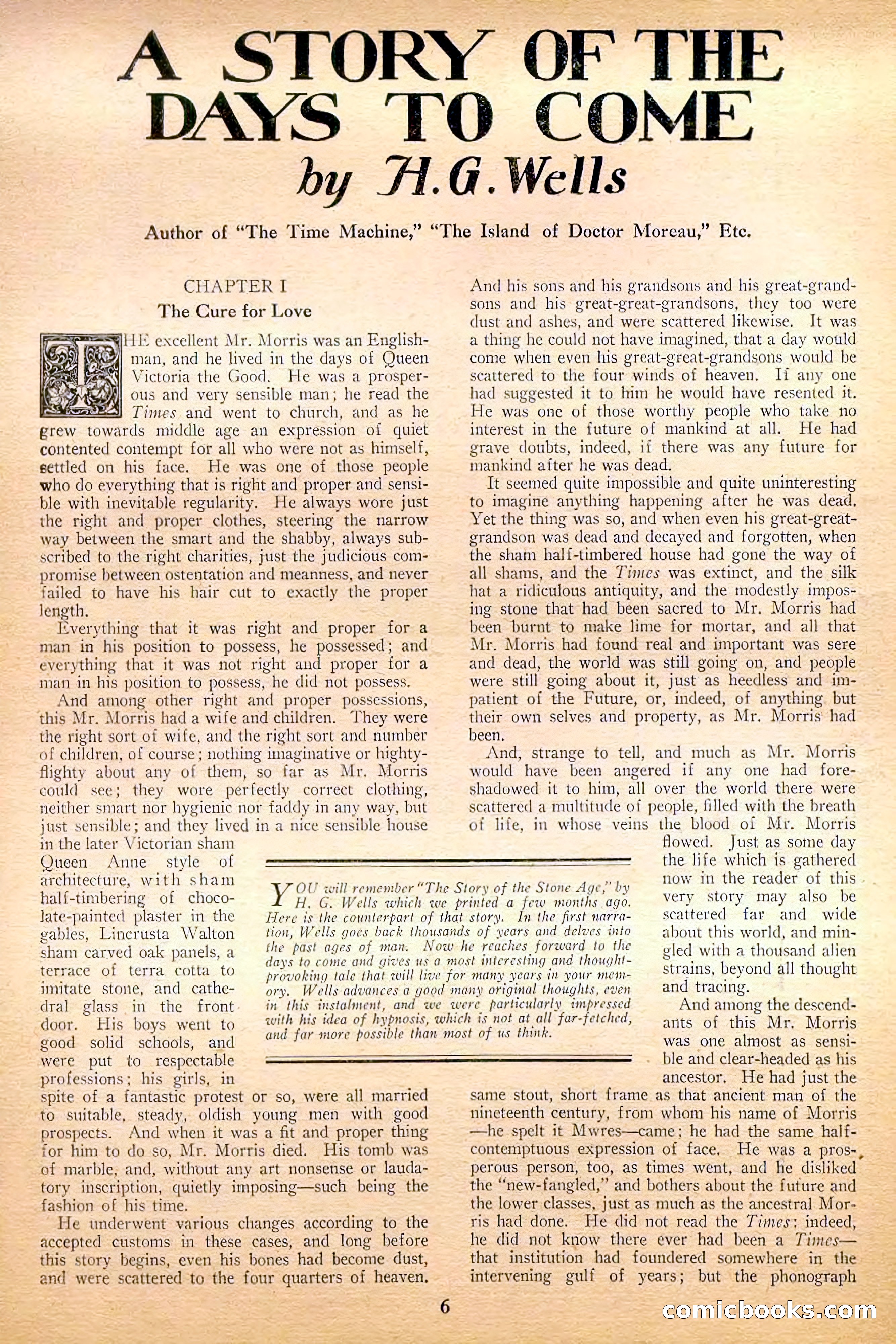
A restored page from Pulp Fiction, 1928. Page through the whole issue in the reader above.
📄 Transcribed text from this page (OCR, searchable)
Machine-transcribed from the original scan — historical spelling and the odd misread are preserved.
Senne Se ae | es, A STORY OF THE DAYS TO COME by F1.G.Wells Author of “The Time Machine,” “The Island of Doctor Moreau,” Etc. CHAPTER I The Cure for Love HIS excellent Mr. Morris was an English- man, and he lived in the days of Queen Iexabews Victoria the Good. He was a prosper- Spees)) ous and very sensible man; he read the MeeE) Tics and went to church, and as he grew towards middle age an expression of quiet contented contempt for all who were not as himself, settled on his face. He was one of those people who do everything that is right and proper and sensi- ble with inevitable regularity. He always wore just the right and proper clothes, steering the narrow way between the smart and the shabby, always sub- scribed to the right charities, just the judicious com- promise between ostentation and meanness, and never failed to have his hair cut to exactly the proper length. Iéverything that it was right and proper for a man in his position to possess, he possessed; and everything that it was not right and proper for a man in his position to possess, he did not possess. And among other right and proper possessions, this Mr. Morris had a wife and children. They were the right sort of wife, and the right sort and number of children, of course; nothing imaginative or highty- flighty about any of them, so far as Mr. Morris could see; they wore perfectly correct clothing, neither smart nor hygienic nor faddy in any way, but just sensible; and they lived in a nice sensible house in the later Victorian sham Queen Anne style of And his sons and his grandsons and his great-grand- sons and his great-great-grandsons, they too were dust and ashes, and were scattered likewise. It was a thing he could not have imagined, that a day would come when even his great-great-grandsons would be scattered to the four winds of heaven. Ii any one had suggested it to him he would have resented it. He was one of those worthy people who take no interest in the future of mankind at all. He had grave doubts, indeed, if there was any future for mankind after he was dead. It seemed quite impossible and quite uninteresting to imagine anything happening after he was dead, Yet the thing was so, and when even his great-great- grandson was dead and decayed and forgotten, when the sham half-timbered house had gone the way of all shams, and the Times was extinct, and the silk hat a ridiculous antiquity, and the modestly impos- ing stone that had been sacred to Mr. Morris had been burnt to make lime for mortar, and all that Mr. Morris had found real and important was sere and dead, the world was still going on, and people were still going about it, just as heedless and im- patient of the Future, or, indeed, of anything. but their own selves and property, as Mr. Morris had been. And, strange to tell, and much as Mr. Morris would have been angered if any one had fore- shadowed it to him, all over the world there were scattered a multitude of people, filled with the breath of life, in whose veins the blood of Mr. Morris flowed, Just as some day the life which is gathered architecture, with sham half-timbering of choco- late-painted plaster in the gables, Lincrusta Walton sham carved oak panels, a terrace of terra cotta to imitate stone, and cathe- ory, dral glass in the front door. His boys went to good solid schools, and were put to respectable professions; his girls, in spite of a fantastic protest or so, were all married to suitable, steady, oldish young men with good prospects. And when it was a fit and proper thing for him to do so, Mr. Morris died. His tomb was of marble, and, without any art nonsense or lauda- tory inscription, quietly imposing—such being the fashion of his time. He underwent various changes according to the accepted customs in these cases, and long before this story begins, even his bones had become dust, and were scattered to the four quarters of heaven. the past ages of man. OU will remember “The Story of the Stone Age,” by H. G. Wells which we printed a few months ago. Here ts the counterpart of that story. tion, Wells goes back thousands of years and delves into Now he reaches forward to the days to come and gives us a most interesting and thought- provoking tale that will live for many years in your mem- Wells advances a yood many original thoughts, even in this instalment, and we were particularly impressed with his idea of hypnosis, which is not at all far-fetched, and far more possible than most of us think. a a See now in the reader of this very story may also be scattered far and wide about this world, and min- gled with a thousand alien strains, beyond all thought and tracing. And among the descend- ants of this Mr. Morris was one almost as sensi- ble and clear-headed as his ancestor, He had just the same stout, short frame as that ancient man of the nineteenth century, from whom his name of Morris —he spelt it Mwres—came: he had the same half- contemptuous expression of face, perous person, too, as times went, and he disliked the “new-fangled,” and bothers about the future and the lower classes, just as much as the ancestral Mor- ris had done. He did not read the Times; indeed, he did not know there ever had been a Tumes— that institution had foundered somewhere in the intervening gulf of years; but the phonograph In the first narra- He was a pros-, SG COmicbooks-com - yo i — ao + — _ ai _ | St eee