
Pulp Fiction, 1922 · page 117 of 176
Argosy All-Story Weekly — page 117: what you’re looking at
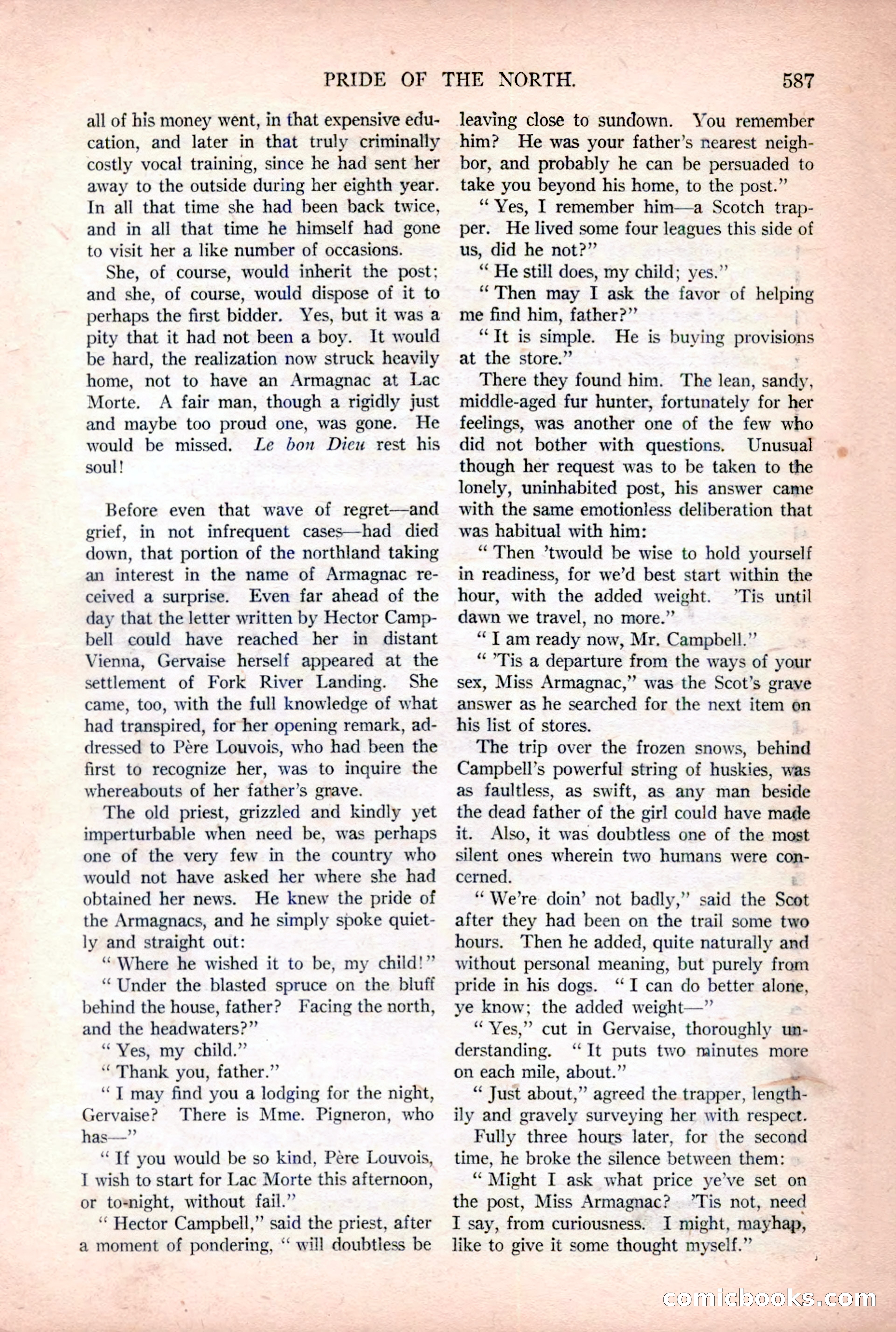
A restored page from Pulp Fiction, 1922. Page through the whole issue in the reader above.
📄 Transcribed text from this page (OCR, searchable)
Machine-transcribed from the original scan — historical spelling and the odd misread are preserved.
PRIDE OF THE NORTH. all of his money went, in that expensive edu- cation, and later in that truly criminally costly vocal training, since he had sent her away to the outside during her eighth year. In all that time she had been back twice, and in all that time he himself had gone to visit her a like number of occasions. She, of course, would inherit the post: and she, of course, would dispose of it to perhaps the first bidder. Yes, but it was a pity that it had not been a boy. It would be hard, the realization now struck heavily home, not to have an Armagnac at Lac Morte. A fair man, though a rigidly just and maybe too proud one, was gone. He would be missed. Le bon Dieu rest his soul! Before even that wave of regret—and grief, in not infrequent cases—had died down, that portion of the northland taking an interest in the name of Armagnac re- ceived a surprise. Even far ahead of the day that the letter written by Hector Camp- bell could have reached her in distant Vienna, Gervaise herself appeared at the settlement of Fork River Landing. She came, too, with the full knowledge of what had transpired, for her opening remark, ad- dressed to Pere Louvois, who had been the first to recognize her, was to inquire the whereabouts of her father’s grave. The old priest, grizzled and kindly yet imperturbable when need be, was perhaps one of the very few in the country who would not have asked her where she had obtained her news. He knew the pride of the Armagnacs, and he simply spoke quiet- ly and straight out: “Where he wished it to be, my child!” “Under the blasted spruce on the bluff behind the house, father? Facing the north, and the headwaters?”’ “Yes, my child.” ‘Thank you, father.” ‘“T may find you a lodging for the night, Gervaise? There is Mme. Pigneron, who has—”’ “Tf you would be so kind, Pere Louvois, 1 wish to start for Lac Morte this afternoon, or tosnight, without fail.” ‘“ Hector Campbell,” said the priest, after a moment of pondering, ‘‘ will doubtless be 587 leaving close to sundown. You remember him? He was your father’s nearest neigh- bor, and probably he can be persuaded to take you beyond his home, to the post.” “Yes, I remember him—a Scotch trap- per. He lived some four leagues this side of us, did he not?” “ He still does, my child; yes.” “Then may I ask the favor of helping me find him, father?’ “Tt is simple. He is buying provisions at the store.” | There they found him. The lean, sandy, middle-aged fur hunter, fortunately for her feelings, was another one of the few who did not bother with questions. Unusual though her request was to be taken to the lonely, uninhabited post, his answer came with the same emotionless deliberation that was habitual with him: “Then ’twould be wise to hold yourself in readiness, for we’d best start within the hour, with the added weight. ’Tis until dawn we travel, no more.” ““T am ready now, Mr. Campbell.” “°Tis a departure from the ways of your sex, Miss Armagnac,” was the Scot’s grave answer as he searched for the next item on his list of stores. The trip over the frozen snows, behind Campbell’s powerful string of huskies, was as faultless, as swift, as any man beside the dead father of the girl could have made it. Also, it was doubtless one of the most silent ones wherein two humans were con- cerned. ‘We're doin’ not badly,” said the Scot after they had been on the trail some two hours. Then he added, quite naturally and without personal meaning, but purely from pride in his dogs. “I can do better alone, ye know; the added weight—”’ “Yes,” cut in Gervaise, thoroughly un- derstanding. ‘It puts two minutes more on each mile, about.” “ Just about,” agreed the trapper, length- ily and gravely surveying her with respect. Fully three hours later, for the second time, he broke the silence between them: “Might I ask what price ye’ve set on the post, Miss Armagnac? ’Tis not, need I say, from curiousness. I might, mayhap, like to give it some thought myself.” COMMCOOOKS. Oh - Te eile ~ ;