
Pulp Fiction, 1922 · page 140 of 176
Argosy All-Story Weekly — page 140: what you’re looking at
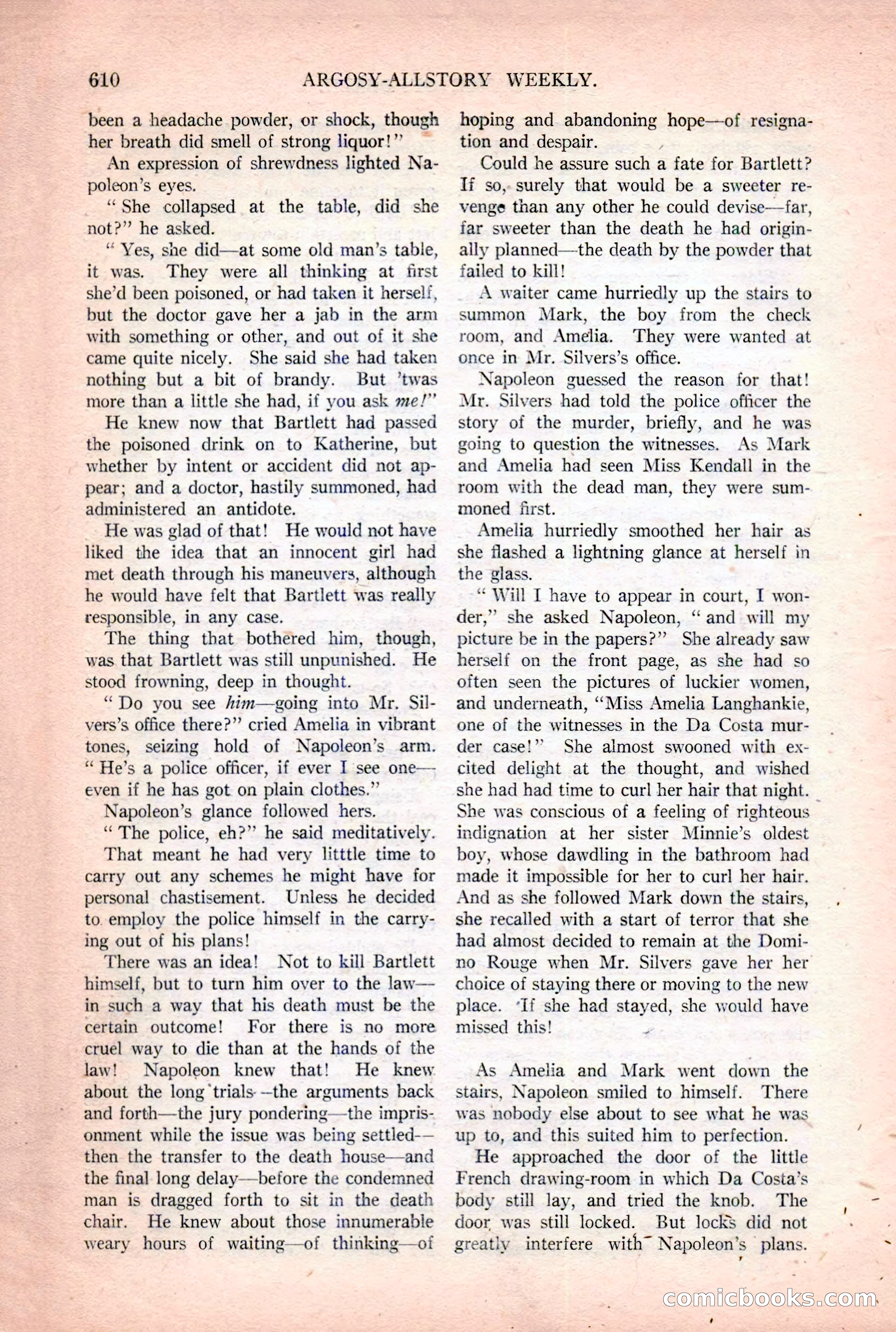
A restored page from Pulp Fiction, 1922. Page through the whole issue in the reader above.
📄 Transcribed text from this page (OCR, searchable)
Machine-transcribed from the original scan — historical spelling and the odd misread are preserved.
610 ‘been a headache powder, or shock, though her breath did smell of strong liquor!”’ An expression of shrewdness lighted Na- poleon’s eyes. “She collapsed at the table, did she not?” he asked. “Yes, sne did—at some old man’s table, it was. They were all thinking at first she’d been poisoned, or had taken it herself, but the doctor gave her a jab in the arm with something or other, and out of it she came quite nicely. She said she had taken nothing but a bit of brandy. But ’twas more than a little she had, if you ask me/!’’ He knew now that Bartlett had passed the poisoned drink on to Katherine, but whether by intent or accident did not ap- pear; and a doctor, hastily summoned, had administered an antidote. He was glad of that! He would not have liked the idea that an innocent girl had met death through his maneuvers, although he would have felt that Bartlett was really responsible, in any case. The thing that bothered him, though, was that Bartlett was still unpunished. He stood frowning, deep in thought. “Do you see him—going into Mr, Sil- vers’s office there?” cried Amelia in vibrant tones, seizing hold of Napoleon’s arm. “He’s a police officer, if ever I see one— even if he has got on plain clothes.” Napoleon’s glance followed hers. “The police, eh?’’ he said meditatively. That meant he had very litttle time to carry out any schemes he might have for personal chastisement. Unless he decided to. employ the police himself in the carry- ing out of his plans! There was an idea! Not to kill Bartlett himself, but to turn him over to the law— in such a way that his death must be the certain outcome! For there is no more cruel way to die than at the hands of the law! Napoleon knew that! He knew about the long trials —the arguments back and forth—the jury pondering—the impris- onment while the issue was being settled-— then the transfer to the death house—and the final long delay——before the condemned man is dragged forth to sit in the death chair. He knew about those innumerable weary hours of waiting—of thinking—oi ARGOSY-ALLSTORY WEEKLY. hoping and abandoning hope—of resigna- tion and despair. ; Could he assure such a fate for Bartlett? Tf so, surely that would be a sweeter re- venge than any other he could devise—far, far sweeter than the death he had origin- ally planned—the death by the powder that failed to kill! A waiter came hurriedly up the stairs to summon Mark, the boy from the check room, and Amelia. They were wanted at once in Mr. Silvers’s office. Napoleon guessed the reason for that! Mr. Silvers had told the police officer the story of the murder, briefly, and he was going to question the witnesses. As Mark and Amelia had seen Miss Kendall in the room with the dead man, they were sum- moned first. Amelia hurriedly smoothed her hair as she flashed a lightning glance at herself in the glass. “ Will I have to appear in court, I won- der,” she asked Napoleon, ‘“ and will my picture be in the papers?” She already saw herself on the front page, as she had so often seen the pictures of luckier women, and underneath, ‘‘Miss Amelia Langhankie, one of the witnesses in the Da Costa mur- der case!”’ She almost swooned with ex- cited delight at the thought, and wished she had had time to curl her hair that night. — She was conscious of a feeling of righteous indignation at her sister Minnie’s oldest boy, whose dawdling in the bathroom had made it impossible for her to curl her hair. And as she followed Mark down the stairs, she recalled with a start of terror that she had almost decided to remain at the Domi- no Rouge when Mr. Silvers gave her her choice of staying there or moving to the new place. ‘If she had stayed, she would have missed this! 4 As Amelia and Mark went down the stairs, Napoleon smiled to himself. There was nobody else about to see what he was up to, and this suited him to perfection. He approached the door of the little French drawing-room in which Da Costa’s body still lay, and tried the knob. The door was still locked. But locks did not greatlv interfere with” Napoleon’s plans. Gomichbooksreonnt ‘