
Pulp Fiction, 1922 · page 15 of 176
Argosy All-Story Weekly — page 15: what you’re looking at
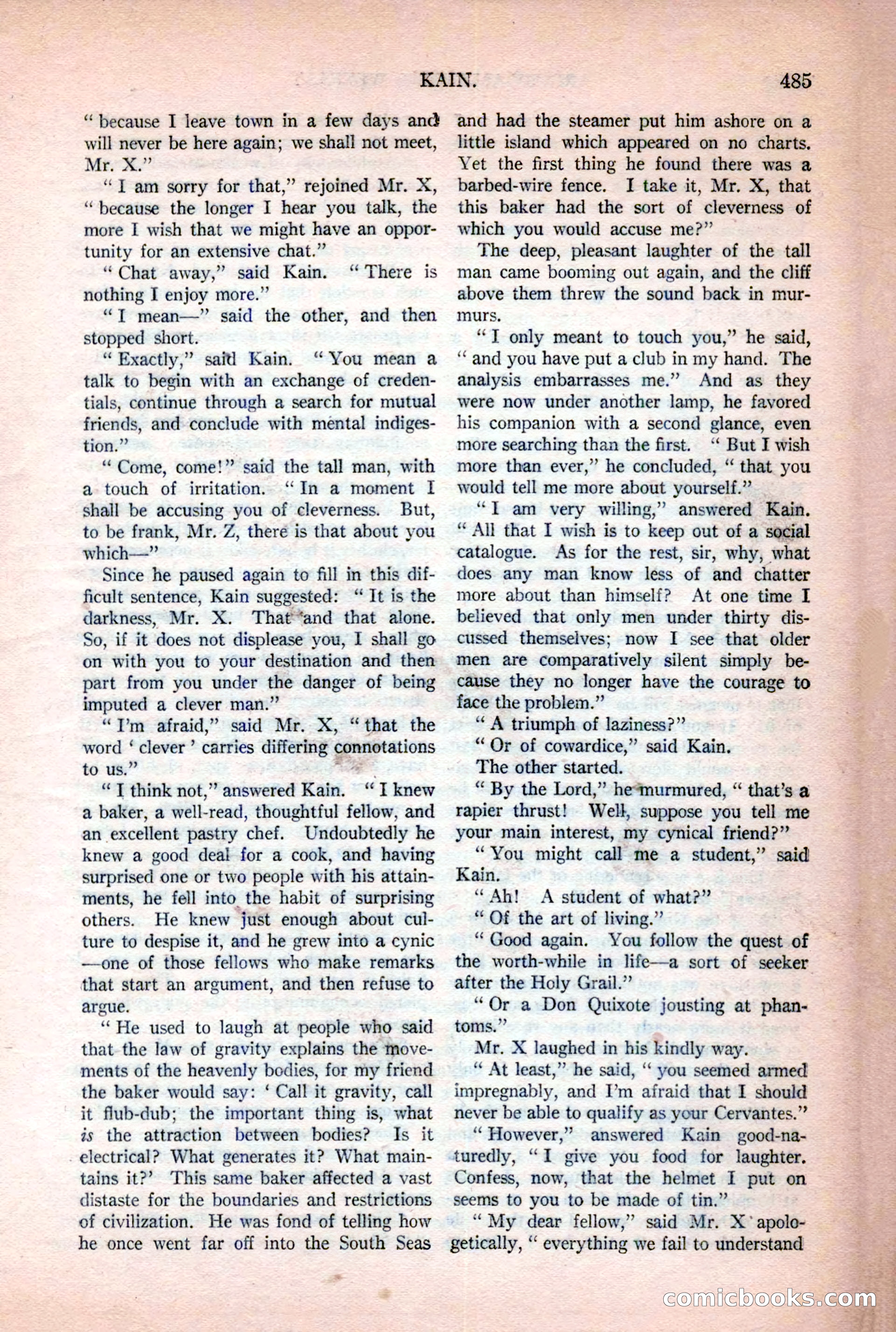
A restored page from Pulp Fiction, 1922. Page through the whole issue in the reader above.
📄 Transcribed text from this page (OCR, searchable)
Machine-transcribed from the original scan — historical spelling and the odd misread are preserved.
KAIN, “ because I leave town in a few days and will never be here again; we shall not meet, Mr. X.” “I am sorry for that,” rejoined Mr. X, “because the longer I hear you talk, the more I wish that we might have an oppor- tunity for an extensive chat.” “Chat away,” said Kain. nothing I enjoy more.” “T mean—” said the other, and then stopped short. “ Exactly,” said Kain. “ You mean a talk to begin with an exchange of creden- tials, continue through a search for mutual friends, and conclude with mental indiges- tion.” “Come, come!” said the tall man, with a touch of irritation. ‘In a moment I shall be accusing you of cleverness. But, to be frank, Mr. Z, there is that about you which—” Since he paused again to fill in this dif- ficult sentence, Kain suggested: “It is the darkness, Mr. X. That“and that alone. So, if it does not displease you, I shall go on with you to your destination and then part from you under the danger of being imputed a clever man.” “Tm afraid,” said Mr. X, “that the word ‘ clever’ carries differing connotations to us.” a “ T think not,” answered Kain. “I knew a baker, a well-read, thoughtful fellow, and an excellent pastry chef. Undoubtedly he knew a good deal for a cook, and having surprised one or two people with his attain- ments, he fell into the habit of surprising others. He knew just enough about cul- ture to despise it, and he grew into a cynic —one of those fellows who make remarks that start an argument, and then refuse to argue. ‘He used to laugh at people who said that the law of gravity explains the move- ments of the heavenly bedies, for my friend the baker would say: ‘ Call it gravity, call it flub-dub; the important thing is, what is the attraction between bodies? Is it electrical? What generates it? What main- tains it?’ This same baker affected a vast distaste for the boundaries and restrictions of civilization. He was fond of telling how he once went far off into the South Seas “There is + and had the steamer put him ashore on a little island which appeared on no charts. Yet the first thing he found there was a barbed-wire fence. I take it, Mr. X, that this baker had the sort of cleverness of which you would accuse me?” The deep, pleasant laughter of the tall man came booming out again, and the cliff above them threw the sound back in mur- murs. ‘““T only meant to touch you,” he said, “and you have put a club in my hand. The analysis embarrasses me.” And as they were now under another lamp, he favored his companion with a second glance, even more searching than the first. ‘‘ But I wish more than ever,” he concluded, “ that you would tell me more about yourself.” “T am very willing,” answered Kain. “ All that I wish is to keep out of a social catalogue. As for the rest, sir, why, what does any man know less of and chatter more about than himself? At one time I believed that only men under thirty dis- cussed themselves; now I see that older men are comparatively silent simply be- cause they no longer have the courage to face the problem.” “A triumph of laziness?” “ Or of cowardice,” said Kain. The other started. “ By the Lord,” he*murmured, “ that’s a rapier thrust! Well, suppose you tell me your main interest, my cynical friend?” “You might call me a student,” said Kain. “Ah! A student of what?” “ Of the art of living.” “Good again. You follow the quest of the worth-while in life—a sort of seeker after the Holy Grail.” “Or a Don Quixote jousting at phan- toms.”’ Mr. X laughed in his kindly way. “ At least,” he said, “‘ you seemed armed impregnably, and I’m afraid that I should never be able to qualify as your Cervantes.” “However,” answered Kain good-na- turedly, “I give you food for laughter. Confess, now, that the helmet I put on seems to you to be made of tin.” ‘““My dear fellow,” said Mr. X° apolo- getically, “‘ everything we fail to understand CONMGCOOOKSaCee} - 485 .s i & iyi wo ae ee be’ ~ . ee » Z “x — *.- 2 as A ~& r * ~ « =i ; \ “* Mie eae 7 Ae ER te > we fae 4 : ie WAR Shee Bey Samo gd m Vv Md Ses ; (f SY Pe > Sid wie. : wnt uate ~~ s ~ SSS eae eS cad ~ »~ ~