
Pulp Fiction, 1922 · page 155 of 176
Argosy All-Story Weekly — page 155: what you’re looking at
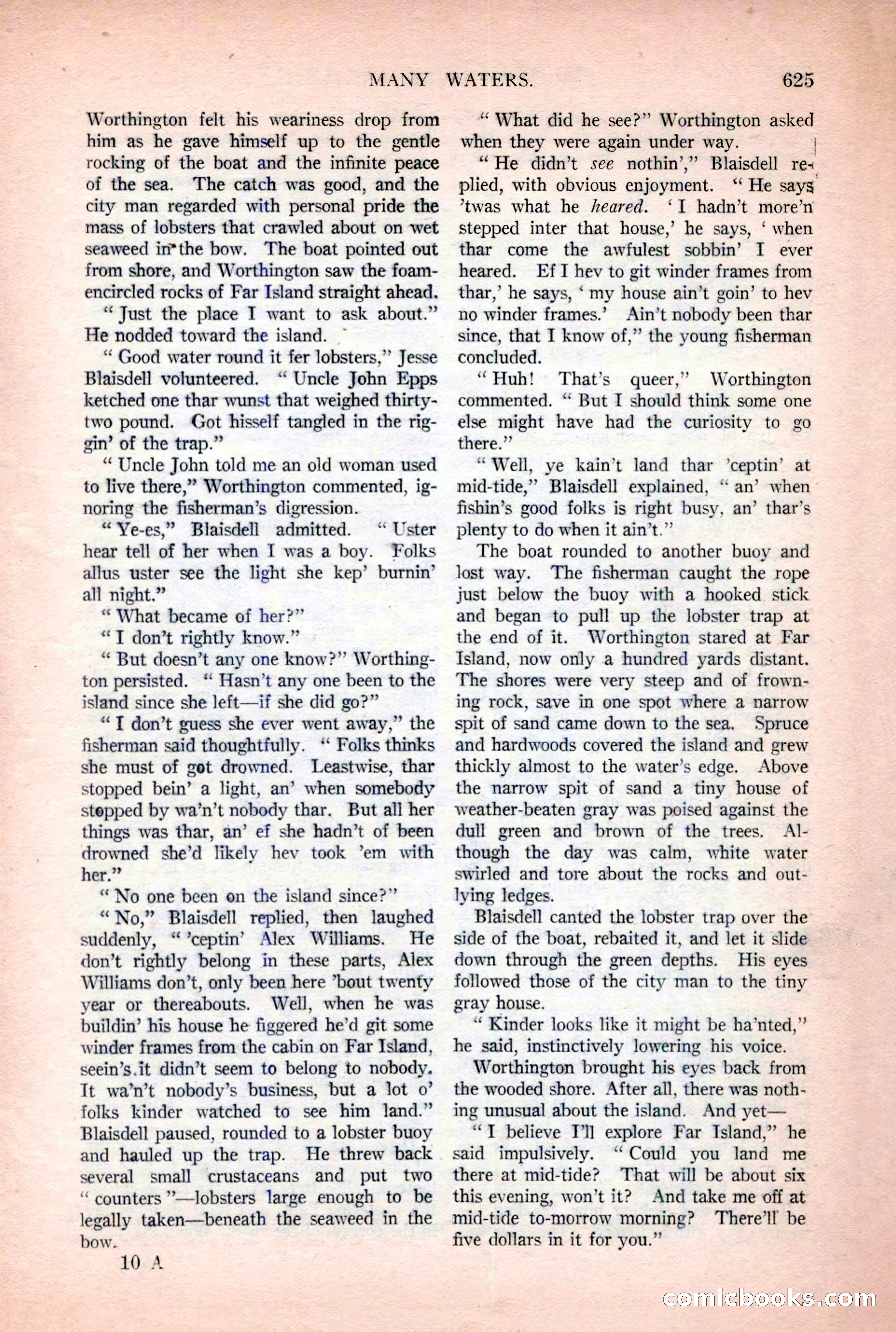
A restored page from Pulp Fiction, 1922. Page through the whole issue in the reader above.
📄 Transcribed text from this page (OCR, searchable)
Machine-transcribed from the original scan — historical spelling and the odd misread are preserved.
MANY WATERS. Worthington felt his weariness drop from him as he gave himself up to the gentle rocking of the boat and the infinite peace of the sea. The catch was good, and the city man regarded with personal pride the mass of lobsters that crawled about on wet seaweed inthe bow. The boat pointed out from shore, and Worthington saw the foam- encircled rocks of Far Island straight ahead. “Just the place I want to ask about.” He nodded toward the island. “ Good water round it fer lobsters,” Jesse Blaisdell volunteered. “ Uncle John Epps ketched one thar wunst that weighed thirty- two pound. Got hisself tangled in the rig- gin’ of the trap.” “ Uncle John told me an old woman used to live there,” Worthington commented, ig- noring the fisherman’s digression. “Ye-es,” Blaisdell admitted. “ Uster hear tell of her when I was a boy. Folks allus uster see the light she kep’ burnin’ all night.” “ What became of her?” “T don’t rightly know.” “ But doesn’t any one know?” Worthing- ton persisted. “ Hasn’t any one been to the island since she left—if she did go?” “T don’t guess she ever went away,” the fisherman said thoughtfully. ‘‘ Folks thinks she must of got drowned. Leastwise, thar stopped bein’ a light, an’ when somebody stepped by wa’n’t nobody thar. But all her things was thar, an’ ef she hadn’t of been drowned she’d likely hev took ’em with her.” “No one been on the island since?” “No,” Blaisdell replied, then laughed suddenly, “ ’ceptin’ Alex Williams. He don’t rightly belong in these parts, Alex Williams don’t, only been here "bout twenty year or thereabouts. Well, when he was buildin’ his house he figgered he’d git some winder frames from the cabin on Far Island, seein’s.it didn’t seem to belong to nobody. It wa’n’t nobody’s business, but a lot o’ folks kinder watched to see him land.” Blaisdell paused, rounded to a lobster buoy and hauled up the trap. He threw back several small crustaceans and put two “ counters ’’—lobsters large enough to be legally taken—beneath the seaweed in the bow. 10 A 625 “What did he see?” Worthington asked when they were again under way. | “He didn’t see nothin’,” Blaisdell re; plied, with obvious enjoyment. ‘He says ’twas what he feared. ‘I hadn’t more’n stepped inter that house,’ he says, ‘ when thar come the awfulest sobbin’ I ever heared. Ef I hev to git winder frames from thar,’ he says, ‘ my house ain’t goin’ to hev no winder frames.’ Ain’t nobody been thar since, that I know of,” the young fisherman concluded. “Huh! That’s queer,’ Worthington commented. “ But I should think some one else might have had the curiosity to go there.” “Well, ve kain’t land thar ’ceptin’ at mid-tide,” Blaisdell explained, ‘“ an’ when fishin’s good folks is right busy, an’ thar’s plenty to do when it ain’t.”’ The boat rounded to another buoy and lost way. The fisherman caught the rope just below the buoy with a hooked stick and began to pull up the lobster trap at the end of it. Worthington stared at Far Island, now only a hundred yards distant. The shores were very steep and of frown- ing rock, save in one spot where a narrow spit of sand came down to the sea. Spruce and hardwoods covered the island and grew thickly almost to the water’s edge. Above the narrow spit of sand a tiny house of weather-beaten gray was poised against the dull green and brown of the trees. Al- though the day was calm, white water swirled and tore about the rocks and out- lying ledges. Blaisdell canted the lobster trap over the side of the boat, rebaited it, and let it slide down through the green depths. His eyes followed those of the city man to the tiny gray house. “ Kinder looks like it might be ha’nted,” he said, instinctively lowering his voice. Worthington brought his eyes back from the wooded shore. After all, there was noth- ing unusual about the island. And yet— “T believe I'll explore Far Island,” he said impulsively. “Could you land me there at mid-tide? That will be about six this evening, won’t it? And take me off at mid-tide to-morrow morning? ‘There'll be five dollars in it for you.” Gomichbooks.com