
Pulp Fiction, 1922 · page 158 of 176
Argosy All-Story Weekly — page 158: what you’re looking at
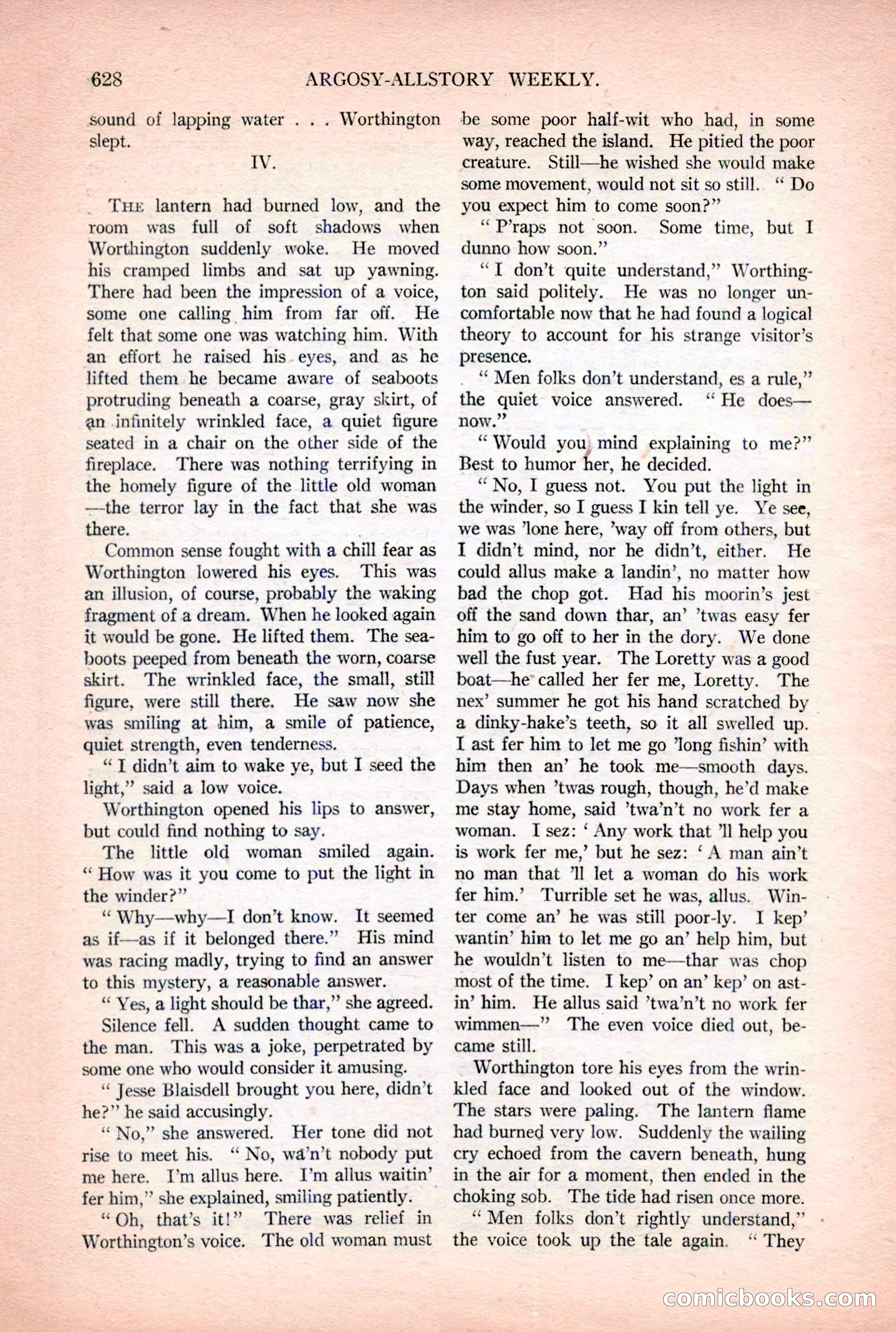
A restored page from Pulp Fiction, 1922. Page through the whole issue in the reader above.
📄 Transcribed text from this page (OCR, searchable)
Machine-transcribed from the original scan — historical spelling and the odd misread are preserved.
628 sound of lapping water . . . Worthington slept. IV. Tue lantern had burned low, and the room was full of soft shadows when Worthington suddenly woke. He moved his cramped limbs and sat up yawning. There had been the impression of a voice, some one calling him from far off. He felt that some one was watching him. With an effort he raised his eyes, and as he lifted them he became aware of seaboots protruding beneath a coarse, gray skirt, of an infinitely wrinkled face, a quiet figure seated in a chair on the other side of the fireplace. There was nothing terrifying in the homely figure of the little old woman —the terror lay in the fact that she was there. | Common sense fought with a chill fear as Worthington lowered his eyes. This was an illusion, of course, probably the waking fragment of a dream. When he looked again it would be gone. He lifted them. The sea- boots peeped from beneath the worn, coarse skirt. The wrinkled face, the small, still figure, were still there. He saw now she was smiling at him, a smile of patience, quiet strength, even tenderness. “T didn’t aim to wake ye, but I seed the light,”’ said a low voice. Worthington opened his lips to answer, but could find nothing to say. The little old woman smiled again. “ How was it you come to put the light in the winder?”’ “ Why—why—I don’t know. It seemed as if—as if it belonged there.” His mind was racing madly, trying to find an answer to this mystery, a reasonable answer. “ Ves, a light should be thar,” she agreed. Silence fell. A sudden thought came to the man. This was a joke, perpetrated by some one who would consider it amusing. ‘“ Jesse Blaisdell brought you here, didn’t he?” he said accusingly. “No,” she answered. Her tone did not rise to meet his. ‘“ No, wa’n’t nobody put me here. I’m allus here. I’m allus waitin’ fer him,’’ she explained, smiling patiently. “Oh, that’s it!” There was relief in Worthington’s voice. The old woman must ARGOSY-ALLSTORY WEEKLY. be some poor half-wit who had, in some way, reached the island. He pitied the poor creature. Still—he wished she would make some movement, would not sit so still. ‘ Do you expect him to come soon?” “P’raps not soon. Some time, but I dunno how soon.” “I don’t quite understand,” Worthing- ton said politely. He was no longer un- comfortable now that he had found a logical theory to account for his strange visitor’s presence. ““ Men folks don’t understand, es a rule,” the quiet voice answered. “He does— now.” “Would you mind explaining to me?” Best to humor her, he decided. “No, I guess not. You put the light in the winder, so I guess I kin tell ye. Ye see, we was ‘lone here, ’way off from others, but I didn’t mind, nor he didn’t, either. He could allus make a landin’, no matter how bad the chop got. Had his moorin’s jest off the sand down thar, an’ ’twas easy fer him to go off to her in the dory. We done well the fust year. The Loretty was a good boat—he’ called her fer me, Loretty. The nex’ summer he got his hand scratched by a dinky-hake’s teeth, so it all swelled up. I ast fer him to let me go ‘long fishin’ with him then an’ he took me—smooth days. Days when ’twas rough, though, he’d make me stay home, said ’twa’n’t no work fer a woman. I sez: ‘ Any work that ’ll help you is work fer me,’ but he sez: ‘ A man ain’t no man that ‘Il let a woman do his work fer him.’ Turrible set he was, allus. Win- ter come an’ he was still poor-ly. I kep’ wantin’ him to let me go an’ help him, but he wouldn’t listen to me—thar was chop most of the time. I kep’ on an’ kep’ on ast- in’ him. He allus said ’twa’n’t no work fer wimmen—” The even voice died out, be- came still. Worthington tore his eyes from the wrin- kled face and looked out of the window. The stars were paling. The lantern flame had burned very low. Suddenly the wailing cry echoed from the cavern beneath, hung in the air for a moment, then ended in the choking sob. The tide had risen once more. “Men folks don’t rightly understand,” the voice took up the tale again. “ They GComichbooksreom