
Pulp Fiction, 1922 · page 46 of 176
Argosy All-Story Weekly — page 46: what you’re looking at
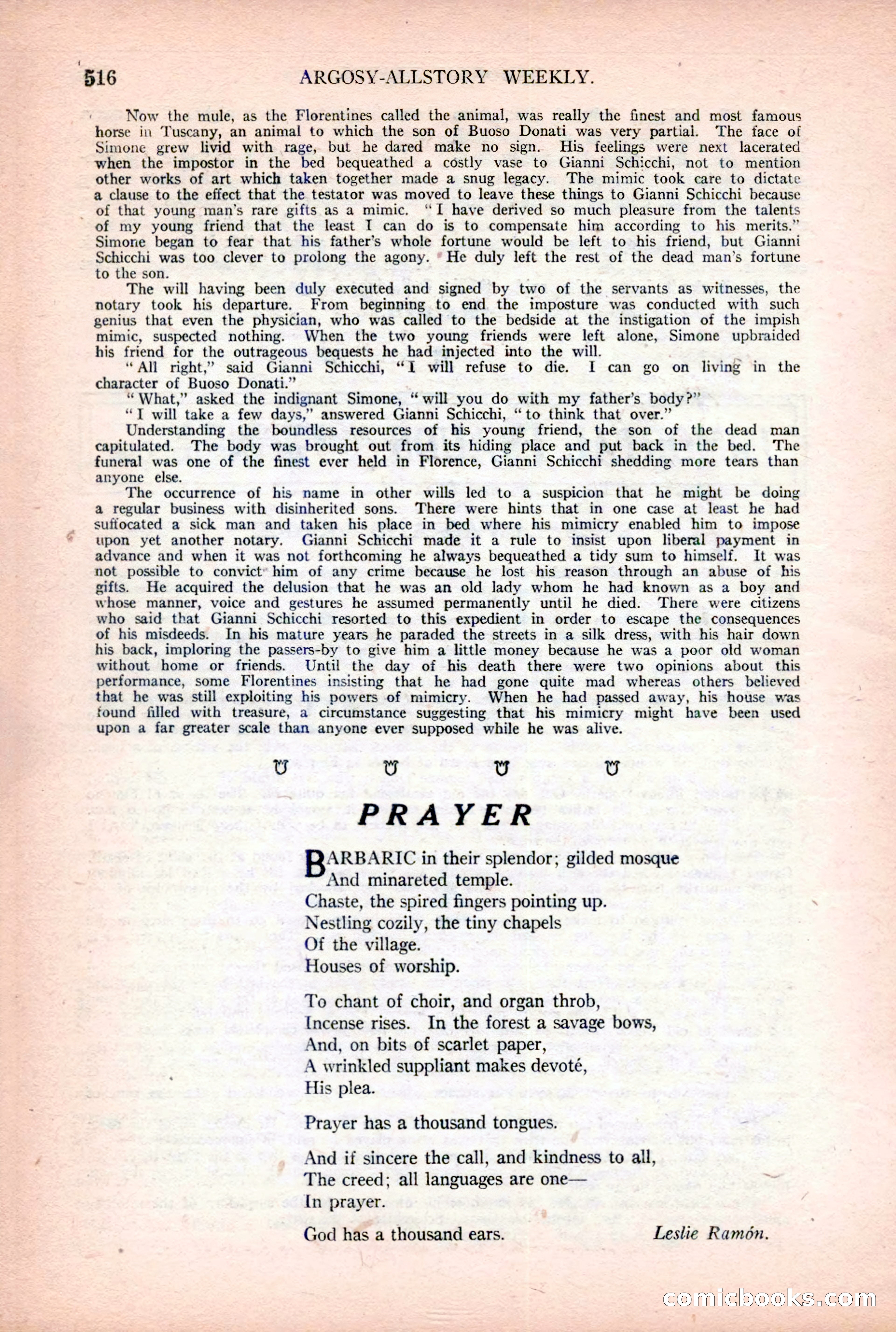
A restored page from Pulp Fiction, 1922. Page through the whole issue in the reader above.
📄 Transcribed text from this page (OCR, searchable)
Machine-transcribed from the original scan — historical spelling and the odd misread are preserved.
*\, 516 ARGOSY-ALLSTORY WEEKLY. Now the mule, as the Florentines called the animal, was really the finest and most famous horse in Tuscany, an animal to which the son of Buoso Donati was very partial. The face of Simone grew livid with rage, but he dared make no sign. His feelings were next lacerated when the impostor in the bed bequeathed a costly vase to Gianni Schicchi, not to mention other works of art which taken together made a snug legacy. The mimic took care to dictate a clause to the effect that the testator was moved to leave these things to Gianni Schicchi because - of that young man’s rare gifts as a mimic. “I have derived so much pleasure from the talents of my young friend that the least I can do is to compensate him according to his merits.” Simone began to fear that his father’s whole fortune would be left to his friend, but Gianni Schicchi was too clever to prolong the agony. © He duly left the rest of the dead man’s fortune to the son. The will having been duly executed and signed by two of the servants as witnesses, the notary took his departure. From beginning to end the imposture was conducted with such genius that even the physician, who was called to the bedside at the instigation of the impish mimic, suspected nothing. When the two young friends were left alone, Simone upbraided his friend for the outrageous bequests he had injected into the will. - ‘All right,” said Gianni Schicchi, “I will refuse to die. I can go on living in the character of Buoso Donati.” “What,” asked the indignant Simone, “will you do with my father’s body?” “T will take a few days,” answered Gianni Schicchi, “to think that over.” Understanding the boundless resources of his young friend, the son of the dead man capitulated. The body was brought out from its hiding place and put back in the bed. The funeral was one of the finest ever held in Florence, Gianni Schicchi shedding more tears than anyone else. The occurrence of his name in other wills led to a suspicion that he might be doing a regular business with disinherited sons. There were hints that in one case at least he had suffocated a sick man and taken his place in bed where his mimicry enabled him to impose upon yet another notary. Gianni Schicchi made it a rule to insist upon liberal payment in advance and when it was not forthcoming he always bequeathed a tidy sum to himself. It was not possible to convict’ him of any crime because he lost his reason through an abuse of his gifts. He acquired the delusion that he was an old lady whom he had known as a boy and whose manner, voice and gestures he assumed permanently until he died. ‘There were citizens who said that Gianni Schicchi resorted to this expedient in order to escape the consequences of his misdeeds. In his mature years he paraded the streets in a silk dress, with his hair down his back, imploring the passers-by to give him a little money because he was a poor old woman without home or friends. Until the day of his death there were two opinions about this performance, some Florentines insisting that he had gone quite mad whereas others believed that he was still exploiting his powers of mimicry. When he had passed away, his house was found filled with treasure, a circumstance suggesting that his mimicry might have been used upon a far greater scale than anyone ever supposed while he was alive. ) ) U U PRAYER BARBARIC in their splendor; gilded mosque And minareted temple. Chaste, the spired fingers pointing up. Nestling cozily, the tiny chapels Of the village. Houses of worship. To chant of choir, and organ throb, Incense rises. In the forest a savage bows, And, on bits of scarlet paper, A wrinkled suppliant makes devoté, His plea. Prayer has a thousand tongues. And if sincere the call, and kindness to all, The creed; all languages are one— {n prayer. God has a thousand ears. Leslie Ramon. Gomichbooksreom