
Pulp Fiction, 1922 · page 96 of 176
Argosy All-Story Weekly — page 96: what you’re looking at
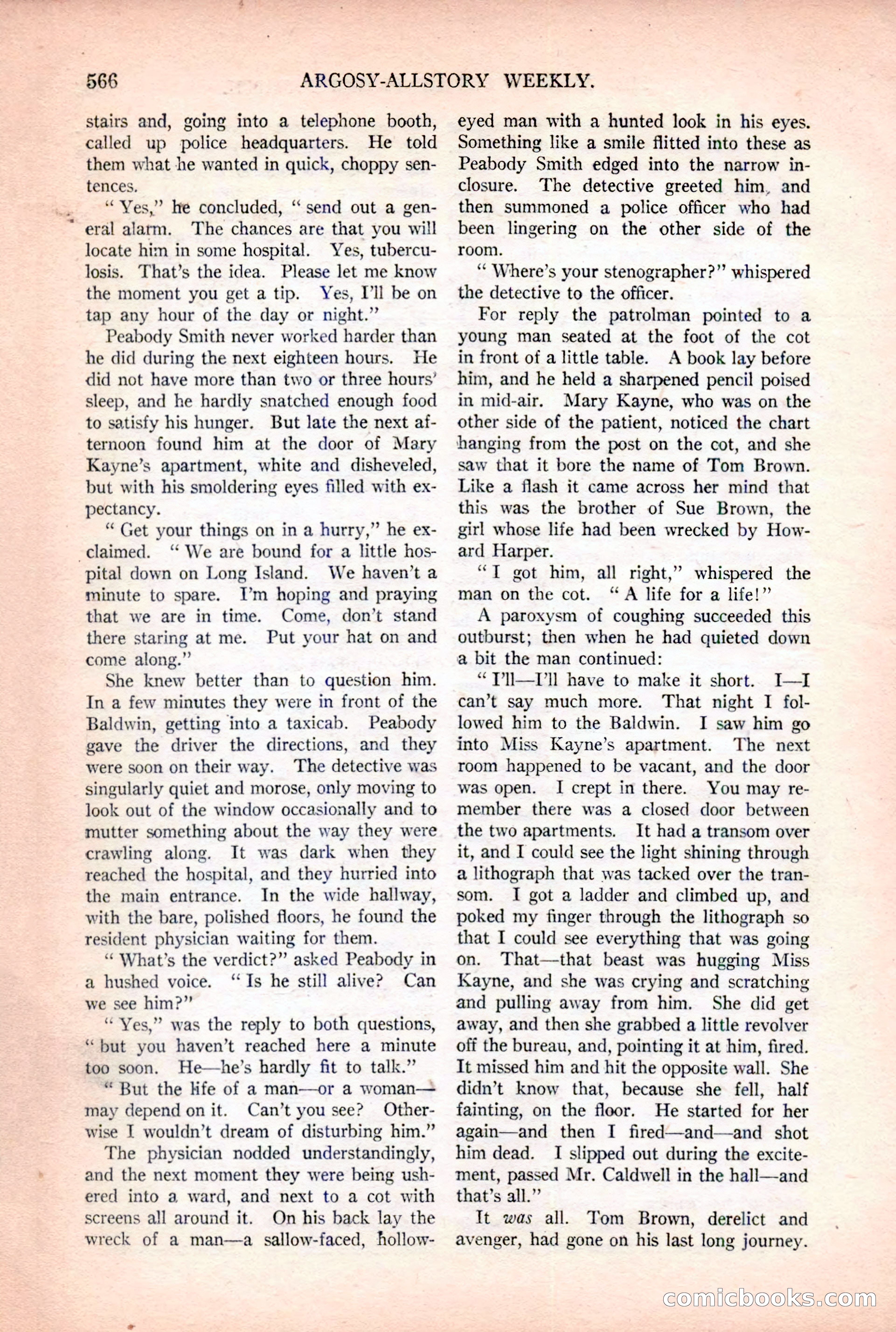
A restored page from Pulp Fiction, 1922. Page through the whole issue in the reader above.
📄 Transcribed text from this page (OCR, searchable)
Machine-transcribed from the original scan — historical spelling and the odd misread are preserved.
a a Ae 9 os claimed. 566 stairs and, going into a telephone booth, called up police headquarters. He told them what he wanted in quick, choppy sen- tences. “Yes,” he concluded, ‘send out a gen- eral alarm. The chances are that you will locate him in some hospital. Yes, tubercu- losis. That’s the idea. Please let me know the moment you get a tip. Yes, Ill be on tap any hour of the day or night.” Peabody Smith never worked harder than he did during the next eighteen hours. He did not have more than two or three hours’ sleep, and he hardly snatched enough food to satisfy his hunger. But late the next af- ternoon found him at the door of Mary Kayne’s apartment, white and disheveled, but with his smoldering eyes filled with ex- pectancy. “ Get your things on in a hurry,” he ex- “We are bound for a little hos- pital down on Long Island. We haven’t a minute to spare. I’m hoping and praying that we are in time. Come, don’t stand there staring at me. Put your hat on and come along.” She knew better than to question him. In a few minutes they were in front of the Baldwin, getting into a taxicab. Peabody gave the driver the directions, and they were soon on their way. The detective was singularly quiet and morose, only moving to look out of the window occasionally and to mutter something about the way they were crawling along. It was dark when they reached the hospital, and they hurried into the main entrance. In the wide hallway, with the bare, polished floors, he found the resident physician waiting for them. “What's the verdict?” asked Peabody in a hushed voice. ‘Is he still alive? Can we see him?” “Yes,” was the reply to both questions, “but you haven’t reached here a minute too soon. He—he’s hardly fit to talk.” “But the fe of a man—or a woman— may depend on it. Can’t you see? Other- wise I wouldn’t dream of disturbing him.” The physician nodded understandingly, and the next moment they were being ush- ered into a ward, and next to a cot with screens all around it. On his back lay the wreck of a man—a sallow-faced, hollow- ARGOSY-ALLSTORY WEEKLY. eyed man with a hunted look in his eyes. Something like a smile flitted into these as Peabody Smith edged into the narrow in- closure. The detective greeted him, and then summoned a police officer who had been lingering on the other side of the room. ‘‘ Where’s your stenographer?”’ whispered the detective to the officer. For reply the patrolman pointed to a young man seated at the foot of the cot in front of a little table. A book lay before him, and he held a sharpened pencil poised in mid-air. Mary Kayne, who was on the other side of the patient, noticed the chart hanging from the post on the cot, and she saw that it bore the name of Tom Brown. Like a flash it came across her mind that this was the brother of Sue Brown, the girl whose life had been wrecked by How- ard Harper. “T got him, all right,’ whispered the man on the cot. “A life for a life!” A paroxysm of coughing succeeded this outburst; then when he had quieted down a bit the man continued: “ Ti—UIl have to make it short. I—I can’t say much more. That night I fol- lowed him to the Baldwin. I saw him go into Miss Kayne’s apartment. The next room happened to be vacant, and the door was open. I crept in there. You may re- member there was a closed door between the two apartments. It had a transom over it, and I could see the light shining through a lithograph that was tacked over the tran- som. I got a ladder and climbed up, and poked my finger through the lithograph so that I could see everything that was going on. That—that beast was hugging Miss Kayne, and she was crying and scratching and pulling away from him. She did get away, and then she grabbed a little revolver off the bureau, and, pointing it at him, fired. It missed him and hit the opposite wall. She didn’t know that, because she fell, half fainting, on the floor. He started for her again—and then I fired—and—and shot him dead. I slipped out during the excite- ment, passed Mr. Caldwell in the hall—and that’s all.” It was all. Tom Brown, derelict and avenger, had gone on his last long journey. ComicoookS Conn