
Pulp Fiction, 1923 · page 125 of 180
Argosy All-Story Weekly — page 125: what you’re looking at
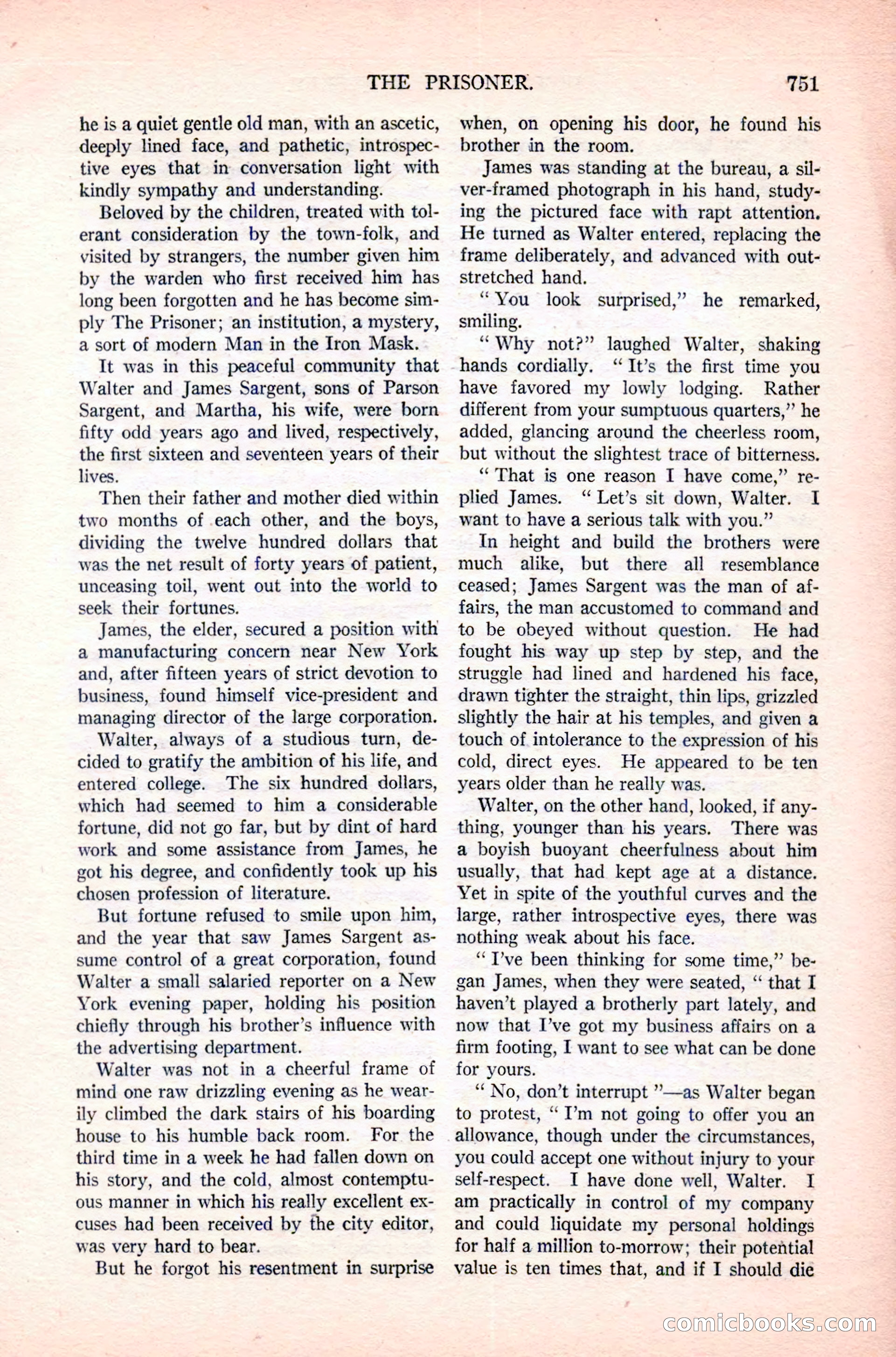
A restored page from Pulp Fiction, 1923. Page through the whole issue in the reader above.
📄 Transcribed text from this page (OCR, searchable)
Machine-transcribed from the original scan — historical spelling and the odd misread are preserved.
THE PRISONER. he is a quiet gentle old man, with an ascetic, deeply lined face, and pathetic, introspec- tive eyes that in conversation light with kindly sympathy and understanding. Beloved by the children, treated with tol- erant consideration by the town-folk, and visited by strangers, the number given him by the warden who first received him has long been forgotten and he has become sim- ply The Prisoner; an institution, a mystery, a sort of modern Man in the Iron Mask. It was in this peaceful community that Walter and James Sargent, sons of Parson Sargent, and Martha, his wife, were born fifty odd years ago and lived, respectively, the first sixteen and seventeen years of their lives. Then their father and mother died within two months of each other, and the boys, dividing the twelve hundred dollars that was the net result of forty years of patient, unceasing toil, went out into the world to seek their fortunes. James, the elder, secured a position with a manufacturing concern near New York and, after fifteen years of strict devotion to business, found himself vice-president and managing director of the large corporation. Walter, always of a studious turn, de- cided to gratify the ambition of his life, and entered college. The six hundred dollars, which had seemed to him a considerable fortune, did not go far, but by dint of hard work and some assistance from James, he got his degree, and confidently took up his chosen profession of literature. But fortune refused to smile upon him, and the year that saw James Sargent as- sume control of a great corporation, found Walter a small salaried reporter on a New York evening paper, holding his position chiefly through his brother’s influence with the advertising department. Walter was not in a cheerful frame of mind one raw drizzling evening as he wear- ily climbed the dark stairs of his boarding house to his humble back room. For the third time in a week he had fallen down on his story, and the cold, almost contemptu- ous manner in which his really excellent ex- cuses had been received by the city editor, was very hard to bear. But he forgot his resentment in surprise 751 when, on opening his door, he found his brother in the room. James was standing at the bureau, a sil- ver-framed photograph in his hand, study- ing the pictured face with rapt attention. He turned as Walter entered, replacing the frame deliberately, and advanced with out- stretched hand. “You look surprised,” he remarked, smiling. “Why not?” laughed Walter, shaking hands cordially. “It’s the first time you have favored my lowly lodging. Rather different from your sumptuous quarters,”’ he added, glancing around the cheerless room, but without the slightest trace of bitterness. “That is one reason I have come,” re- plied James. “ Let’s sit down, Walter. I want to have a serious talk with you.” In height and build the brothers were much alike, but there all resemblance ceased; James Sargent was the man of af- fairs, the man accustomed to command and to be obeyed without question. He had fought his way up step by step, and the struggle had lined and hardened his face, drawn tighter the straight, thin lips, grizzled slightly the hair at his temples, and given a touch of intolerance to the expression of his cold, direct eyes. He appeared to be ten years older than he really was. Walter, on the other hand, looked, if any- thing, younger than his years. There was a boyish buoyant cheerfulness about him usually, that had kept age at a distance. Yet in spite of the youthful curves and the large, rather introspective eyes, there was nothing weak about his face. ‘“T’ve been thinking for some time,” be- gan James, when they were seated, “ that I haven’t played a brotherly part lately, and now that I’ve got my business affairs on a firm footing, I want to see what can be done for yours. ‘“ No, don’t interrupt ”—as Walter began to protest, “ I’m not going to offer you an allowance, though under the circumstances, you could accept one without injury to your self-respect. I have done well, Walter. I am practically in control of my company and could liquidate my personal holdings for half a million to-morrow; their potential value is ten times that, and if I should die COMmiCMOookKks (C@