
Pulp Fiction, 1923 · page 133 of 180
Argosy All-Story Weekly — page 133: what you’re looking at
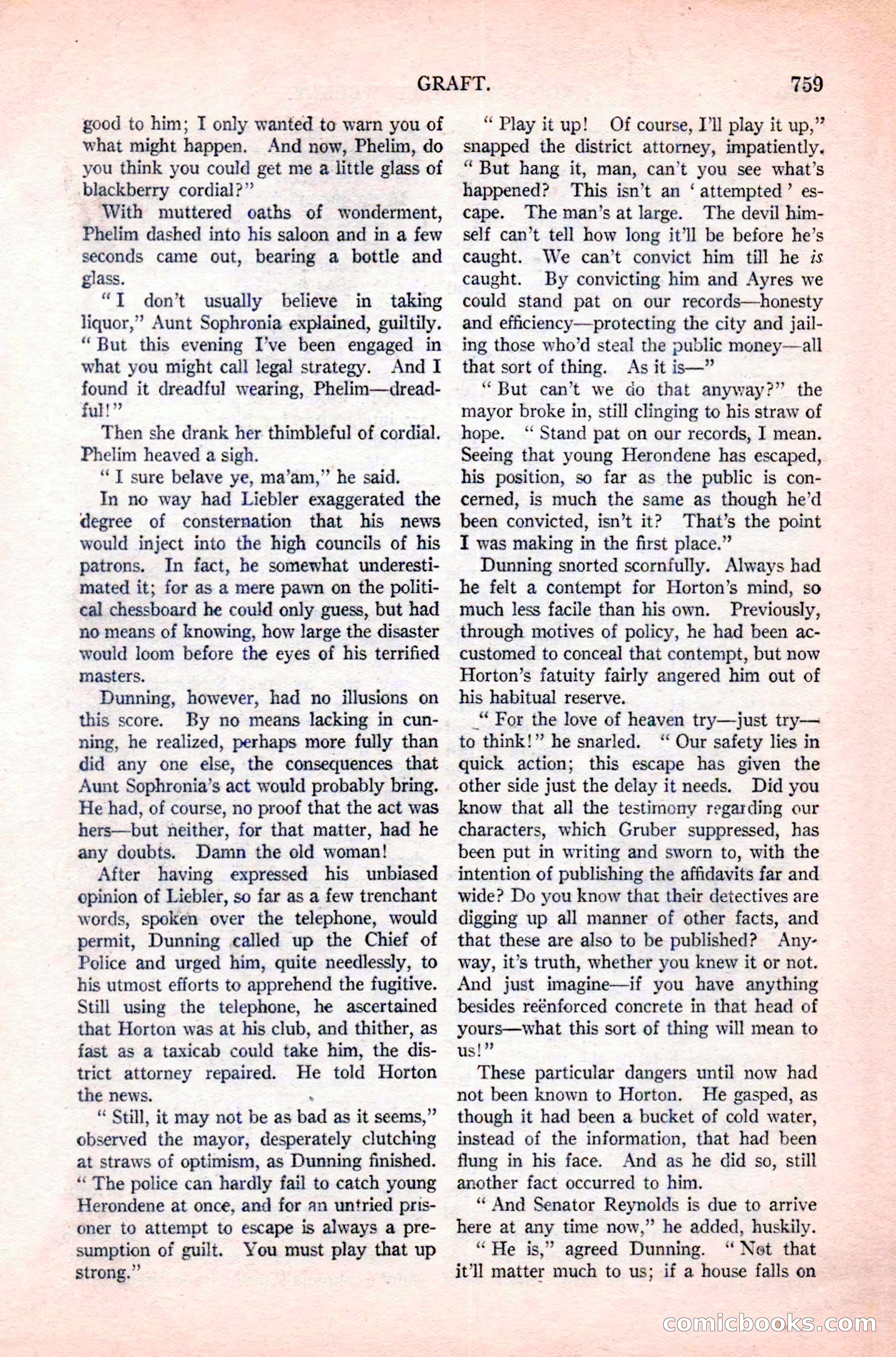
A restored page from Pulp Fiction, 1923. Page through the whole issue in the reader above.
📄 Transcribed text from this page (OCR, searchable)
Machine-transcribed from the original scan — historical spelling and the odd misread are preserved.
GRAFT. good to him; I only wanted to warn you of what might happen. And now, Phelim, do you think you could get me a little glass of blackberry cordial?” With muttered oaths of wonderment, Phelim dashed into his saloon and in a few seconds came out, bearing a bottle and glass. “IT don’t usually believe in taking liquor,” Aunt Sophronia explained, guiltily. “But this evening I’ve been engaged in what you might call legal strategy. And I found it dreadful wearing, Phelim—dread- ful!” Then she drank her thimbleful of cordial. Phelim heaved a sigh. “JT sure belave ye, ma’am,” he said. In no way had Liebler exaggerated the degree of consternation that his news would inject into the high councils of his patrons. In fact, he somewhat underesti- mated it; for as a mere pawn on the politi- cal chessboard he could only guess, but had no means of knowing, how large the disaster would loom before the eyes of his terrified masters. Dunning, however, had no illusions on this score. By no means lacking in cun- ning, he realized, perhaps more fully than did any one else, the consequences that Aunt Sophronia’s act would probably bring. He had, of course, no proof that the act was hers—but neither, for that matter, had he any doubts. Damn the old woman! After having expressed his unbiased opinion of Liebler, so far as a few trenchant words, spoken over the telephone, would permit, Dunning called up the Chief of Police and urged him, quite needlessly, to his utmost efforts to apprehend the fugitive. Still using the telephone, he ascertained that Horton was at his club, and thither, as fast as a taxicab could take him, the dis- trict attorney repaired. He told Horton the news. . “ Still, it may not be as bad as it seems,” observed the mayor, desperately clutching at straws of optimism, as Dunning finished. ‘““ The police can hardly fail to catch young Herondene at once, and for an untried pris- oner to attempt to escape is always a pre- sumption of guilt. You must play that up strong.” 759 “Play it up! Of course, I'll play it up,” snapped the district attorney, impatiently. “But hang it, man, can’t you see what’s happened? This isn’t an ‘ attempted’ es- cape. The man’s at large. The devil him- self can’t tell how long it’ll be before he’s caught. We can’t convict him till he is caught. By convicting him and Ayres we could stand pat on our records—honesty and efficiency—protecting the city and jail- ing those who’d steal the public money—all that sort of thing. As it is—” “But can’t we ao that anyway?’ the mayor broke in, still clinging to his straw of hope. ‘‘ Stand pat on our records, I mean. Seeing that young Herondene has escaped, his position, so far as the public is con- cerned, is much the same as though he’d been convicted, isn’t it? That’s the point I was making in the first place.” Dunning snorted scornfully. Always had he felt a contempt for Horton’s mind, so much less facile than his own. Previously, through motives of policy, he had been ac- customed to conceal that contempt, but now Horton’s fatuity fairly angered him out of his habitual reserve. “For the love of heaven try—just try— to think!” he snarled. “ Our safety lies in quick action; this escape has given the other side just the delay it needs. Did you know that all the testimony regarding our characters, which Gruber suppressed, has been put in writing and sworn to, with the intention of publishing the affidavits far and wide? Do you know that their detectives are digging up all manner of other facts, and that these are also to be published? Any- way, it’s truth, whether you knew it or not. And just imagine—if you have anything besides reénforced concrete in that head of yours—what this sort of thing will mean to us!” These particular dangers until now had not been known to Horton. He gasped, as though it had been a bucket of cold water, instead of the information, that had been flung in his face. And as he did so, still another fact occurred to him. “And Senator Reynolds is due to arrive here at any time now,” he added, huskily. “He is,” agreed Dunning. ‘“ Not that it'll matter much to us; if a house falls on COMmMicloo“lkKxs (C@