
Pulp Fiction, 1923 · page 154 of 180
Argosy All-Story Weekly — page 154: what you’re looking at
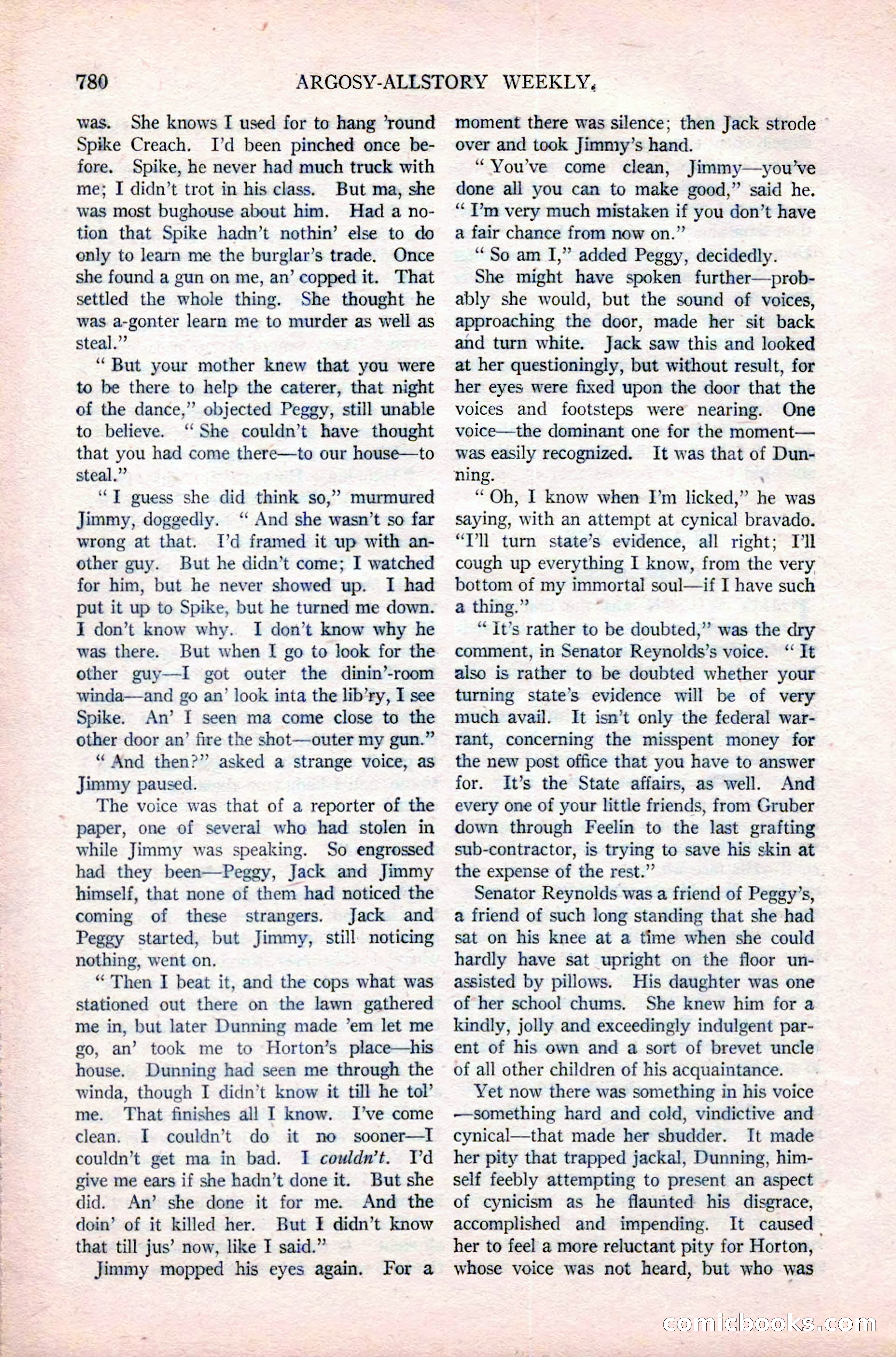
A restored page from Pulp Fiction, 1923. Page through the whole issue in the reader above.
📄 Transcribed text from this page (OCR, searchable)
Machine-transcribed from the original scan — historical spelling and the odd misread are preserved.
—- oe ow Sel ee 780 ARGOSY-ALLSTORY WEEKLY, was. She knows I used for to hang ‘round Spike Creach. I’d been pinched once be- fore. Spike, he never had much truck with me; I didn’t trot in his class. But ma, she Was most bughouse about him. Had a no- tion that Spike hadn’t nothin’ else to do only to learn me the burglar’s trade. Once she found a gun on me, an’ copped it. That settled the whole thing. She thought he was a-gonter learn me to murder as well as steal.” “But your mother knew that you were to be there to help the caterer, that night of the dance,” objected Peggy, still unable to believe. ‘She couldn’t have thought that you had come there—to our house—to steal.” ‘““T guess she did think so,” murmured Jimmy, doggedly. ‘“‘ And she wasn’t so far wrong at that. Id framed it up with an- other guy. But he didn’t come; I watched for him, but he never showed up. I had put it up to Spike, but he turned me down. J don’t know why. I don’t know why he was there. But when I go to look for the other guy—I got outer the dinin’-room winda—and go an’ look inta the lib’ry, I see Spike. An’ I seen ma come close to the other door an’ fire the shot—outer my gun.” “ And then?” asked a strange voice, as Jimmy paused. The voice was that of a reporter of the paper, one of several who had stolen in while Jimmy was speaking. So engrossed had they been—Peggy, Jack and Jimmy himself, that none of them had noticed the coming of these strangers. Jack and Peggy started, but Jimmy, still noticing nothing, went on. “Then I beat it, and the cops what was stationed out there on the lawn gathered me in, but later Dunning made ’em let me go, an’ took me to Horton’s place—his house. Dunning had seen me through the winda, though I didn’t know it till he tol’ me. That finishes all I know. I’ve come clean. I couldn’t do it no sooner—I couldn’t get ma in bad. I couwldn’t. Vd give me ears if she hadn’t done it. But she did. An’ she done it for me. And the dein’ of it killed her. But Ef didn’t know that till jus’ now, like IT said.” Jimmy mopped his eyes again. For a moment there was silence; then Jack strode © over and took Jimmy’s hand. “You've come clean, Jimmy—you’ve done all you can to make good,” said he. ‘‘ T’m very much mistaken if you don’t have a fair chance from now on.” “So am I,” added Peggy, decidedly. She might have spoken further—prob- ably she would, but the sound of voices, approaching the door, made her sit back and turn white. Jack saw this and looked at her questioningly, but without result, for her eyes were fixed upon the door that the voices and footsteps were nearing. One voice—the dominant one for the moment— was easily recognized. It was that of Dun- ning. “Oh, I know when I’m licked,” he was saying, with an attempt at cynical bravado. “ll turn state’s evidence, all right; Ill cough up everything I know, from the very bottom of my immortal soul—if I have such a thing.” “it’s rather to be doubted,” was the dry comment, in Senator Reynolds’s voice. ‘‘ It also is rather to be doubted whether your turning state’s evidence will be of very much avail. It isn’t only the federal war- rant, concerning the misspent money for the new post office that you have to answer for. It’s the State affairs, as well. And every one of your little friends, from Gruber down through Feelin to the last grafting sub-contractor, is trying to save his skin at the expense of the rest.” Senator Reynolds was a friend of Peggy’s, a friend of such long standing that she had sat on his knee at a time when she could hardly have sat upright on the floor un- assisted by pillows. His daughter was one of her school chums. She knew him for a kindly, jolly and exceedingly indulgent par- ent of his own and a sort of brevet uncle of all other children of his acquaintance. Yet now there was something in his voice —something hard and cold, vindictive and cynical—that made her shudder. It made her pity that trapped jackal, Dunning, him- self feebly attempting to present an aspect of cynicism as he flaunted his disgrace, accomplished and impending. her to feel a more reluctant pity for Horton, whose voice was not heard, but who was C@Micloooks It caused (C@