
Pulp Fiction, 1923 · page 18 of 180
Argosy All-Story Weekly — page 18: what you’re looking at
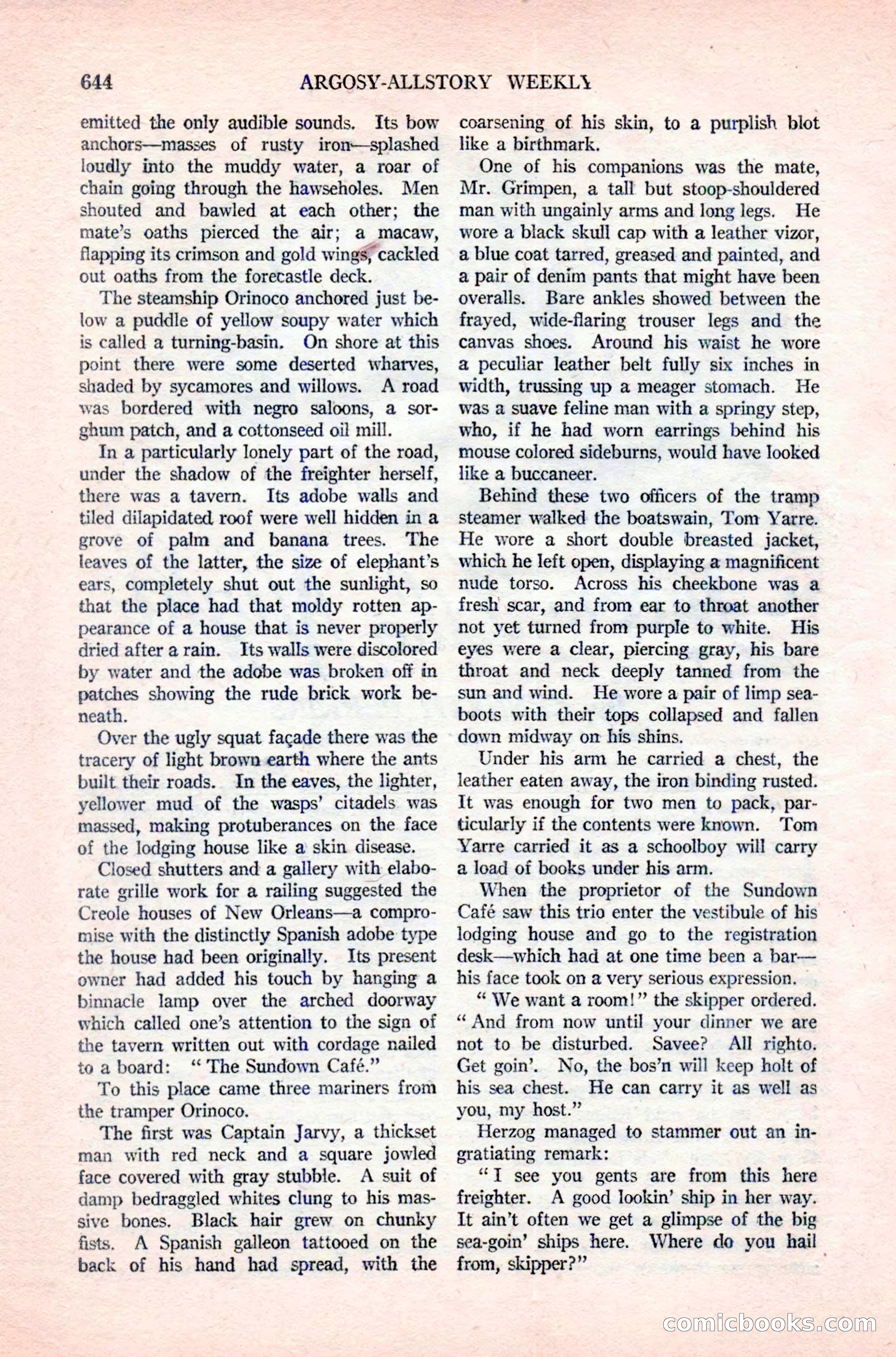
A restored page from Pulp Fiction, 1923. Page through the whole issue in the reader above.
📄 Transcribed text from this page (OCR, searchable)
Machine-transcribed from the original scan — historical spelling and the odd misread are preserved.
644 emitted the only audible sounds. Its bow anchors—masses of rusty iron—splashed loudly into the muddy water, a roar of chain going through the hawseholes. Men shouted and bawled at each other; the mate’s oaths pierced the air; a macaw, flapping its crimson and gold wings, cackled out oaths from the foretastle deck. The steamship Orinoco anchored just be- low a puddle of yellow soupy water which is called a turning-basin. On shore at this point there were some deserted wharves, shaded by sycamores and willows. <A road was bordered with negro saloons, a sor- ghum patch, and a cottonseed oil mill. In a particularly lonely part of the road, under the shadow of the freighter herself, there was a tavern. Its adobe walls and tiled dilapidated roof were well hidden in a grove of palm and banana trees. The leaves of the latter, the size of elephant’s ears, completely shut out the sunlight, so that the place had that moldy rotten ap- pearance of a house that is never properly dried after a rain. Its walls were discolored by water and the adebe was broken off in patches showing the rude brick work be- neath. Over the ugly squat facade there was the tracery of light brown earth where the ants built their roads. In the eaves, the lighter, yellower mud of the wasps’ citadels was massed, making protuberances on the face of the lodging house like a skin disease. Closed shutters and a gallery with elabo- rate grille work for a railing suggested the Creole houses of New Orleans—a compro- mise with the distinctly Spanish adobe type the house had been originally. Its present owner had added his touch by hanging a binnacle lamp over the arched doorway which called one’s attention to the sign of the tavern written out with cordage nailed to a board: ‘‘ The Sundown Café.” To this place came three mariners from the tramper Orinoco. The first was Captain Jarvy, a thickset man with red neck and a square jowled face covered with gray stubble. A suit of damp bedraggled whites clung to his mas- sive bones. Black hair grew on chunky fists. A Spanish galleon tattooed on the back of his hand had spread, with the ARGOSY-ALLSTORY WEEKLY coarsening of his skin, to a purplish blot like a birthmark, One of his companions was the mate, Mr. Grimpen, a tall but stoop-shouldered man with ungainly arms and long legs. He wore a black skull cap with a leather vizor, a blue coat tarred, greased and painted, and a pair of denim pants that might have been overalls. Bare ankles showed between the frayed, wide-flaring trouser legs and the canvas shoes. Around his waist he wore a peculiar leather belt fully six inches in width, trussing up a meager stomach. He was a suave feline man with a springy step, who, if he had worn earrings behind his mouse colored sideburns, would have looked like a buccaneer. Behind these two officers of the tramp steamer walked the boatswain, Tom Yarre. He wore a short double breasted jacket, which he left open, displaying a magnificent nude torso. Across his cheekbone was a fresh scar, and from ear to throat another not yet turned from purple to white. His eyes were a Clear, piercing gray, his bare throat and neck deeply tanned from the sun and wind. He wore a pair of limp sea- boots with their tops collapsed and fallen down midway on his shins. Under his arm he carried a chest, the leather eaten away, the iron binding rusted. It was enough for two men to pack, par- ticularly if the contents were known. Tom Yarre carried it as a schoolboy will carry a load of books under his arm. When the proprietor of the Sundown Café saw this trio enter the vestibule of his lodging house and go to the registration desk—which had at one time been a bar— his face took on a very serious expression. “ We want a room!” the skipper ordered. “ And from now until your dinner we are not to be disturbed. Savee? All righto. Get goin’. No, the bos’n will keep holt of his sea chest. He can carry it as well as you, my host.” Herzog managed to stammer out an in- gratiating remark: “T see you gents are from this here freighter. A good lookin’ ship in her way. It ain’t often we get a glimpse of the big sea-goin’ ships here. from, skipper?” Go VOO|KS Where do you hail | (C@