
Pulp Fiction, 1923 · page 46 of 180
Argosy All-Story Weekly — page 46: what you’re looking at
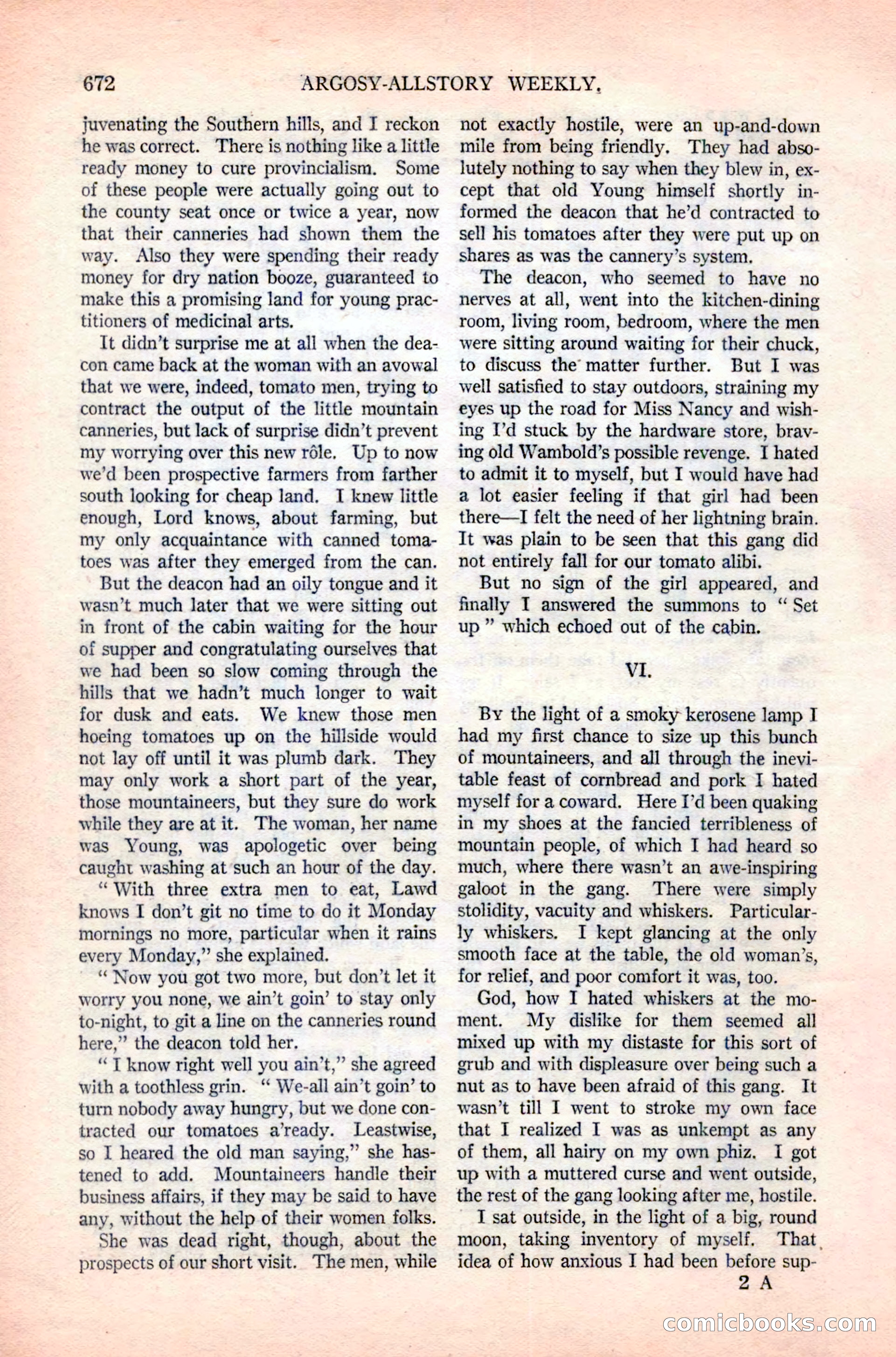
A restored page from Pulp Fiction, 1923. Page through the whole issue in the reader above.
📄 Transcribed text from this page (OCR, searchable)
Machine-transcribed from the original scan — historical spelling and the odd misread are preserved.
672 juvenating the Southern hills, and I reckon he was correct. There is nothing like a little ready money to cure provincialism. Some of these people were actually going out to the county seat once or twice a year, now that their canneries had shown them the way. Also they were spending their ready money for dry nation booze, guaranteed to make this a promising land for young prac- titioners of medicinal arts. It didn’t surprise me at all when the dea- con came back at the woman with an avowal that we were, indeed, tomato men, trying to contract the output of the little mountain canneries, but lack of surprise didn’t prevent my worrying over this new role. Up to now we’d been prospective farmers from farther south looking for cheap land. I knew little enough, Lord knows, about farming, but my only acquaintance with canned toma- toes was after they emerged from the can. But the deacon had an oily tongue and it wasn’t much later that we were sitting out in front of the cabin waiting for the hour of supper and congratulating ourselves that we had been so slow coming through the hills that we hadn’t much longer to wait for dusk and eats. We knew those men hoeing tomatoes up on the hillside would not lay off until it was plumb dark. They may only work a short part of the year, those mountaineers, but they sure do work while they are at it. The woman, her name was Young, was apologetic over being caught washing at’such an hour of the day. “With three extra men to eat, Lawd knows I don’t git no time to do it Monday mornings no more, particular when it rains every Monday,” she explained. ““ Now you got two more, but don’t let it worry you none, we ain’t goin’ to stay only to-night, to git a line on the canneries round here,” the deacon told her, “ T know right well you ain’t,” she agreed with a toothless grin. “ We-all ain’t goin’ to turn nobody away hungry, but we done con- tracted our tomatoes a’ready. Leastwise, so I heared the old man saying,” she has- tened to add. Mountaineers handle their business affairs, if they may be said to have any, without the help of their women folks. She was dead right, though, about the prospects of our short visit. The men, while ARGOSY-ALLSTORY WEEKLY. not exactly hostile, were an up-and-down mile from being friendly, They had abso- lutely nothing to say when they blew in, ex- cept that old Young himself shortly in- formed the deacon that he’d contracted to sell his tomatoes after they were put up on shares as was the cannery’s system. The deacon, who seemed to have no nerves at all, went into the kitchen-dining room, living room, bedroom, where the men were sitting around waiting for their chuck, to discuss the’ matter further. But I was well satisfied to stay outdoors, straining my eyes up the road for Miss Nancy and wish- ing I’d stuck by the hardware store, brav- ing old Wambold’s possible revenge. I hated to admit it to myself, but I would have had a lot easier feeling if that girl had been there—I felt the need of her lightning brain. It was plain to be seen that this gang did not entirely fall for our tomato alibi. But no sign of the girl appeared, and finally I answered the summons to “ Set up ” which echoed out of the cabin. VI. By the light of a smoky kerosene lamp I had my first chance to size up this bunch of mountaineers, and all through the inevi- table feast of cornbread and pork I hated myself fora coward. Here I’d been quaking in my shoes at the fancied terribleness of mountain people, of which I had heard so much, where there wasn’t an awe-inspiring galoot in the gang. There were simply stolidity, vacuity and whiskers. Particular- ly whiskers. I kept glancing at the only smooth face at the table, the old woman’s, for relief, and poor comfort it was, too. God, how I hated whiskers at the mo- ment. My dislike for them seemed all mixed up with my distaste for this sort of grub and with displeasure over being such a nut as to have been afraid of this gang. It wasn’t till I went to stroke my own face that I realized I was as unkempt as any of them, all hairy on my own phiz. I got up with a muttered curse and went outside, the rest of the gang looking after me, hostile. I sat outside, in the light of a big, round moon, taking inventory of myself. idea of how anxious I had been before sup- 2A CORNICLOOKS That. (C@