
Pulp Fiction, 1923 · page 59 of 180
Argosy All-Story Weekly — page 59: what you’re looking at
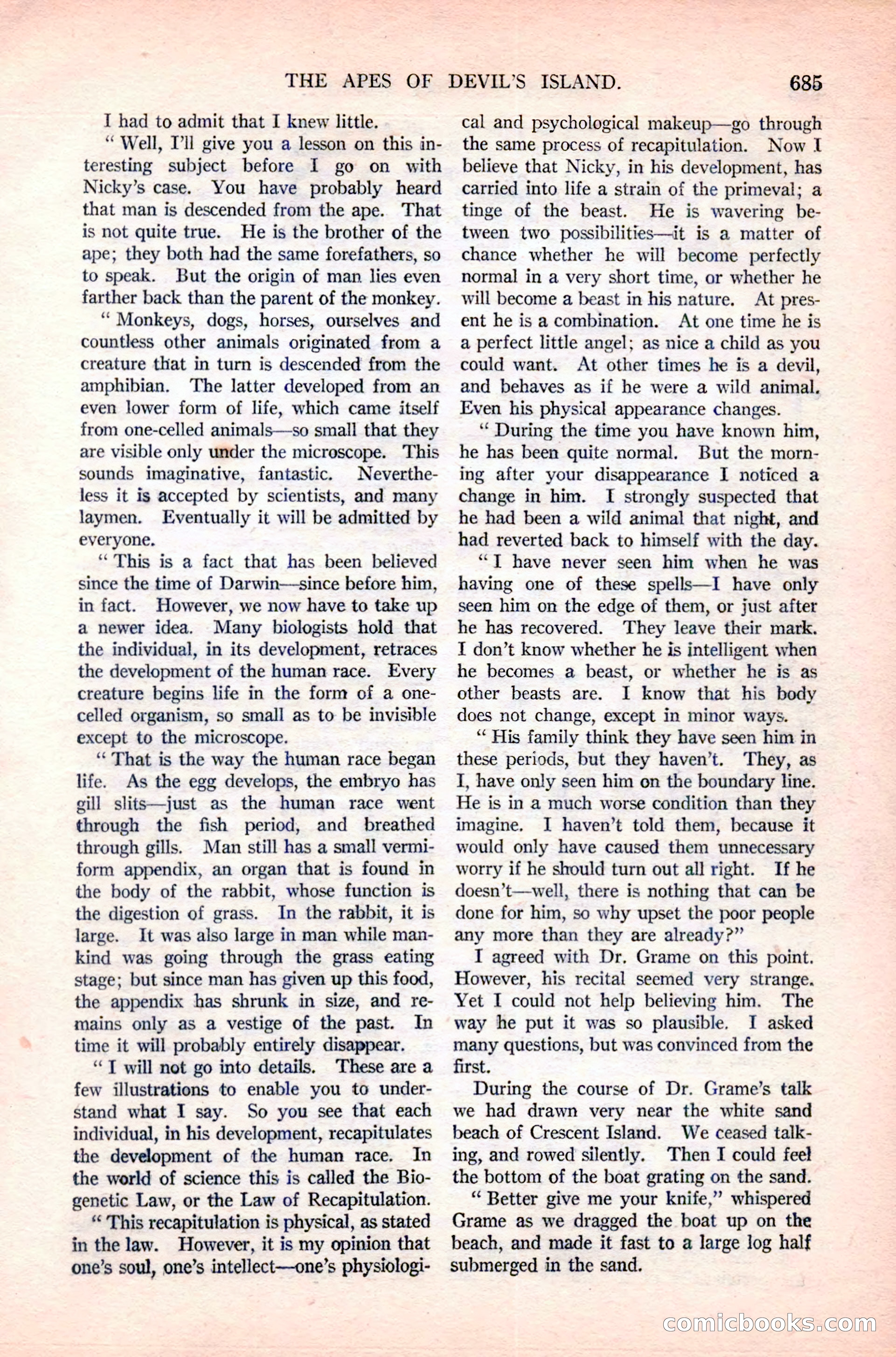
A restored page from Pulp Fiction, 1923. Page through the whole issue in the reader above.
📄 Transcribed text from this page (OCR, searchable)
Machine-transcribed from the original scan — historical spelling and the odd misread are preserved.
THE APES OF DEVIL’S ISLAND. I had to admit that I knew little. “Well, Ill give you a lesson on this in- teresting subject before I go on with Nicky’s case. You have probably heard that man is descended from the ape. That is not quite true. He is the brother of the ape; they both had the same forefathers, so to speak. But the origin of man lies even farther back than the parent of the monkey. ‘““ Monkeys, dogs, horses, ourselves and countless other animals originated from a creature that in turn is descended from the amphibian. The latter developed from an even lower form of life, which came itself from one-celled animals—so small that they are visible only under the microscope. This sounds imaginative, fantastic. Neverthe- less it Is accepted by scientists, and many laymen. Eventually it will be admitted by everyone. “This is a fact that has been believed since the time of Darwin—since before him, in fact. However, we now have to take up a newer idea. Many biologists hold that the individual, in its development, retraces the development of the human race. Every creature begins life in the form of a one- celled organism, so small as to be invisible except to the microscope. ‘That is the way the human race began life. As the egg develops, the embryo has eill slits—just as the human race went through the fish period, and breathed through gills. Man still has a small vermi- form appendix, an organ that is found in the body of the rabbit, whose function is the digestion of grass. In the rabbit, it is large. It was also large in man while man- kind was going through the grass eating stage; but since man has given up this food, the appendix has shrunk in size, and re- mains only as a vestige of the past. In time it will probably entirely disappear. ‘“‘T will not go into details. These are a few illustrations to enable you to under- stand what I say. So you see that each individual, in his development, recapitulates the development of the human race. In the world of science this is called the Bio- genetic Law, or the Law of Recapitulation. * This recapitulation is physical, as stated in the law. However, it is my opinion that one’s soul, one’s intellect—one’s physiologi- 685 cal and psychological makeup—go through the same process of recapitulation. Now I believe that Nicky, in his development, has carried into life a strain of the primeval; a tinge of the beast. He is wavering be- tween two possibilities—it is a matter of chance whether he will become perfectly normal in a very short time, or whether he will become a beast in his nature. At pres- ent he is a combination. At one time he is a perfect little angel; as nice a child as you could want. At other times he is a devil, and behaves as if he were a wild animal. Even his physical appearance changes. ‘““ During the time you have known him, he has been quite normal. But the morn- ing after your disappearance I noticed a change in him. I strongly suspected that he had been a wild animal that night, and had reverted back to himself with the day. ““T have never seen him when he was having one of these spells—I have only seen him on the edge of them, or just after he has recovered. They leave their mark. T don’t know whether he is intelligent when he becomes a beast, or whether he is as other beasts are. I know that his body does not change, except in minor ways. “His family think they have seen him in these periods, but they haven’t. They, as I, have only seen him on the boundary line. He is in a much worse condition than they imagine. I haven’t told them, because it would only have caused them unnecessary worry if he should turn out all right. If he doesn’t—well, there is nothing that can be done for him, so why upset the poor people any more than they are already?” I agreed with Dr. Grame on this point. However, his recital seemed very strange. Yet I could not help believing him. The way he put it was so plausible. I asked many questions, but was convinced from the first. During the course of Dr. Grame’s talk we had drawn very near the white sand beach of Crescent Island. We ceased talk- ing, and rowed silently. Then I could feel the bottom of the boat grating on the sand. “ Better give me your knife,” whispered Grame as we dragged the boat up on the beach, and made it fast to a large log half submerged in the sand. Gomichooks (C@