
Pulp Fiction, 1923 · page 65 of 180
Argosy All-Story Weekly — page 65: what you’re looking at
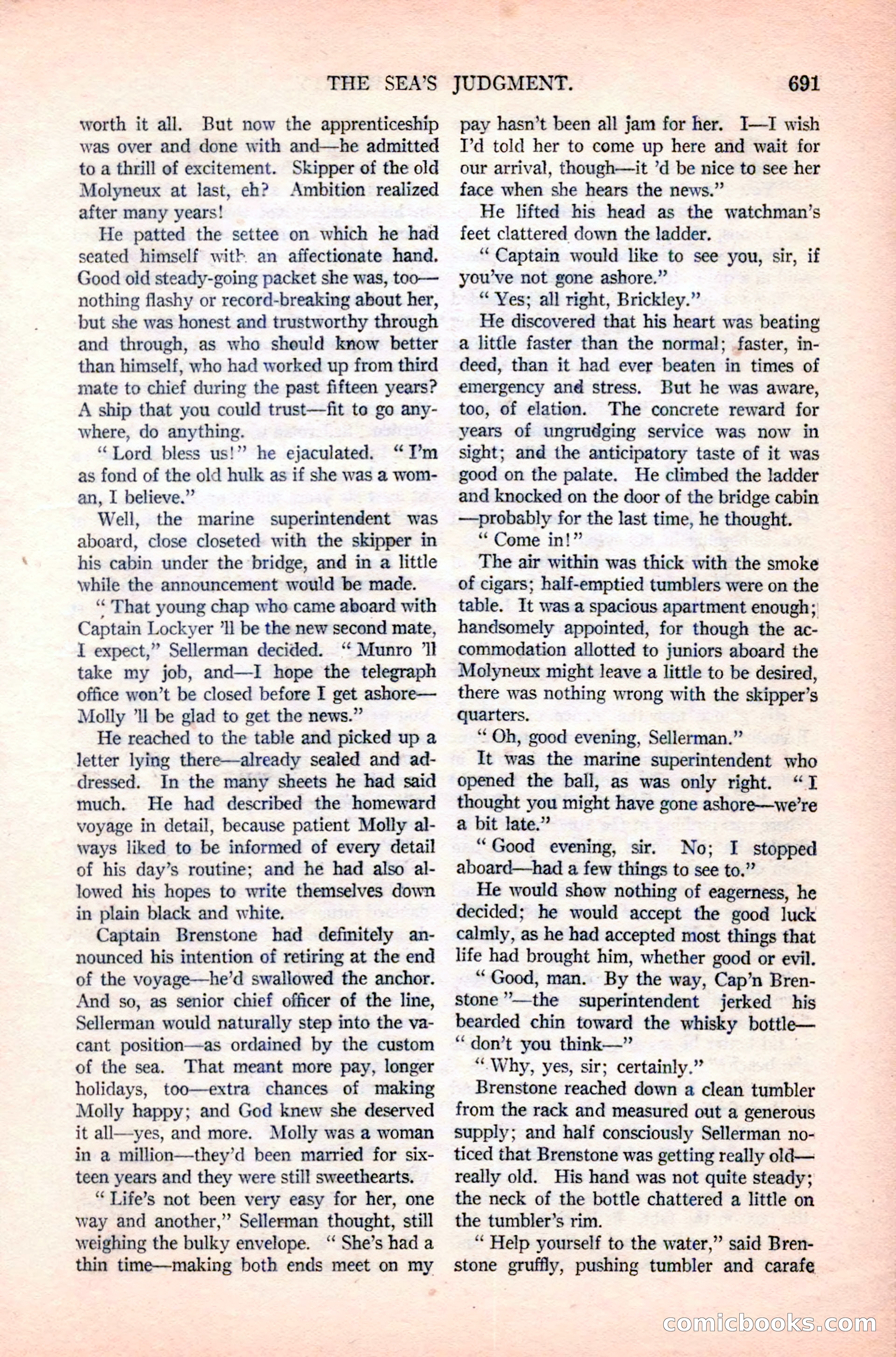
A restored page from Pulp Fiction, 1923. Page through the whole issue in the reader above.
📄 Transcribed text from this page (OCR, searchable)
Machine-transcribed from the original scan — historical spelling and the odd misread are preserved.
THE SEA’S worth it all. But now the apprenticeship was over and done with and—he admitted to a thrill of excitement. Skipper of the old Molyneux at last, eh? Ambition realized after many years! He patted the settee on which he had seated himself with an affectionate hand. Good old steady-going packet she was, too— nothing flashy or record-breaking about her, but she was honest and trustworthy through and through, as who sheuld know better than himself, who had worked up from third mate to chief during the past fifteen years? A ship that you could trust—fit te go any- where, do anything. “Lord bless us!” he ejaculated. “I’m as fond of the old hulk as if she was a wom- an, I believe.” Well, the marine superintendent was aboard, close closeted with the skipper in his cabin under the bridge, and in a little while the announcement would be made. “That young chap who came aboard with Captain Lockyer ’ll be the new second mate, I expect,” Sellerman decided. “ Munro ‘Il take my job, and—I hope the telegraph office won’t be closed before I get ashore— Molly ’ll be glad to get the news.” He reached to the table and picked up a letter lying there—already sealed and ad- dressed. In the many sheets he had said much. He had described the homeward voyage in detail, because patient Molly al- ways liked to be informed of every detail of his day’s routine; and he had also al- lowed his hopes to write themselves down in plain black and white. Captain Brenstone had definitely an- nounced his intention of retiring at the end of the voyage—he’d swallowed the anchor. And so, as senior chief officer of the line, Sellerman would naturally step into the va- cant position—as ordained by the custom of the sea. That meant more pay, longer holidays, too—extra chances of making Molly happy; and God knew she deserved it all—yes, and more. Molly was a woman in a million—they’d been married for six- teen years and they were still sweethearts. “ Life’s not been very easy for her, one way and another,” Sellerman thought, still weighing the bulky envelope. “ She’s had a thin time—making both ends meet on my JUDGMENT. 691 pay hasn’t been all jam for her. I—1I wish I’d told her to come up here and wait for our arrival, though—it ’d be nice to see her face when she hears the news.” He lifted his head as the watchman’s feet clattered down the ladder. “Captain would like to see you, sir, if you’ve not gone ashore.” * Yes; all right, Brickley.” He discovered that his heart was beating a little faster than the normal; faster, in- deed, than it had ever beaten in times of emergency and stress. But he was aware, too, of elation. The concrete reward for years of ungrudging service was now in sight; and the anticipatory taste of it was good on the palate. He climbed the ladder and knocked on the door of the bridge cabin —probably for the last time, he thought. ‘“* Come in!” The air within was thick with the smoke of cigars; half-emptied tumblers were on the table. It was a spacious apartment enough; handsomely appointed, for though the ac- commodation allotted to juniors aboard the Molyneux might leave a little to be desired, there was nothing wrong with the skipper’s quarters. “ Oh, good evening, Sellerman.” It was the marine superintendent who opened the ball, as was only right. “TI thought you might have gone ashore—we’re a bit late.” “Good evening, sir. No; I stopped aboard—had a few things to see to.” He would show nothing of eagerness, he decided; he would accept the good luck calmly, as he had accepted most things that life had brought him, whether good or evil. “Good, man. By the way, Cap’n Bren- stone ’’—the superintendent jerked his bearded chin toward the whisky bottle— “don’t you think—” | “Why, yes, sir; certainly.” Brenstone reached down a clean tumbler from the rack and measured out a generous supply; and half consciously Sellerman no- ticed that Brenstone was getting really old— really old. His hand was not quite steady; the neck of the bottle chattered a little on the tumbler’s rim. “ Help yourself to the water,” said Bren- stone gruffly, pushing tumbler and carafe Gomichbooks (C@