
Pulp Fiction, 1923 · page 67 of 180
Argosy All-Story Weekly — page 67: what you’re looking at
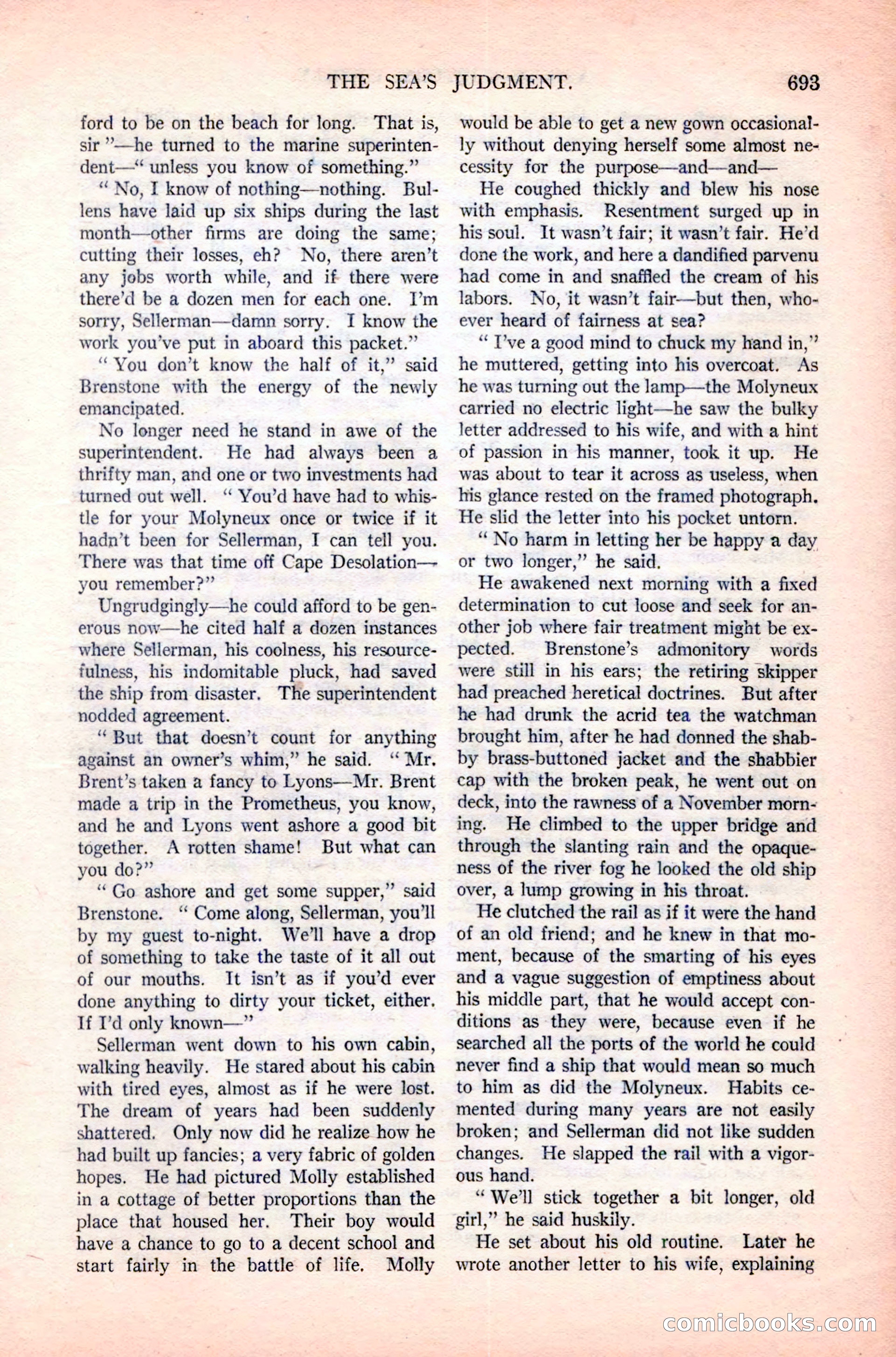
A restored page from Pulp Fiction, 1923. Page through the whole issue in the reader above.
📄 Transcribed text from this page (OCR, searchable)
Machine-transcribed from the original scan — historical spelling and the odd misread are preserved.
THE SEA’S JUDGMENT. ford to be on the beach for long. That is, sir ’’—he turned to the marine superinten- dent—*‘ unless you know of something.” “No, I know of nothing—nothing. Bul- lens have laid up six ships during the last month—other firms are doing the same; cutting their losses, eh? No, there aren’t any jobs worth while, and if there were there’d be a dozen men for each one. I’m sorry, Sellerman—damn sorry. I know the work you’ve put in aboard this packet.”’ “You don’t know the half of it,” said Brenstone with the energy of the newly emancipated. No longer need he stand in awe of the superintendent. He had always been a thrifty man, and one or two investments had turned out well. “ You’d have had to whis- tle for your Molyneux once or twice if it hadn’t been for Sellerman, I can tell you. There was that time off Cape Desolation— you remember?” Ungrudgingly—he could afford to be gen- erous now—he cited half a dozen instances where Sellerman, his coolness, his resource- fulness, his indomitable pluck, had saved the ship from disaster. The superintendent nodded agreement. “But that doesn’t count for anything against an owner’s whim,” he said. “ Mr. Brent’s taken a fancy to Lyons—Mr. Brent made a trip in the Prometheus, you know, and he and Lyons went ashore a good bit together. A rotten shame! But what can you do?” ‘Go ashore and get some supper,” said Brenstone. ‘‘ Come along, Sellerman, you'll by my guest to-night. We'll have a drop of something to take the taste of it all out of our mouths. It isn’t as if you’d ever done anything to dirty your ticket, either. If I’d only known—”’ Sellerman went down to his own cabin, walking heavily. He stared about his cabin with tired eyes, almost as if he were lost. The dream of years had been suddenly shattered. Only now did he realize how he had built up fancies; a very fabric of golden hopes. He had pictured Molly established in a cottage of better proportions than the place that housed her. Their boy would have a chance to go to a decent school and start fairly in the battle of life. Molly 693 would be able to get a new gown occasional- ly without denying herself some almost ne- cessity for the purpose—and—and— He coughed thickly and blew his nose with emphasis. Resentment surged up in his soul. It wasn’t fair; it wasn’t fair. He’d done the work, and here a dandified parvenu had come in and snaffled the cream of his labors. No, it wasn’t fair—but then, who- ever heard of fairness at sea? “ T’ve a good mind to chuck my hand in,” he muttered, getting into his overcoat. As he was turning out the lamp—the Molyneux carried no electric light—he saw the bulky letter addressed to his wife, and with a hint of passion in his manner, took it up. He was about to tear it across as useless, when his glance rested on the framed photograph. He slid the letter into his pocket untorn. “No harm in letting her be happy a day or two longer,” he said. He awakened next morning with a fixed determination to cut loose and seek for an- other job where fair treatment might be ex- pected. Brenstone’s admonitory words were still in his ears; the retiring skipper had preached heretical doctrines. But after he had drunk the acrid tea the watchman brought him, after he had donned the shab- by brass-buttoned jacket and the shabbier cap with the broken peak, he went out on deck, into the rawness of a November morn- ing. He climbed to the upper bridge and through the slanting rain and the opaque- ness of the river fog he looked the old ship over, a lump growing in his throat. He clutched the rail as if it were the hand of an old friend; and he knew in that mo- ment, because of the smarting of his eyes and a vague suggestion of emptiness about his middle part, that he would accept con- ditions as they were, because even if he searched all the ports of the world he could never find a ship that would mean so much to him as did the Molyneux. Habits ce- mented during many years are not easily broken; and Sellerman did not like sudden changes. He slapped the rail with a vigor- ous hand. “We'll stick together a bit longer, old girl,” he said huskily. He set about his old routine. Later he wrote another letter to his wife, explaining GComicbdooks (E@)