
Pulp Fiction, 1923 · page 69 of 180
Argosy All-Story Weekly — page 69: what you’re looking at
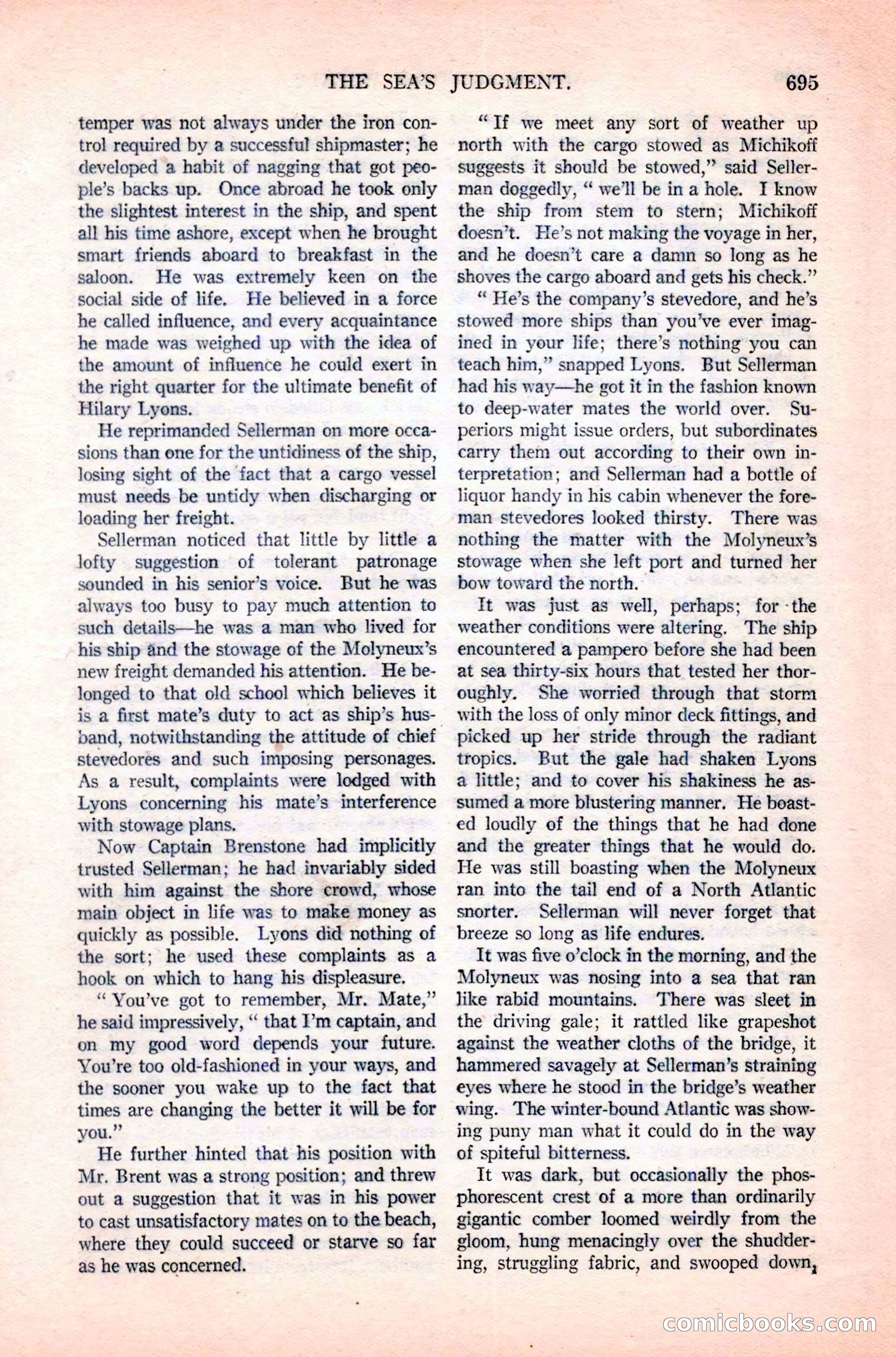
A restored page from Pulp Fiction, 1923. Page through the whole issue in the reader above.
📄 Transcribed text from this page (OCR, searchable)
Machine-transcribed from the original scan — historical spelling and the odd misread are preserved.
THE SEA’S temper was not always under the iron con- trol required by a successful shipmaster; he developed a habit of nagging that got peo- ple’s backs up. Once abroad he took only the slightest interest in the ship, and spent all his time ashore, except when he brought smart friends aboard to breakfast in the saloon. He was extremely keen on the social side of life. He believed in a force he called influence, and every acquaintance he made was weighed up with the idea of the amount of influence he could exert in the right quarter for the ultimate benefit of Hilary Lyons. He reprimanded Sellerman on more occa- sions than one for the untidiness of the ship, losing sight of the fact that a cargo vessel must needs be untidy when discharging or loading her freight. Sellerman noticed that little by little a lofty suggestion of tolerant patronage sounded in his senior’s voice. But he was always too busy to pay much attention to such details—he was a man who lived for his ship and the stowage of the Molyneux’s new freight demanded his attention. He be- longed to that old school which believes it is a first mate’s duty to act as ship’s hus- band, notwithstanding the attitude of chief stevedores and such imposing personages. As a result, complaints were lodged with Lyons concerning his mate’s interference with stowage plans. Now Captain Brenstone had implicitly trusted Sellerman; he had invariably sided with him against the shore crowd, whose main object in life was to make money as quickly as possible. Lyons did nothing of the sort; he used these complaints as a hook on which to hang his displeasure. “VYou’ve got to remember, Mr. Mate,” he said impressively, “ that I’m captain, and on my good word depends your future. You’re too old-fashioned in your ways, and the sooner you wake up to the fact that times are changing the better it will be for you.” He further hinted that his position with Mr. Brent was a strong position; and threw out a suggestion that it was in his power to cast unsatisfactory mates on to the beach, where they could succeed or starve so far as he was concerned. JUDGMENT. “Tf we meet any sort of weather up north with the cargo stowed as Michikoff suggests it should be stowed,” said Seller- man doggedly, “ we'll be in a hole. I know the ship from stem to stern; Michikoff doesn’t. He’s not making the voyage in her, and he doesn’t care a damn so long as he shoves the cargo aboard and gets his check.” “ He’s the company’s stevedore, and he’s stowed more ships than you’ve ever imag- ined in your life; there’s nothing you can teach him,” snapped Lyons. But Sellerman had his way—he got it in the fashion known to deep-water mates the world over. Su- periors might issue orders, but subordinates carry them out according to their own in- terpretation; and Sellerman had a bottle of liquor handy in his cabin whenever the fore- man stevedores looked thirsty. There was nothing the matter with the Molyneux’s stowage when she left port and turned her bow toward the north. It was just as well, perhaps; for -the weather conditions were altering. The ship encountered a pampero before she had been at sea thirty-six hours that tested her thor- oughly. She worried through that storm with the loss of only minor deck fittings, and picked up her stride through the radiant tropics. But the gale had shaken Lyons a little; and to cover his shakiness he as- sumed a more blustering manner. He boast- ed loudly of the things that he had done and the greater things that he would do. He was still boasting when the Molyneux ran into the tail end of a North Atlantic snorter. Sellerman will never forget that breeze so long as life endures. It was five o’clock in the morning, and the Molyneux was nosing into a sea that ran like rabid mountains. There was sleet in the driving gale; it rattled like grapeshot against the weather cloths of the bridge, it hammered savagely at Sellerman’s straining eyes where he stood in the bridge’s weather wing. The winter-bound Atlantic was show- ing puny man what it could do in the way of spiteful bitterness. It was dark, but occasionally the phos- phorescent crest of a more than ordinarily gigantic comber loomed weirdly from the gloom, hung menacingly over the shudder- ing, struggling fabric, and swooped down, Gomicbooks 695. (C@