
Pulp Fiction, 1923 · page 93 of 180
Argosy All-Story Weekly — page 93: what you’re looking at
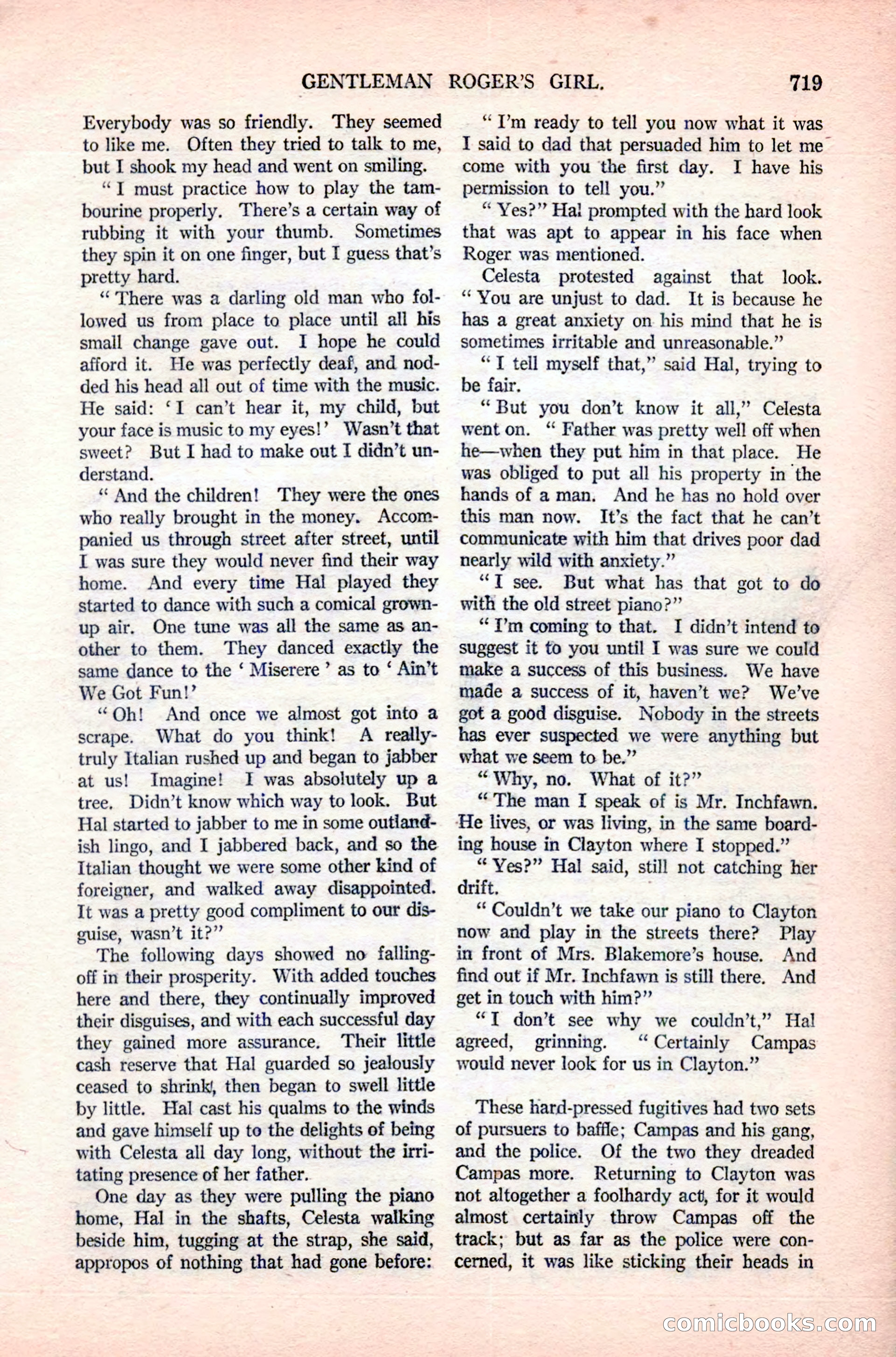
A restored page from Pulp Fiction, 1923. Page through the whole issue in the reader above.
📄 Transcribed text from this page (OCR, searchable)
Machine-transcribed from the original scan — historical spelling and the odd misread are preserved.
GENTLEMAN ROGER’S GIRL. Everybody was so friendly. They seemed to like me. Often they tried to talk to me, but I shook my head and went on smiling. “T must practice how to play the tam- bourine properly. There’s a certain way of rubbing it with your thumb. Sometimes they spin it on one finger, but I guess that’s pretty hard. “There was a darling old man who fol- lowed us from place to place until all his small change gave out. I hope he could afford it. He was perfectly deaf, and nod- ded his head all out of time with the music. He said: ‘I can’t hear it, my child, but your face is music to my eyes!’ Wasn’t that sweet? But I had to make out I didn’t un- derstand. “And the children! They were the ones who really brought in the money. Accom- panied us through street after street, until I was sure they would never find their way home. And every time Hal played they started to dance with such a comical grown- up air. One tune was all the same as an- other to them. They danced exactly the same dance to the ‘ Miserere ’ as to ‘ Ain’t We Got Fun!’ “Oh! And once we almost got into a scrape. What do you think! A really- truly Italian rushed up and began to jabber at us! Imagine! I was absolutely up a tree, Didn’t know which way to look. But Hal started to jabber to me in some outiand- ish lingo, and I jabbered back, and so the Italian thought we were some other kind of foreigner, and walked away disappointed. It was a pretty good compliment to our dis- guise, wasn’t it?” The following days showed no falling- off in their prosperity. With added touches here and there, they continually improved their disguises, and with each successful day they gained more assurance, Their little cash reserve that Hal guarded so jealously ceased to shrink, then began to swell little by little. Hal cast his qualms to the winds and gave himself up to the delights of being with Celesta all day long, without the irri- tating presence of her father. One day as they were pulling the piano home, Hal in the shafts, Celesta walking beside him, tugging at the strap, she said, appropos of nothing that had gone before: 719 *T’m ready to tell you now what it was I said to dad that persuaded him to let me— come with you the first day. I have his permission to tell you.” “Yes?” Hai prompted with the hard look that was apt to appear in his face when Roger was mentioned. Celesta protested against that look. ‘You are unjust to dad. It is because he has a great anxiety on his mind that he is sometimes irritable and unreasonable.” “T tell myself that,” said Hal, trying to be fair. “But you don’t know it all,” Celesta went on. “ Father was pretty well off when he—when they put him in that place. He was obliged to put all his property in the hands of a man. And he has no hold over this man now. It’s the fact that he can’t communicate with him that drives poor dad nearly wild with anxiety.” “I see. But what has that got to do with the old street piano?” “1’m coming to that. I didn’t intend to suggest it to you until I was sure we could make a success of this business. We have made a success of it, haven’t we? We’ve got a good disguise. Nobody in the streets has ever suspected we were anything but what we seem to be.” “Why, no. What of it?” “The man I speak of is Mr. Inchfawn. ‘He lives, or was living, in the same board- ing house in Clayton where I stopped.” “Yes?” Hal said, still not catching her drift, . “ Couldn’t we take our piano to Clayton now and play in the streets there? Play in front of Mrs. Blakemore’s house. And find out if Mr. Inchfawn is still there. And get in touch with him?” “TI don’t see why we couldn’t,” Hal agreed, grinning. “Certainly Campas would never look for us in Clayton.” These hard-pressed fugitives had two sets of pursuers to baffle; Campas and his gang, and the police. Of the two they dreaded Campas more. Returning to Clayton was not altogether a foolhardy act, for it would almost certainly throw Campas off the track; but as far as the police were con- cerned, it was like sticking their heads in COMmMICLOolkKks (C@