
Pulp Fiction, 1923 · page 101 of 172
Argosy All-Story Weekly — page 101: what you’re looking at
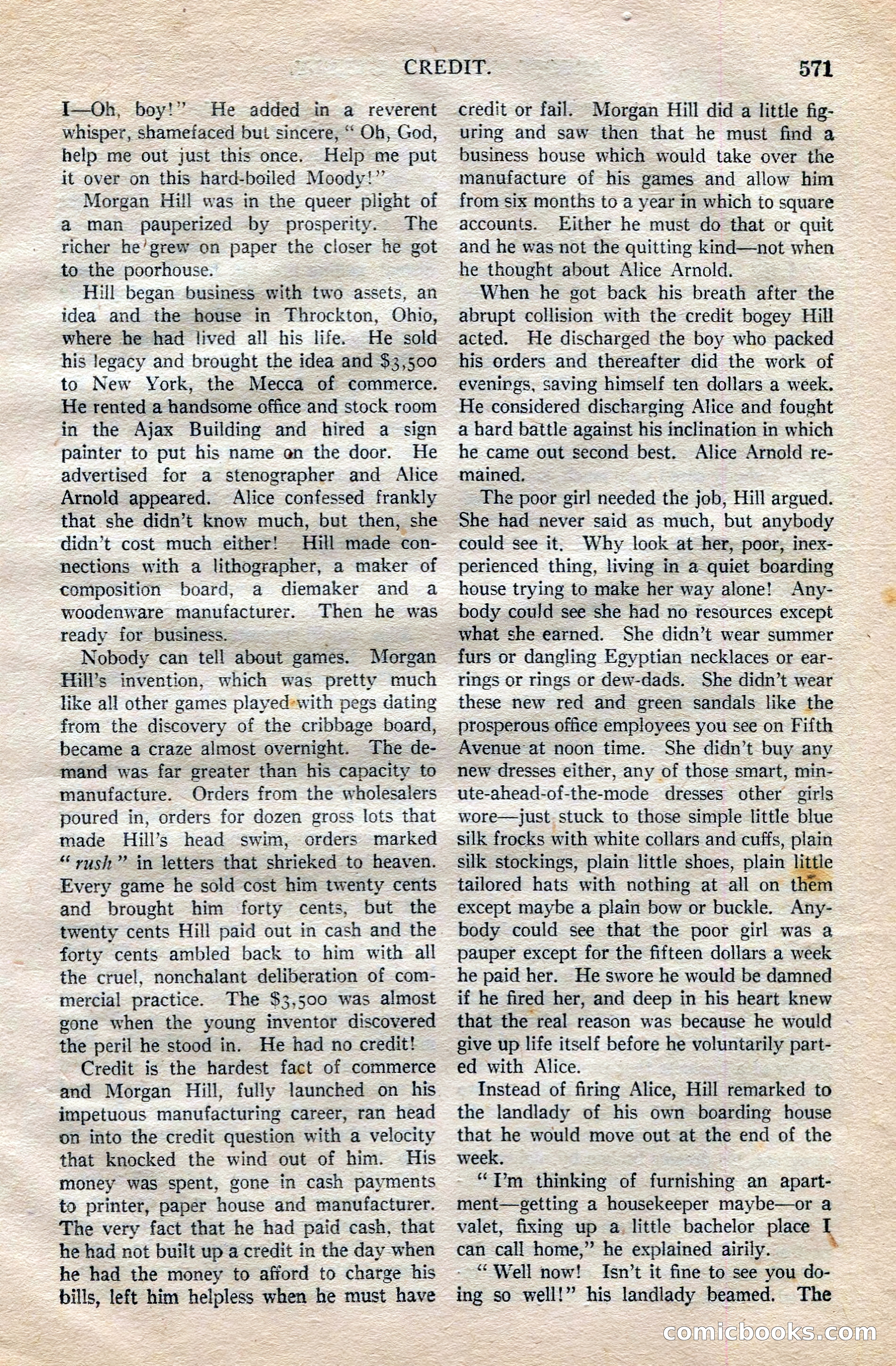
A restored page from Pulp Fiction, 1923. Page through the whole issue in the reader above.
📄 Transcribed text from this page (OCR, searchable)
Machine-transcribed from the original scan — historical spelling and the odd misread are preserved.
CREDIT. I—Oh, boy!” He added in a reverent whisper, Shamefaced bui sincere, “ Oh, God, help me out just this once. Help me put it over-on this hard-boiled Moody!” Morgan Hill was in the queer plight of a man pauperized by prosperity... The richer he’grew on paper the closer he got to the aeons. Hill began business with two assets, an idea and the house in Throckton, Ohio, where he had lived all his life. He sold his legacy and brought the idea and $3,500 to New York, the Mecca of commerce. He rented a handsome office and stock room in the Ajax Building and hired a sign ‘painter to put his name on the door. He advertised for a stenographer and Alice Arnold appeared. Alice confessed frankly that she didn’t know much, but then, she didn’t cost much either! Hill made con- nections with a lithographer, a maker of composition board, a diemaker and a woodenware manufacturer. Then he was ready for business. = Nobody can tell aboat: games. Morgan Hill’s invention, which was pretty much like all other games played-with pegs dating from the discovery of the cribbage board, became a craze almost overnight. The de- mand was far greater than his capacity to manufacture. Orders from the wholesalers poured in, orders for dozen gross lots that made Hill’s head swim, orders marked “yvush” in letters that shrieked to heaven. Every game he sold cost him twenty cents and brought him forty cents, but the twenty cents Hill paid out in cash and the forty cents ambled back to him with all the cruel, nonchalant deliberation of com- mercial practice. The $3,500 was almost gone when the young inventor discovered the peril he stood in. He had no credit! Credit is the hardest fact of commerce and Morgan Hill, fully launched on his impetuous manufacturing career, ran head on into the credit question with a velocity that knocked the wind out of him. His money was spent, gone in cash payments to printer, paper house and manufacturer. - The very fact that he had paid cash, that he had not built up a credit in the day when he had the money to afford to charge his bills, left him helpless when he must have 571 credit or fail. Morgan Hill did a little fig- uring and saw then that he must find a business house which would take over the manufacture of his games and allow him from six months to a year in which to square accounts. Either he must do that or quit and he was not the quitting kind—not when he thought about Alice Arnold. When he got back his breath after the abrupt collision with the credit bogey Hill acted. He discharged the boy who packed his orders and thereafter did the work of evenings, saving himself ten dollars a week. He considered discharging Alice and fought a hard battle against his inclination in which he came out second best. Alice Arnold re- mained. The poor girl needed the job, Hill argued. She had never said as much, but anybody could see it. Why look at her, poor, inex- perienced thing, living in a quiet boarding house trying to make her way alone! Any- body could see she had no resources except what she earned. She didn’t wear summer furs or dangling Egyptian necklaces or ear- rings or rings or denned: She didn’t wear these new red and green sandals like the prosperous office employees you see on Fifth Avenue at noon time. She didn’t buy any new dresses either, any of those smart, min- ute-ahead-of-the-mode dresses other girls wore—just. stuck to those simple little blue silk frocks with white collars and cuffs, plain silk stockings, plain little shoes, plain litt tailored hats with nothing at all on except maybe a plain bow or buckle. Any- body could see that the poor girl was a pauper except for the fifteen dollars a week he paid her. He swore he would be damned if he fired her, and deep in his heart knew that the real reason was because he would | give up life itself before he voluntarily part- ed with Alice. Instead of firing Alice, Hill remarked to the landlady of his own boarding house that he would move out at the end of the week. “Tm thinking of fanithing an apart- ment—getting a housekeeper maybe—or a valet, fixing up a little bachelor place ft can call home,” he explained airily. “Well now! Isn’t it fine to see you do- ing so well!” his landlady beamed. The © Gomicbooks com