
Pulp Fiction, 1923 · page 105 of 172
Argosy All-Story Weekly — page 105: what you’re looking at
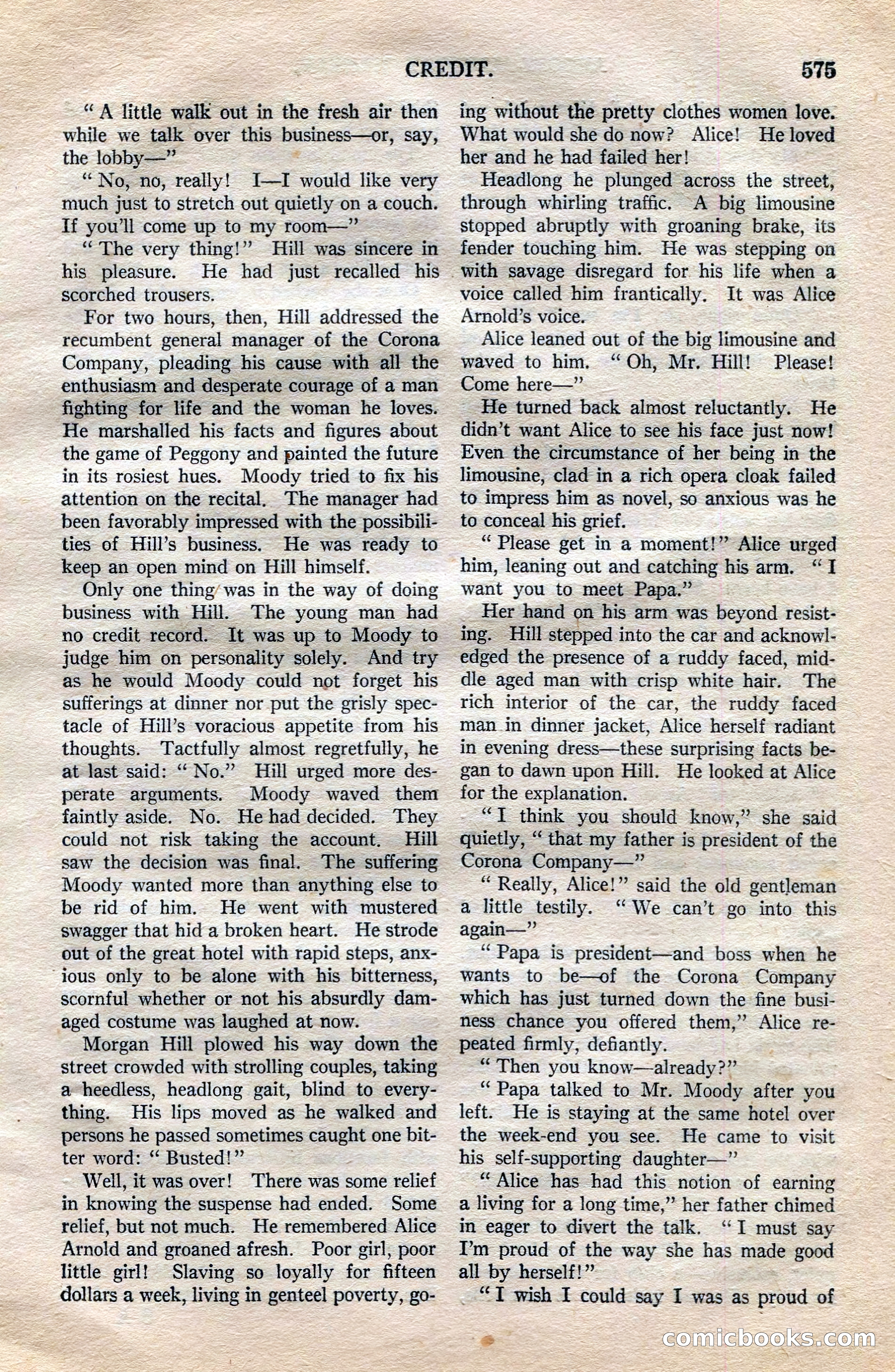
A restored page from Pulp Fiction, 1923. Page through the whole issue in the reader above.
📄 Transcribed text from this page (OCR, searchable)
Machine-transcribed from the original scan — historical spelling and the odd misread are preserved.
CREDIT. “ A little walk out in the fresh air then while we talk over this ee say, the lobby—” ‘No, no, really! I—I would like very much wast to stretch out quietly on a couch. {f you'll come up to my room—” | “The very thing!” Hill was sincere in his pleasure. He had just recalled his scorched trousers. For two hours, then, Hill addressed the recumbent general manager of the Corona Company, pleading his cause with all the enthusiasm and desperate courage of a man fighting for life and the woman he loves. He marshalled his facts and figures about the game of Peggony and painted the future in its rosiest hues. Moody tried to fix his attention on the recital. The manager had been favorably impressed with the possibili- ties of Hill’s business. He was ready to keep an open mind on Hill himself. Only one thing’ was in the way of doing business with Hill. The young man had no credit record. It was up to Moody to judge him on personality solely. And try as he would Moody could not forget his sufferings at dinner nor put the grisly spec- tacle of Hill’s voracious appetite from his thoughts. Tactfully almost regretfully, he at last said: “‘ No.” Hill urged more des- perate arguments. Moody waved them faintly aside. No. He had decided. They could not risk taking the account. Hill saw the decision was final. The suffering Moody wanted more than anything else to be rid of him. He went with mustered swagger that hid a broken heart. He strode out of the great hotel with rapid steps, anx- ‘jous only to be alone with his bitterness, scornful whether or not his absurdly dam- aged costume was laughed at now. Morgan Hill plowed his way down the street crowded with strolling couples, taking a heedless, headlong gait, blind to every- thing. His lips moved as he walked and persons he passed sometimes caught one bit- ter word: ‘‘ Busted!” Well, it was over! There was some relief in knowing the suspense had ended. Some relief, but not much. He remembered Alice Arnold and groaned afresh. Poor girl, poor little girl! Slaving so loyally for fifteen dollars a week, living in genteel poverty, go- 575 ing without the pretty clothes women love. What would she do now? Alice! He loved her and he had failed her! Headlong he plunged across the street, through whirling traffic. “A big limousine stopped abruptly with groaning brake, its fender touching him. He was stepping on with savage disregard for his life when a voice called him frantically. It was Alice Arnold’s voice. | Alice leaned out of the big limousine and waved to him. “‘Oh, Mr. Hill! Please! Come here—” -He turned back almost reluctantly. He didn’t want Alice to see his face just now! Even the circumstance of her being in the limousine, clad in a rich opera cloak failed to impress him as novel, so anxious was he to conceal his grief. “ Please get in a moment!” Alice urged him, leaning out and catching his arm. “I want you to meet Papa.” | _ Her hand on his arm was beyond resist- ing. Hill stepped into the car and acknowl- edged the presence of a ruddy faced, mid- dle aged man with crisp white hair. The rich interior of the car, the ruddy faced man_in dinner jacket, Alice herself radiant in evening dress—these surprising facts be- gan to dawn upon Hill. He looked at Alice for the explanation. “T think you should know,” she said quietly, “ that my fathers is president of the Corona Company— ‘ Really, Alice!” said the old gentleman a little testily. ‘‘ We can’t go into this again—”’ “Papa is president—and boss when he wants to be—of the Corona Company which has just turned down the fine busi- ness chance you offered them,” Alice re- peated firmly, defiantly. “Then you know—already?” ‘Papa talked to Mr. Moody after you left. He is staying at the same hotel over the week-end you see. He came to visit his self-supporting daughter—” “Alice has had this notion of earning a living for a long time,” her father chimed in eager to divert the talk. ‘I must say I’m proud of the way she has made good all by herself!” _ “T wish I could say I was as proud of — _ © cComicbooks (ae) fa