
Pulp Fiction, 1923 · page 29 of 172
Argosy All-Story Weekly — page 29: what you’re looking at
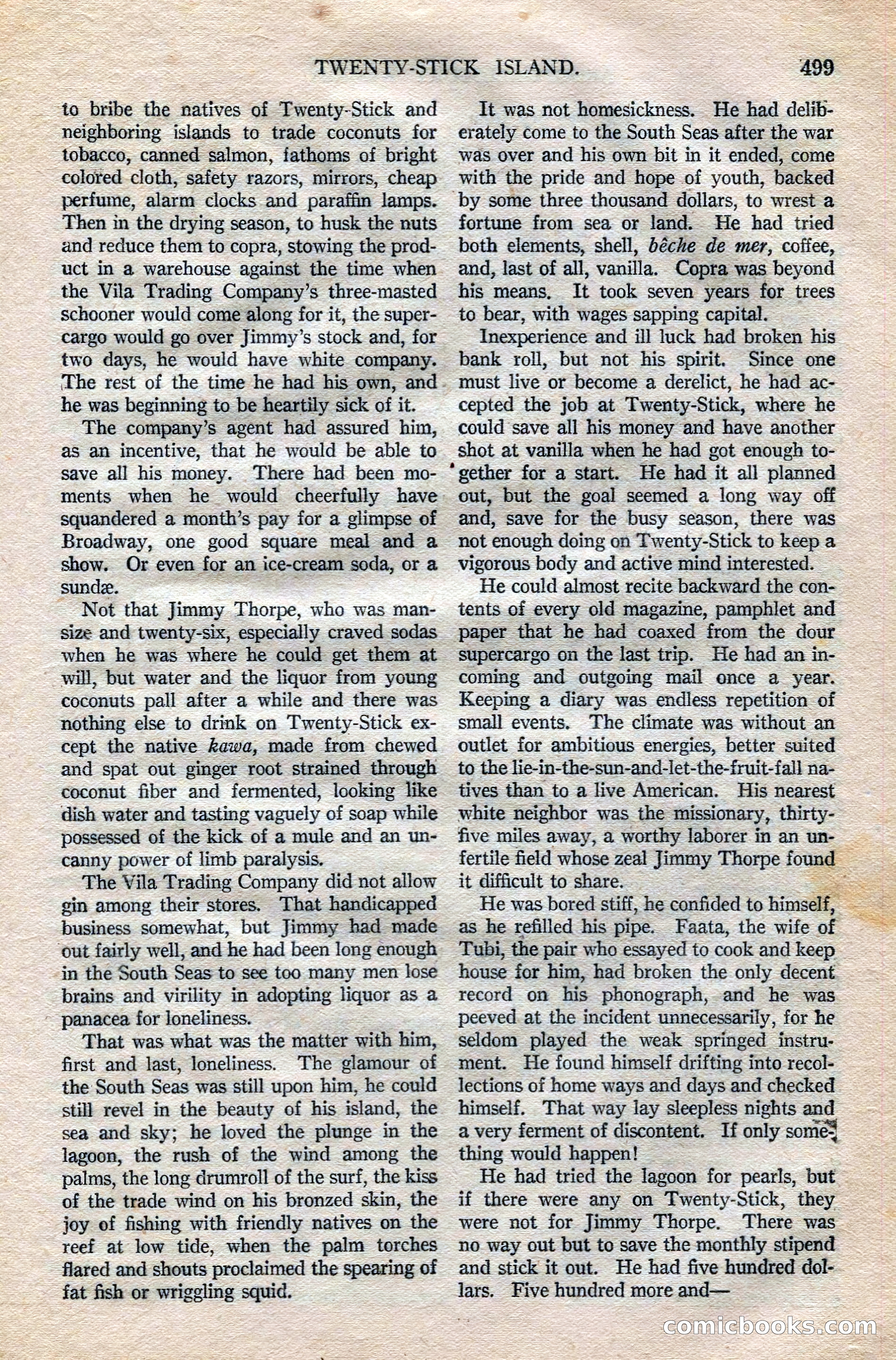
A restored page from Pulp Fiction, 1923. Page through the whole issue in the reader above.
📄 Transcribed text from this page (OCR, searchable)
Machine-transcribed from the original scan — historical spelling and the odd misread are preserved.
*TWENTY-STICK ISLAND. to bribe the natives of Twenty-Stick and neighboring islands to trade coconuts for tobacco, canned salmon, fathoms of bright _ colored cloth, safety razors, mirrors, cheap perfume, alarm clocks and paraffin lamps. Then in the drying season, to husk the nuts and reduce them to copra, stowing the prod- uct In @ warehouse against the time when the Vila Trading Company’s three-masted schooner would come along for it, the super- cargo would go over Jimmy’s stock and, for two days, he would have white company. The rest of the time he had his own, and - he was beginning to be heartily sick of it. The company’s agent had assured him, as an incentive, that he would be able to save all his money. There had been mo- ments when he would cheerfully have squandered a month’s pay for a glimpse of Broadway, one good square meal and a show. Or even for an ice-cream soda, or a sunde. Not that Jimmy Thorpe, who was man- size and twenty-six, especially craved sodas when he was where he could get them at will, but water and the liquor from young coconuts pall aiter a while and there was nothing else to drink on Twenty-Stick ex- cept the native kawa, made from chewed and spat out ginger root strained through coconut fiber and fermented, looking like dish water and tasting vaguely of soap while possessed of the kick of a mule and an un- canny power of limb paralysis. The Vila Trading Company did not allow gin among their stores. That handicapped business somewhat, but Jimmy had made out fairly well, and he had been long enough in the South Seas to see too many men lose brains and virility in adopting liquor as a - panacea for loneliness. That was what was the matter with him, first and last, loneliness. The glamour of the South Seas was still upon him, he could still revel in the beauty of his island, the sea and sky; he loved the plunge in the lagoon, the rush of the wind among the palms, the long drumroll of the surf, the kiss of the trade wind on his bronzed skin, the joy of fishing with friendly natives on the reef at low tide, when the palm torches flared and shouts proclaimed the spearing of fat fish or wriggling squid. It was not homesickness. He had delib- erately come to the South Seas after the war was over and his own bit in it ended, come with the pride and hope of youth, backed ‘by some three thousand dollars, to wrest a fortune from sea or land. He had tried both elements, shell, béche de mer, coffee, and, last of all, vanilla. Copta was beyond his means, It took seven years for trees to bear, with wages sapping capital. Inexperience and ill luck had broken his bank roll, but not his spirit. Since one must live or become a derelict, he had ac- cepted the job at Twenty-Stick, where he could save all his money and have another shot at vanilla when he had got enough to- ‘gether for a start. He had it all planned out, but the goal seemed a long way off and, save for the busy season, there was not enough doing on Twenty-Stick to keep a vigorous body and active mind interested. He could almost recite backward the con- tents of every old magazine, pamphlet and paper that he had coaxed ‘from the dour supercargo on the last trip. He had an in- coming and outgoing mail ence a year. Keeping a diary was endless repetition of small events. The climate was without an outlet for ambitious energies, better suited to the lie-in-the-sun-and-let-the-fruit-fall na- tives than to a live American. His nearest white neighbor was the ‘Missionary, thirty- five miles away, a worthy laborer in an un- 499 fertile field whose zeal Jimmy Thorpe found = it difficult to share. He was bored stiff, he conndea to himself, = as he refilled his pipe. Faata, the wife of Tubi, the pair who essayed to cook and keep house for him, had broken the only decent record on his phonograph, and he was peeved. at the incident unnecessarily, for he seldom played the weak springed instru- ment. He found himself drifting into recol- lections of home ways and days and checked himself. That way lay sleepless nights and a very ferment of discontent. If only somes thing would happen! He had tried the lagoon for pearls, but if there were any on Twenty-Stick, they were not for Jimmy Thorpe. There was no. way out but to save the monthly stipend and stick it out. He had five hundred dol-. | lars. Five hundred more and— oO S EGOmIicboo €O