
Pulp Fiction, 1923 · page 59 of 172
Argosy All-Story Weekly — page 59: what you’re looking at
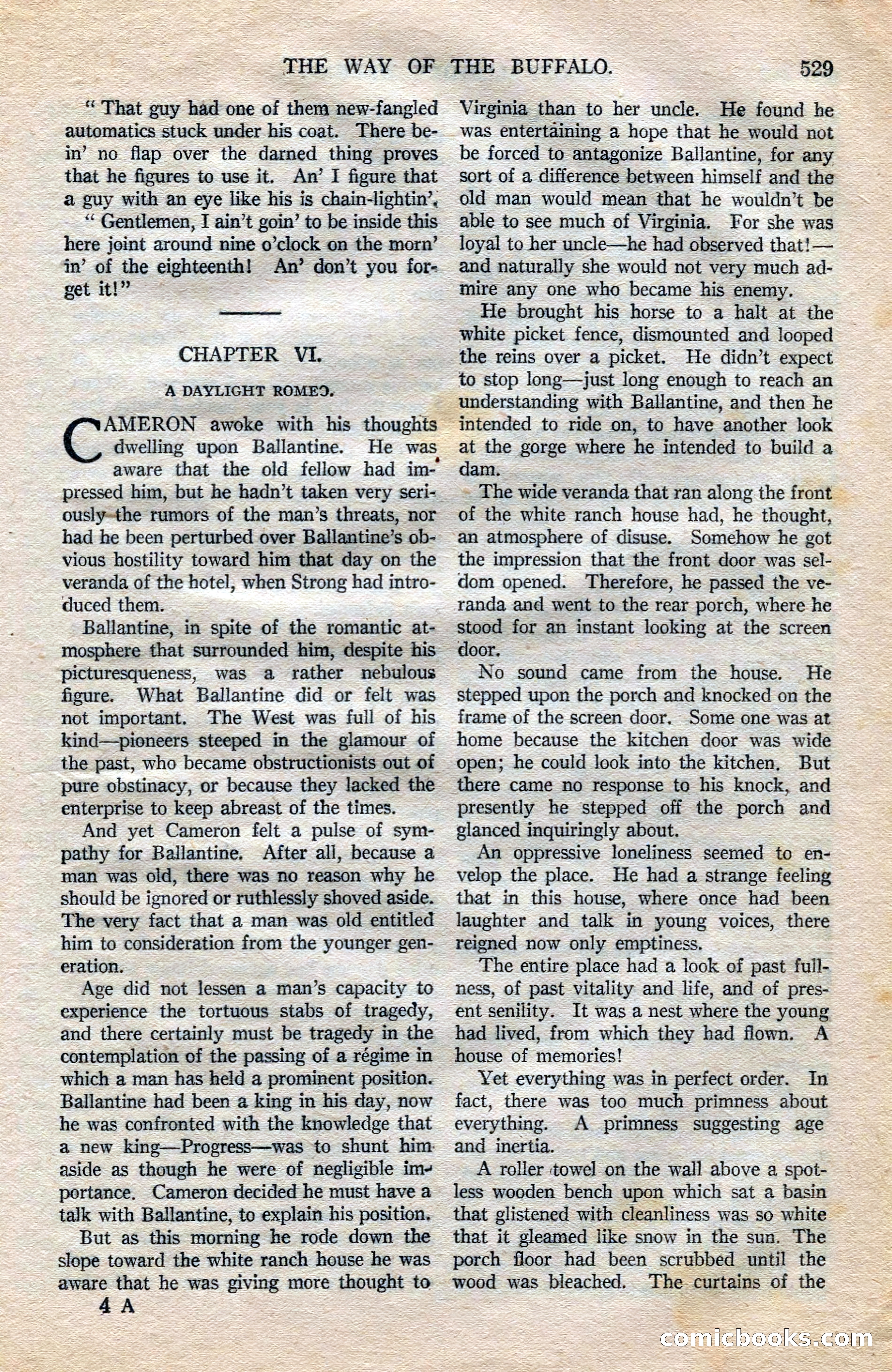
A restored page from Pulp Fiction, 1923. Page through the whole issue in the reader above.
📄 Transcribed text from this page (OCR, searchable)
Machine-transcribed from the original scan — historical spelling and the odd misread are preserved.
“That guy had one of them new-fangled automatics stuck under his coat. There he | in’ no flap over the darned thing proves that he figures to use it. An’ I figure that a guy with an eye like his is chain-lightin’, “Gentlemen, I ain’t goin’ to be inside this here joint around nine o’clock on the morn’ in’ of the eighteenth! An’ don’t you for- get it!” CHAPTER VI. A DAYLIGHT ROMED. AMERON awoke with his thoughts dwelling upon Ballantine. He was aware that the old fellow had im- pressed him, but he hadn’t taken very seri- ously-the rumors of the man’s threats, nor had he been perturbed over Ballantine’s ob- vious hostility toward him that day on the veranda of the hotel, when Strong had intro- duced them. Ballantine, in spite of the romantic at- mosphere that surrounded him, despite his picturesqueness, was a rather nebulous figure. What Ballantine did or felt was not important. The West was full of his kind—pioneers steeped in the glamour of the past, who became obstructionists out of pure obstinacy, or because they lacked the enterprise to keep abreast of the times. And yet Cameron felt a pulse of sym-— pathy for Ballantine, After all, because a man was old, there was no reason why he should be ignored or ruthlessly shoved aside. The very fact that a man was old entitled him to consideration from the younger gen- eration. Age did not lessen a man’s capacity to experience the tortuous stabs of tragedy, and there certainly must be tragedy in the contemplation of the passing of a régime in which a man has held a prominent position. Ballantine had been a king in his day, now he was confronted with the knowledge that a new king—Progress—was to shunt him: aside as though he were of negligible im- portance. Cameron decided he must have a talk with Ballantine, to explain his position. But as this morning he rode down the slope toward the white ranch house he was aware that he was giving more thouget to 4A THE WAY OF THE BUFFALO. 529 Virginia than to her uncle. He found he was entertaining a hope that he would not be forced to antagonize Ballantine, for any sort of a difference between himself and the old man would mean that he wouldn’t be able to see much of Virginia. For she was loyal to her uncle—he had observed that! — and naturally she would not very much ad- mire any one who became his enemy. He brought his horse to a halt at the white picket fence, dismounted and looped the reins over a picket. He didn’t expect to stop long—just long enough to reach an understanding with Ballantine, and then he Intended to ride on, to have another look at the gorge where he intended to build a dam. _- - The wide veranda that ran along the front of the white ranch house had, he thought, an atmosphere of disuse. Somehow he got the impression that the front door was sel- dom opened. Therefore, he passed the ve- randa and went to the rear porch, where he stood for an instant looking at the screen door. 3 No sound came from the house. He stepped upon the porch and knocked on the frame of the screen door. Some one was at home because the kitchen door was wide open; he could look into the kitchen, But there came no response to his knock, and presently he stepped off the porch and glanced inquiringly about. An oppressive loneliness seemed to en- velop the place. He had a strange feeling that in this house, where once had been laughter and talk in young voices, there reigned now only emptiness. The entire place had a look of past full- ness, of past vitality and life, and of pres- ent senility. It was a nest where the young had lived, from which they had flown. A house of memories! Yet everything was in perfect order. In fact, there was too much primness about everything. and inertia. A roller ‘towel on the wall above a spoi- less wooden bench upon which sat a basin that glistened with cleanliness was so white that it gleamed like snow in the sun. The porch floor had been scrubbed until the wood was bleached. The curtains of the A primness suggesting age Comicbooks-com..