
Pulp Fiction, 1923 · page 112 of 176
Argosy All-Story Weekly — page 112: what you’re looking at
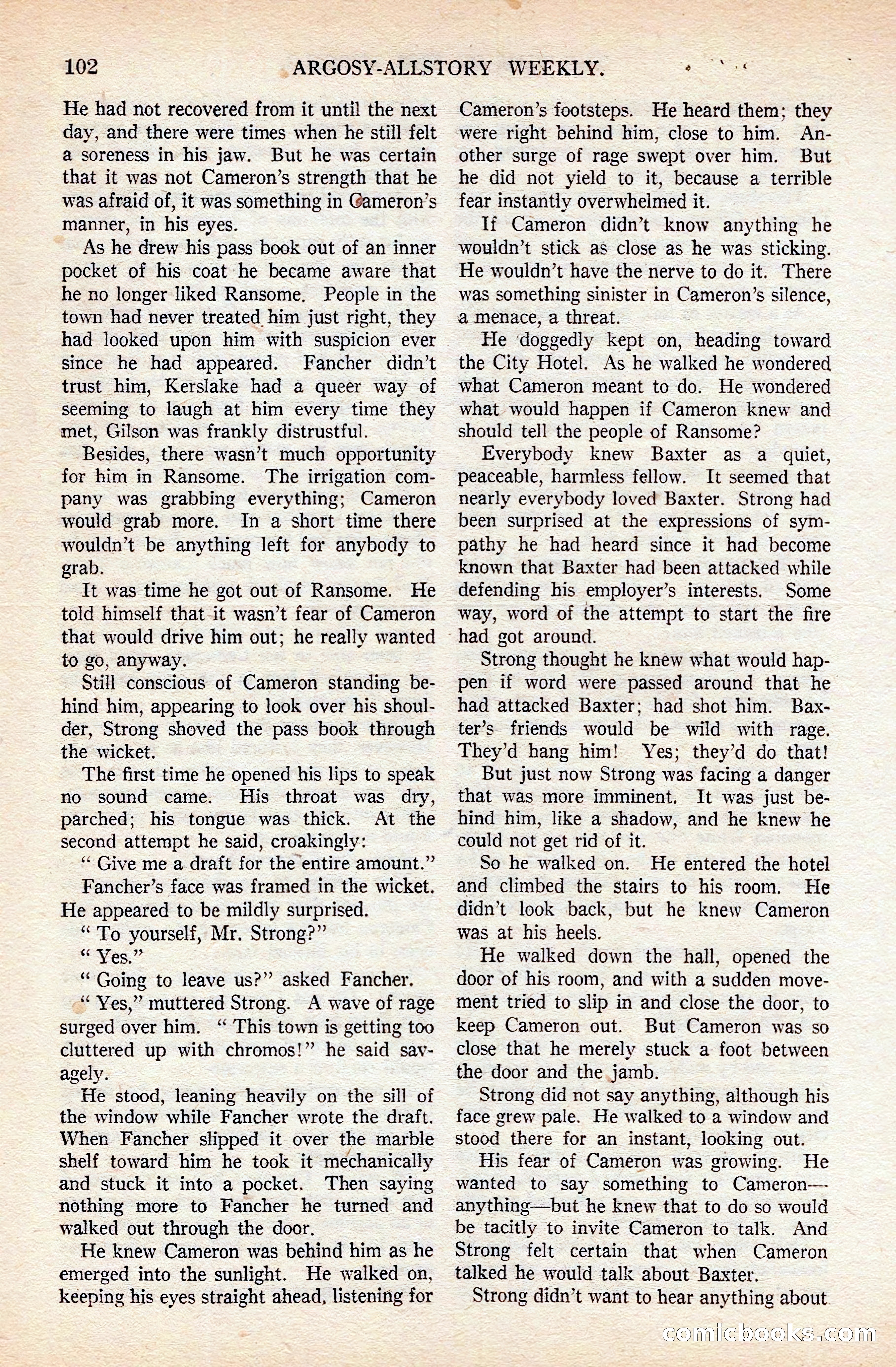
A restored page from Pulp Fiction, 1923. Page through the whole issue in the reader above.
📄 Transcribed text from this page (OCR, searchable)
Machine-transcribed from the original scan — historical spelling and the odd misread are preserved.
102 He had not recovered from it until the next day, and there were times when he still felt a soreness in his jaw. But he was certain that it was not Cameron’s strength that he was afraid of, it was something in Gameron’s manner, in his eyes. As he drew his pass book out of an inner pocket of his coat he became aware that he no longer liked Ransome, People in the town had never treated him just right, they had looked upon him with suspicion ever since he had appeared. Fancher didn’t trust him, Kerslake had a queer way of seeming to laugh at him every time they met, Gilson was frankly distrustful. Besides, there wasn’t much opportunity for him in Ransome. The irrigation com- pany was grabbing everything; Cameron would grab more. In a short time there wouldn’t be anything left for anybody to grab. It was time he got out of Ransome. He told himself thatit wasn’t fear of Cameron that would drive him out; he really wanted to go, anyway. Still conscious of Cameron standing be- hind him, appearing to look over his shoul- der, Strong shoved the pass book through the wicket. The first time he opened his lips to speak no sound came. His throat was dry, parched; his tongue was thick. At the second attempt he said, croakingly: ‘“‘ Give me a draft for the entire amount.” Fancher’s face was framed in the wicket. He appeared to be mildly surprised. “To yourself, Mr. Strong?” (T¢ Yes.”’ “Going to leave us?” asked Fancher. “Yes,” muttered Strong. A wave of rage surged over him. “ This town is getting too cluttered up with chromos!” he said sav- agely. He stood, leaning heavily on the sill of the window while Fancher wrote the draft. When Fancher slipped it over the marble shelf toward him he took it mechanically and stuck it into a pocket. Then saying nothing more to Fancher he turned and walked out through the door. He knew Cameron was behind him as he emerged into the sunlight. He walked on, keeping his eyes straight ahead, listening for ARGOSY-ALLSTORY WEEKLY. oe Cameron’s footsteps. He heard them; they were right behind him, close to him. An- other surge of rage swept over him. But he did not yield to it, because a terrible fear instantly overwhelmed it. If Cameron didn’t know anything he wouldn’t stick as close as he was sticking. He wouldn’t have the nerve to do it. There was something sinister in Cameron’s silence, a menace, a threat. He ‘doggedly kept on, heading toward the City Hotel. As he walked he wondered what Cameron meant to do. He wondered what would happen if Cameron knew and should tell the people of Ransome? Everybody knew Baxter as a quiet, peaceable, harmless fellow. It seemed that nearly everybody loved Baxter. Strong had been surprised at the expressions of sym- pathy he had heard since it had become known that Baxter had been attacked while defending his employer’s interests. Some way, word of the attempt to start the fire ~had got around. Strong thought he knew what would hap- pen if word were passed around that he had attacked Baxter; had shot him. Bax- ter’s friends would be wild with rage. They’d hang him! Yes; they’d do that! But just now Strong was facing a danger that was more imminent. It was just be- hind him, like a shadow, and he knew he could not get rid of it. So he walked on. He entered the hotel and climbed the stairs to his room. He didn’t look back, but he knew Cameron was at his heels. He walked down the hall, opened the door of his room, and with a sudden move- ment tried to slip in and close the door, to keep Cameron out. But Cameron was so close that he merely stuck a foot between the door and the jamb. Strong did not say anything, although his face grew pale. He walked to a window and stood there for an instant, looking out. His fear of Cameron was growing. He wanted to say something to Cameron— anything—but he knew that to do so would be tacitly to invite Cameron to talk. And Strong felt certain that when Cameron talked he would talk about Baxter. Strong didn’t want to hear anything about ‘a CcommicloOokSsc@©