
Pulp Fiction, 1923 · page 146 of 176
Argosy All-Story Weekly — page 146: what you’re looking at
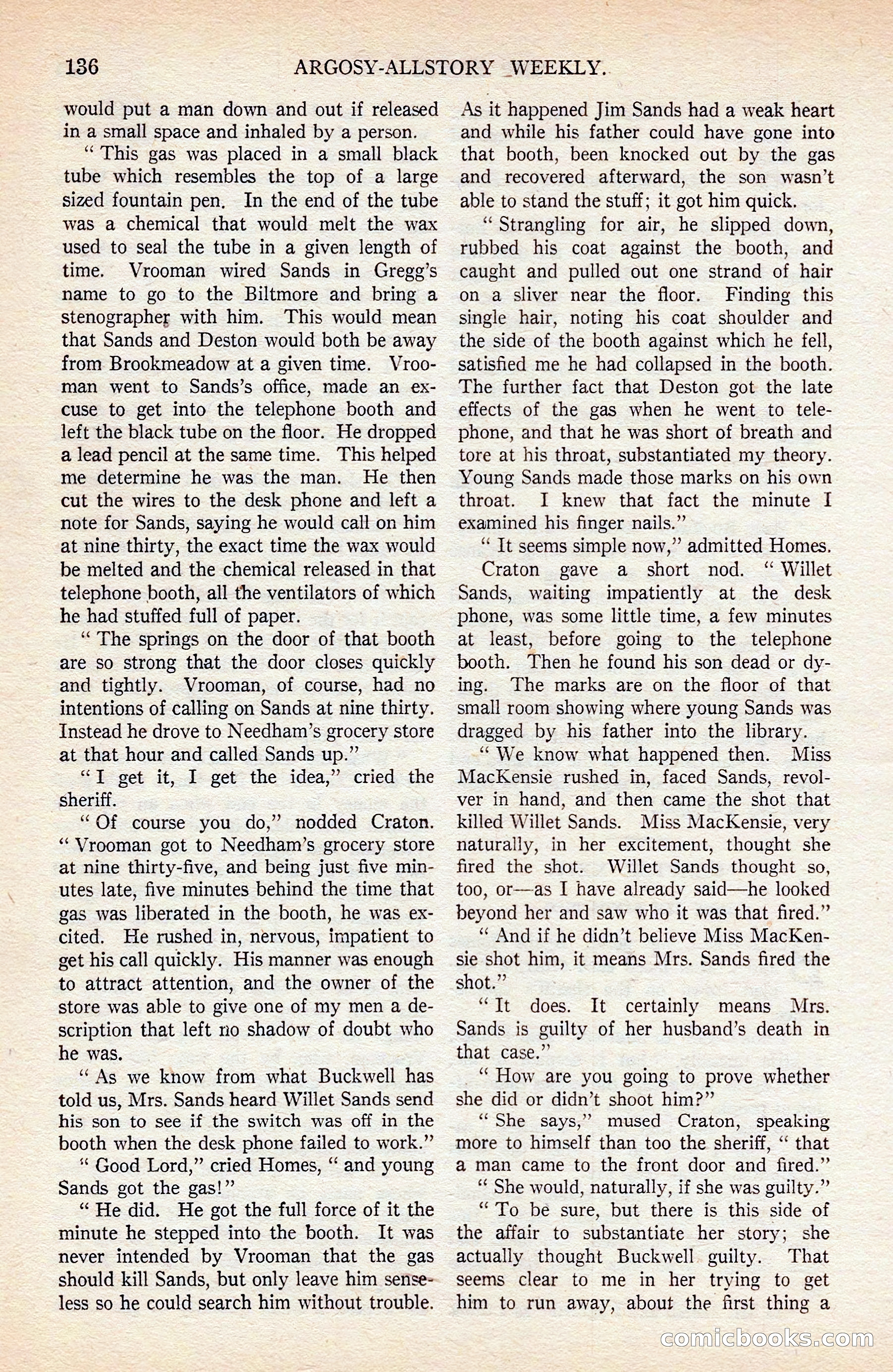
A restored page from Pulp Fiction, 1923. Page through the whole issue in the reader above.
📄 Transcribed text from this page (OCR, searchable)
Machine-transcribed from the original scan — historical spelling and the odd misread are preserved.
136 would put a man down and out if released in a small space and inhaled by a person. ‘This gas was placed in a small black tube which resembles the top of a large sized fountain pen. In the end of the tube was a chemical that would melt the wax used to seal the tube in a given length of time. Vrooman wired Sands in Gregg’s name to go to the Biltmore and bring a stenographer with him. This would mean that Sands and Deston would both be away from Brookmeadow at a given time. Vroo- man went to Sands’s office, made an ex- cuse to get into the telephone booth and left the black tube on the floor. He dropped a lead pencil at the same time. This helped me determine he was the man. He then cut the wires to the desk phone and left a note for Sands, saying he would call on him at nine thirty, the exact time the wax would be melted and the chemical released in that telephone booth, all the ventilators of which he had stuffed full of paper. “The springs on the door of that booth are so strong that the door closes quickly and tightly. Vrooman, of course, had no intentions of calling on Sands at nine thirty. Instead he drove to Needham’s grocery store at that hour and called Sands up.” “JT get it, I get the idea,” cried the sheriff. “Of course you do,” nodded Craton. ‘‘Vrooman got to Needham’s grocery store at nine thirty-five, and being just five min- utes late, five minutes behind the time that gas was liberated in the booth, he was ex- cited. He rushed in, nervous, impatient to get his call quickly. His manner was enough to attract attention, and the owner of the store was able to give one of my men a de- scription that left no shadow of doubt who he was. ‘“ As we know from what Buckwell has told us, Mrs. Sands heard Willet Sands send his son to see if the switch was off in the booth when the desk phone failed to work.” “ Good Lord,” cried Homes, “ and young Sands got the gas!” “ He did. He got the full force of it the minute he stepped into the booth. It was never intended by Vrooman that the gas should kill Sands, but only leave him sense- less so he could search him without trouble. ARGOSY-ALLSTORY WEEKLY.. As it happened Jim Sands had a weak heart and while his father could have gone into that booth, been knocked out by the gas and recovered afterward, the son wasn’t able to stand the stuff; it got him quick. ‘““Strangling for air, he slipped down, rubbed his coat against the booth, and caught and pulled out one strand of hair on a sliver near the floor. Finding this single hair, noting his coat shoulder and the side of the booth against which he fell, satisfied me he had collapsed in the booth. The further fact that Deston got the late effects of the gas when he went to tele- phone, and that he was short of breath and tore at his throat, substantiated my theory. Young Sands made those marks on his own throat. I knew that fact the minute I examined his finger nails.” “It seems simple now,” admitted Homes. Craton gave a short nod. ‘“ Willet Sands, waiting impatiently at the desk phone, was some little time, a few minutes at least, before going to the telephone booth. Then he found his son dead or dy- ing. The marks are on the floor of that small room showing where young Sands was dragged by his father into the library. ‘‘'We know what happened then. Miss MacKensie rushed in, faced Sands, revol- ver in hand, and then came the shot that killed Willet Sands. Miss MacKensie, very naturally, in her excitement, thought she fired the shot. Willet Sands thought so, too, or—as I have already said—he looked beyond her and saw who it was that fired.” ‘“* And if he didn’t believe Miss MacKen- sie shot him, it means Mrs. Sands fired the shot.” “Tt does. It certainly means Mrs. Sands is guilty of her husband’s death in that case.” _“ How are you going to prove whether she did or didn’t shoot him?” “She says,’ mused Craton, speaking more to himself than too the sheriff, ‘‘ that a man came to the front door and fired.” ** She would, naturally, if she was guilty.” “To be sure, but there is this side of the affair to substantiate her story; she actually thought Buckwell guilty. That seems clear to me in her trying to get him to run away, about the first thing a CoOmnicooolkkSse©