
Pulp Fiction, 1923 · page 23 of 176
Argosy All-Story Weekly — page 23: what you’re looking at
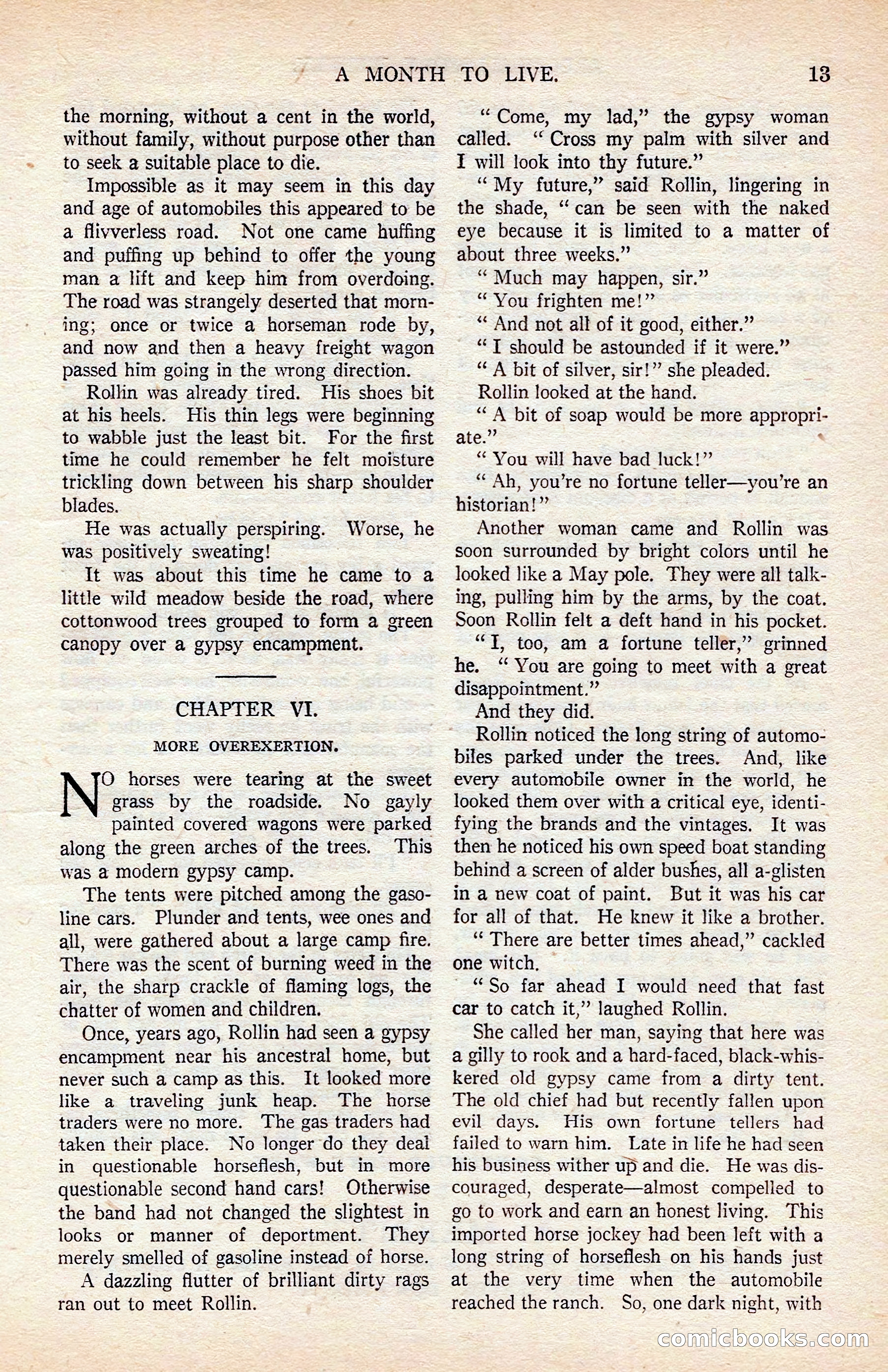
A restored page from Pulp Fiction, 1923. Page through the whole issue in the reader above.
📄 Transcribed text from this page (OCR, searchable)
Machine-transcribed from the original scan — historical spelling and the odd misread are preserved.
A MONTH the morning, without a cent in the world, without family, without purpose other than to seek a suitable place to die. Impossible as it may seem in this day and age of automobiles this appeared to be a flivverless road. Not one came huffing and puffing up behind to offer the young man a lift and keep him from overdoing. The road was strangely deserted that morn- ing; once or twice a horseman rode by, and now and then a heavy freight wagon passed him going in the wrong direction. Rollin was already tired. His shoes bit at his heels. His thin legs were beginning to wabble just the least bit. For the first time he could remember he felt moisture trickling down between his sharp shoulder blades. He was actually perspiring. Worse, he was positively sweating! It was about this time he came to a little wild meadow beside the road, where cottonwood trees grouped to form a green canopy over a gypsy encampment. CHAPTER VI. MORE OVEREXERTION. ‘O horses were tearing at the sweet NI grass by the roadside. No gayly painted covered wagons were parked along the green arches of the trees. This was a modern gypsy camp. The tents were pitched among the gaso- line cars. Plunder and tents, wee ones and all, were gathered about a large camp fire. There was the scent of burning weed in the air, the sharp crackle of flaming logs, the chatter of women and children. Once, years ago, Rollin had seen a gypsy encampment near his ancestral home, but never such a camp as this. It looked more like a traveling junk heap. The horse traders were no more. The gas traders had taken their place. No longer do they deai in questionable horseflesh, but in more questionable second hand cars! Otherwise the band had not changed the slightest in looks or manner of deportment. They merely smelled of gasoline instead of horse. A dazzling flutter of brilliant dirty rags ran out to meet Rollin. TO LIVE, 13 “Come, my lad,” the gypsy woman called. “‘ Cross my palm with silver and I will look into thy future.” “My future,” said Rollin, lingering in the shade, ‘‘can be seen with the naked eye because it is limited to a matter of about three weeks.” “Much may happen, sir.” “You frighten me!” “And not all of it good, either.” ““T should be astounded if it were.” ‘* A bit of silver, sir!” she pleaded. Rollin looked at the hand. ‘“‘ A bit of soap would be more appropri- ate.” : * You will have bad luck!” ‘“‘ Ah, you’re no fortune teller—you’re an historian!” Another woman came and Rollin was soon surrounded by bright colors until he looked like a May pole. They were all talk- Ing, pulling him by the arms, by the coat. Soon Rollin felt a deft hand in his pocket. ‘““T, too, am a fortune teller,” grinned he. “ You are going to meet with a great disappointment.” And they did. Rollin noticed the long string of automo- biles parked under the trees. And, like every automobile owner in the world, he looked them over with a critical eye, identi- fying the brands and the vintages. It was then he noticed his own speed boat standing behind a screen of alder bushes, all a-glisten in a new coat of paint. But it was his car for all of that. He knew it like a brother. ‘* There are better times ahead,” cackled one witch, | “So far ahead I would need that fast car to catch it,” laughed Rollin. She called her man, saying that here was a gilly to rook and a hard-faced, black-whis- kered old gypsy came from a dirty tent. The old chief had but recently fallen upon evil days. His own fortune tellers had failed to warn him. Late in life he had seen his business wither up and die. He was dis- couraged, desperate—almost compelled to go to work and earn an honest living. This imported horse jockey had been left with a long string of horseflesh on his hands just at the very time when the automobile reached the ranch. So, one dark night, with CopmmiclookSse@