
Pulp Fiction, 1923 · page 39 of 176
Argosy All-Story Weekly — page 39: what you’re looking at
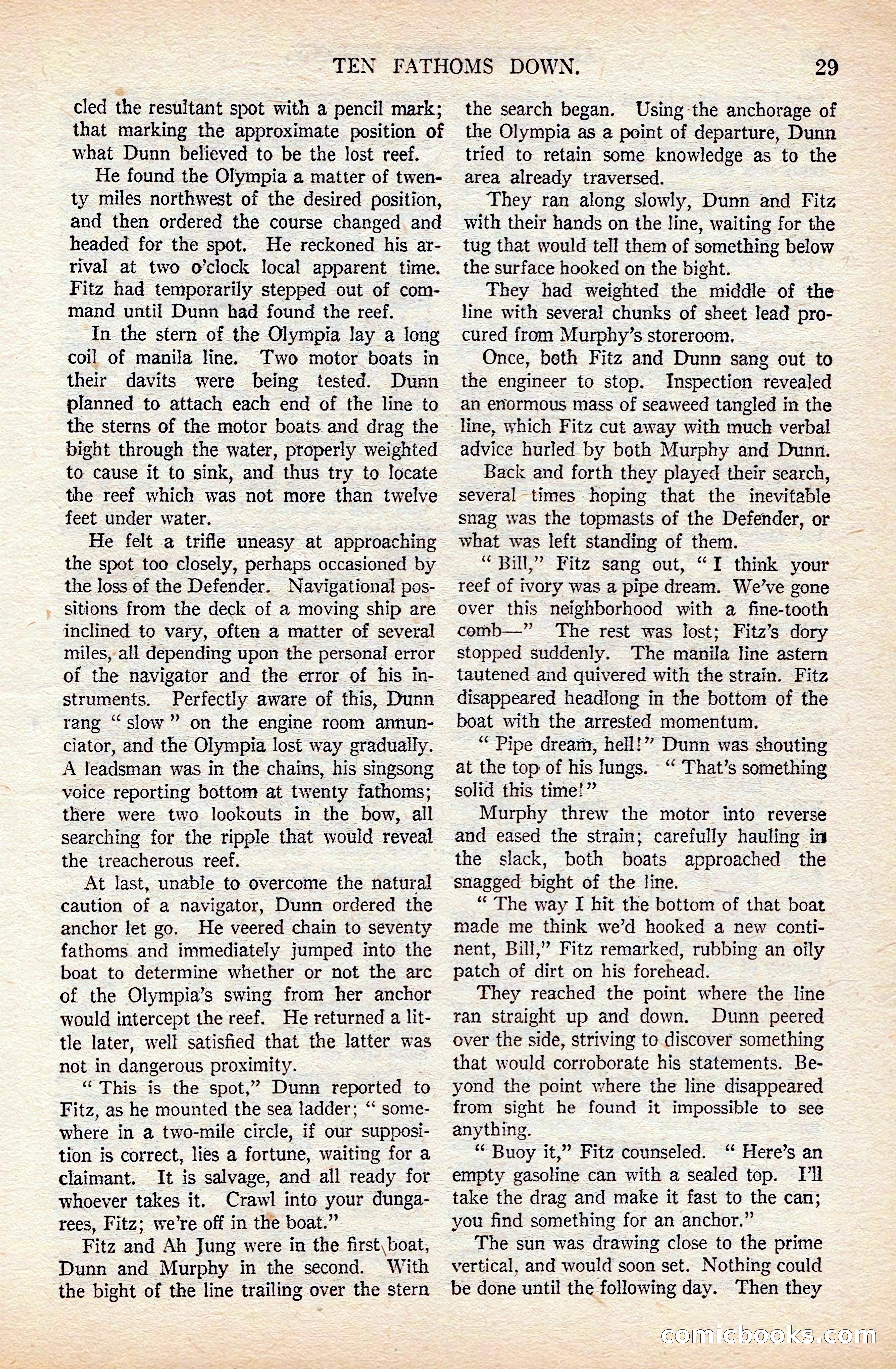
A restored page from Pulp Fiction, 1923. Page through the whole issue in the reader above.
📄 Transcribed text from this page (OCR, searchable)
Machine-transcribed from the original scan — historical spelling and the odd misread are preserved.
TEN FATHOMS DOWN. cled the resultant spot with a pencil mark; that marking the approximate position of what Dunn believed to be the lost reef. He found the Olympia a matter of twen- ty miles northwest of the desired position, and then ordered the course changed and headed for the spot. He reckoned his ar- rival at two o'clock local apparent time. Fitz had temporarily stepped out of com- mand until Dunn had found the reef. In the stern of the Olympia Jay a long coil of manila line. Two motor boats in their davits were being tested. Dunn planned to attach each end of the line to the sterns of the motor boats and drag the bight through the water, properly weighted to cause it to sink, and thus try to locate the reef which was not more than twelve feet under water. He felt a trifle uneasy at approaching the spot too closely, perhaps occasioned by the loss of the Defender. Navigational pos- sitions from the deck of a moving ship are inclined to vary, often a matter of several miles, all depending upon the personal error of the navigator and the error of his in- struments. Perfectly aware of this, Dunn rang “slow” on the engine room annun- ciator, and the Olympia lost way gradually. A leadsman was in the chains, his singsong voice reporting bottom at twenty fathoms; there were two lookouts in the bow, all searching for the ripple that would reveal the treacherous reef. At last, unable to overcome the natural caution of a navigator, Dunn ordered the anchor let go. He veered chain to seventy fathoms and immediately jumped into the boat to determine whether or not the arc of the Olympia’s swing from her anchor would intercept the reef. He returned a lit- tle later, well satisfied that the latter was not in dangerous proximity. “ This is the spot,” Dunn reported to Fitz, as he mounted the sea ladder; “ some- where in a two-mile circle, if our supposi- tion is correct, lies a fortune, waiting for a claimant. It is salvage, and all ready for whoever takes it. Crawl into your dunga- rees, Fitz; we’re off in the boat.” — Fitz and Ah Jung were in the first, boat, Dunn and Murphy in the second. With the bight of the line trailing over the stern 29 the search began. Using-the anchorage of the Olympia as a point of departure, Dunn tried to retain some knowledge as to the area already traversed. They ran along slowly, Dunn and Fitz with their hands on the line, waiting for the tug that would tell them of something below the surface hooked on the bight. They had weighted the middle of the line with several chunks of sheet lead pro- cured from Murphy’s storeroom. Once, beth Fitz and Dunn sang out to the engineer to stop. Inspection revealed an eriormous mass of seaweed tangled in the line, which Fitz cut away with much verbal advice hurled by both Murphy and Dunn. Back and forth they played their search, several times hoping that the inevitable snag was the topmasts of the Defender, or what was left standing of them. “ Bill,” Fitz sang out, “I think your reef of ivory was a pipe dream. We’ve gone over this neighborhood with a fine-tooth comb—” The rest was lost; Fitz’s dory stopped suddenly. The manila line astern tautened and quivered with the strain. Fitz disappeared headlong in the bottom of the boat with the arrested momentum. ‘Pipe dream, hell!” Dunn was shouting at the top of his lungs. - “ That’s something solid this time!” Murphy threw the motor into reverse and eased the strain; carefully hauling in the slack, both boats approached the snagged bight of the line. “ The way I hit the bottom of that boat made me think we’d hooked a new conti- nent, Bill,” Fitz remarked, rubbing an oily patch of dirt on his forehead. They reached the point where the line ran straight up and down. Dunn peered over the side, striving to discover something that would corroborate his statements. Be- yond the point where the line disappeared from sight he found it impossible to see anything. ““ Buoy it,” Fitz counseled. “ Here’s an empty gasoline can with a sealed top. [’ll take the drag and make it fast to the can; you find something for an anchor.” The sun was drawing close to the prime vertical, and would soon set. Nothing could be done until the following day. Then they MIC OOOKS (E@) (S@) A