
Pulp Fiction, 1923 · page 41 of 176
Argosy All-Story Weekly — page 41: what you’re looking at
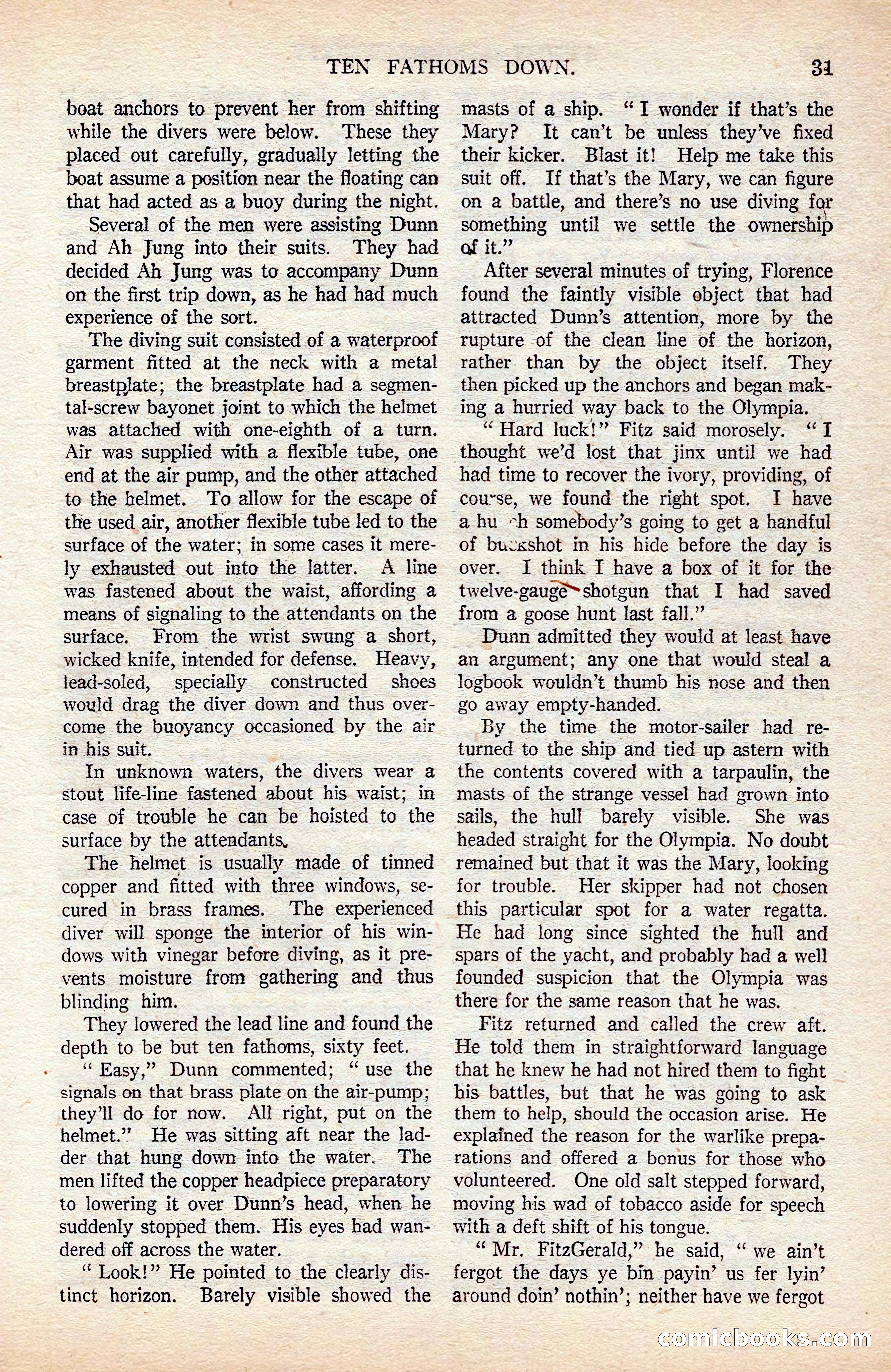
A restored page from Pulp Fiction, 1923. Page through the whole issue in the reader above.
📄 Transcribed text from this page (OCR, searchable)
Machine-transcribed from the original scan — historical spelling and the odd misread are preserved.
TEN FATHOMS DOWN. 34 boat anchors to prevent her from shifting while the divers were below. These they placed out carefully, gradually letting the boat assume a position near the floating can that had acted as a buoy during the night. Several of the men were assisting Dunn and Ah Jung into their suits. They had decided Ah Jung was to accompany Dunn on the first trip down, as he had had much experience of the sort. The diving suit consisted of a waterproof garment fitted at the neck with a metal breastplate; the breastplate had a segmen- tal-screw bayonet joint to which the helmet was attached with one-eighth of a turn. Air was supplied with a flexible tube, one end at the air pump, and the other attached to the helmet. To allow for the escape of the used air, another flexible tube led to the surface of the water; in some cases it mere- ly exhausted out into the latter. A line was fastened about the waist, affording a means of signaling to the attendants on the surface. From the wrist swung a short, wicked knife, intended for defense. Heavy, lead-soled, specially constructed shoes would drag the diver down and thus over- come the buoyancy occasioned by the air in his suit. In unknown waters, the divers wear a stout life-line fastened about his waist; in case of trouble he can be hoisted to the surface by the attendants, The helmet is usually made of tinned copper and fitted with three windows, se- cured in brass frames. The experienced diver will sponge the interior of his win- dows with vinegar before diving, as it pre- vents moisture from gathering and thus blinding him. They lowered the lead line and found the depth to be but ten fathoms, sixty feet. ‘“ Easy,” Dunn commented; “use the signals on that brass plate on the air-pump; they’ll do for now. All right, put on the helmet.”” He was sitting aft near the lad- der that hung down into the water. The men lifted the copper headpiece preparatory to lowering it over Dunn’s head, when he suddenly stopped them. His eyes had wan- dered off across the water. ‘“ Look!” He pointed to the clearly dis- tinct horizon. Barely visible showed the masts of a ship. “I wonder if that’s the Mary? It can’t be unless they’ve fixed their kicker. Blast it! Help me take this suit off. If that’s the Mary, we can figure on 2 battle, and there’s no use diving for something until we settle the ownership af it.” : After several minutes of trying, Florence found the faintly visible object that had attracted Dunn’s attention, more by the rupture of the clean line of the horizon, rather. than by the object itself. They then picked up the anchors and began mak- ing a hurried way back to the Olympia. “Hard luck!” Fitz said morosely. “I thought we’d lost that jinx until we had had time to recover the ivory, providing, of course, we found the right spot. I have a hu ch somebody’s going to get a handful of busxshot in his hide before the day is over. I think I have a box of it for the twelve-gaugé~shoteun that I had saved from a goose hunt last fall.” Dunn admitted they would at least have an argument; any one that would steal a logbook wouldn’t thumb his nose and then go away empty-handed. By the time the motor-sailer had _ re- turned to the ship and tied up astern with the contents covered with a tarpaulin, the masts of the strange vessel had grown into sails, the hull barely visible. She was headed straight for the Olympia. No doubt remained but that it was the Mary, looking for trouble. Her skipper had not chosen this particular spot for a water regatta. He had long since sighted the hull and spars of the yacht, and probably had a well founded suspicion that the Olympia was there for the same reason that he was. Fitz returned and called the crew aft. He told them in straightforward language that he knew he had not hired them to fight his battles, but that he was going to ask them to help, should the occasion arise. He explained the reason for the warlike prepa- rations and offered a bonus for those who volunteered. One old salt stepped forward, moving his wad of tobacco aside for speech with a deft shift of his tongue. ‘Mr. FitzGerald,” he said, “ we ain’t fergot the days ye bin payin’ us fer lyin’ around doin’ nothin’; neither have we fergot CORMIC OOO KS sCO)