
Pulp Fiction, 1923 · page 45 of 176
Argosy All-Story Weekly — page 45: what you’re looking at
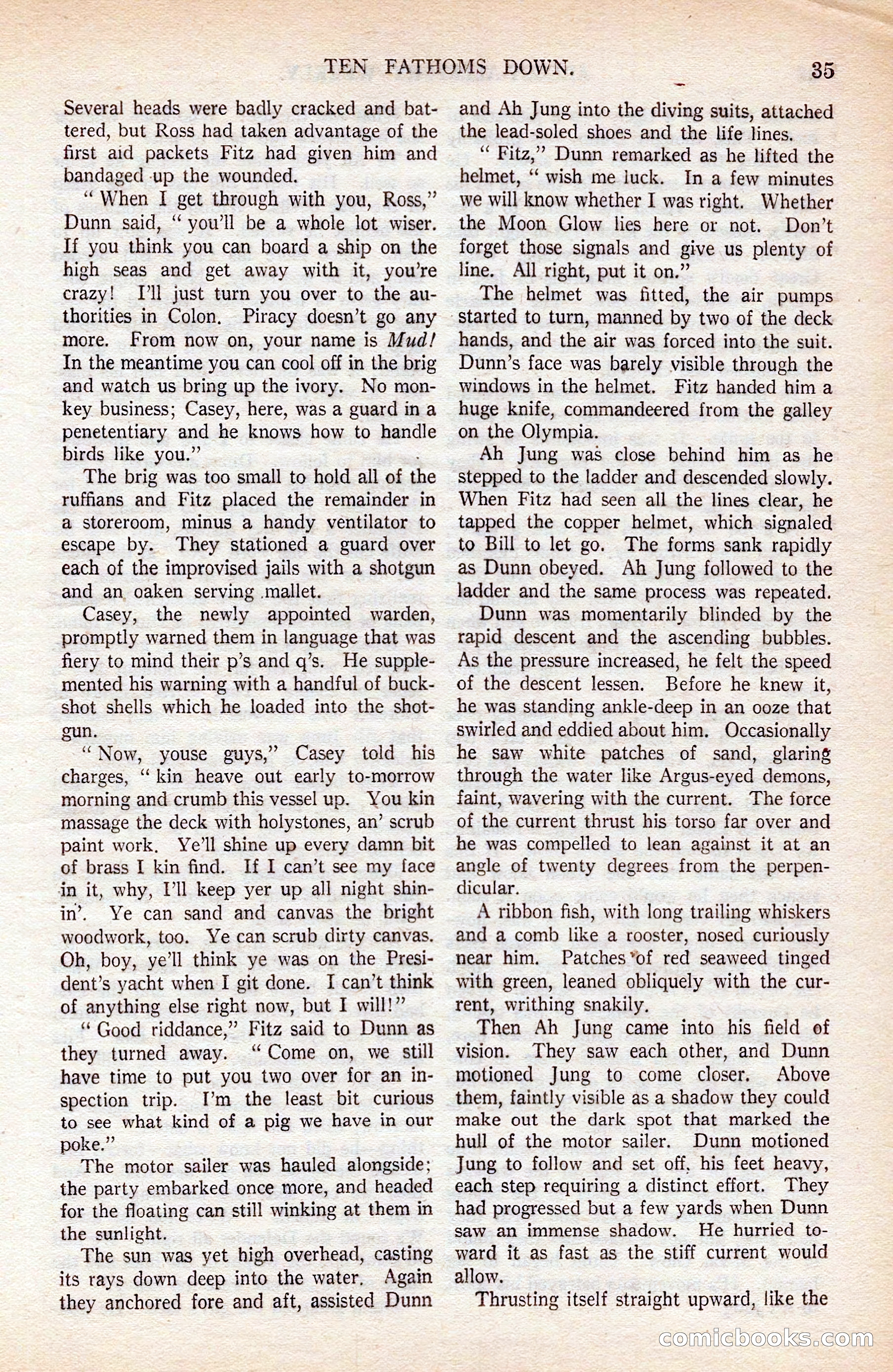
A restored page from Pulp Fiction, 1923. Page through the whole issue in the reader above.
📄 Transcribed text from this page (OCR, searchable)
Machine-transcribed from the original scan — historical spelling and the odd misread are preserved.
TEN FATHOMS DOWN. Several heads were badly cracked and bat- tered, but Ross had taken advantage of the first aid packets Fitz had given him and bandaged -up the wounded. “When I get through with you, Ross,” Dunn said, “ you’ll be a whole lot wiser. If you think you can board a ship on the high seas and get away with it, you're crazy! Il just turn you over to the au- thorities in Colon. Piracy doesn’t go any more. From now on, your name is Mud/ In the meantime you can cool off in the brig and watch us bring up the ivory. No mon- key business; Casey, here, was a guard in a penetentiary and he knows how to handle birds like you.” The brig was too small to hold all of the ruffians and Fitz placed the remainder in a storeroom, minus a handy ventilator to escape by. They stationed a guard over each of the improvised jails with a shotgun and an oaken serving .mallet. Casey, the newly appointed warden, promptly warned them in language that was fiery to mind their p’s and q’s. He supple- mented his warning with a handful of buck- shot shells which he loaded into the shot- gun. “Now, youse guys,” Casey told his charges, “kin heave out early to-morrow morning and crumb this vessel up. You kin massage the deck with holystones, an’ scrub paint work. Ye’ll shine up every damn bit of brass I kin find. If I can’t see my face in it, why, I'll keep yer up all night shin- in’. Ye can sand and canvas the bright woodwork, too. Ye can scrub dirty canvas. Oh, boy, ye’ll think ye was on the Presi- dent’s yacht when I git done. I can’t think of anything else right now, but I will!” “Good riddance,” Fitz said to Dunn as they turned away. “Come on, we still have time to put you two over for an in- spection trip. I’m the least bit curious to see what kind of a pig we have in our poke.” The motor sailer was hauled alongside; the party embarked once more, and headed for the floating can still winking at them in the sunlight. The sun was yet high overhead, casting its rays down deep into the water. Again they anchored fore and aft, assisted Dunn ¢ 35 and Ah Jung into the diving suits, attached the lead-soled shoes and the life lines, ‘“ Fitz,” Dunn remarked as he lifted the helmet, “ wish me luck. In a few minutes we will know whether I was right. Whether the Moon Glow lies here or not. Don’t forget those signals and give us plenty of line. All right, put it on.” The helmet was fitted, the air pumps Started to turn, manned by two of the deck hands, and the air was forced into the suit. Dunn’s face was barely visible through the windows in the helmet. Fitz handed him a huge knife, commandeered from the galley on the Olympia. Ah Jung was close behind him as he stepped to the ladder and descended slowly. When Fitz had seen all the lines clear, he tapped the copper helmet, which signaled to Bill to let go. The forms sank rapidly as Dunn obeyed. Ah Jung followed to the ladder and the same process was repeated. Dunn was momentarily blinded by the rapid descent and the ascending bubbles. As the pressure increased, he felt the speed of the descent lessen. Before he knew it, he was standing ankle-deep in an ooze that swirled and eddied about him. Occasionally he saw white patches of sand, glaring through the water like Argus-eyed demons, faint, wavering with the current. The force of the current thrust his torso far over and he was compelled to lean against it at an angle of twenty degrees from the perpen- dicular. A ribbon fish, with long trailing whiskers and a comb like a rooster, nosed curiously near him. Patches*of red seaweed tinged with green, leaned obliquely with the cur- rent, writhing snakily, Then Ah Jung came into his field of vision. They saw each other, and Dunn motioned Jung to come closer. Above them, faintly visible as a shadow they could make out the dark spot that marked the hull of the motor sailer. Dunn motioned Jung to follow and set off, his feet heavy, each step requiring a distinct effort. They had progressed but a few yards when Dunn saw an immense shadow. He hurried to- ward it as fast as the stiff current would allow. Thrusting itself straight upward, like the ComicoOoolks (C@