
Pulp Fiction, 1923 · page 51 of 176
Argosy All-Story Weekly — page 51: what you’re looking at
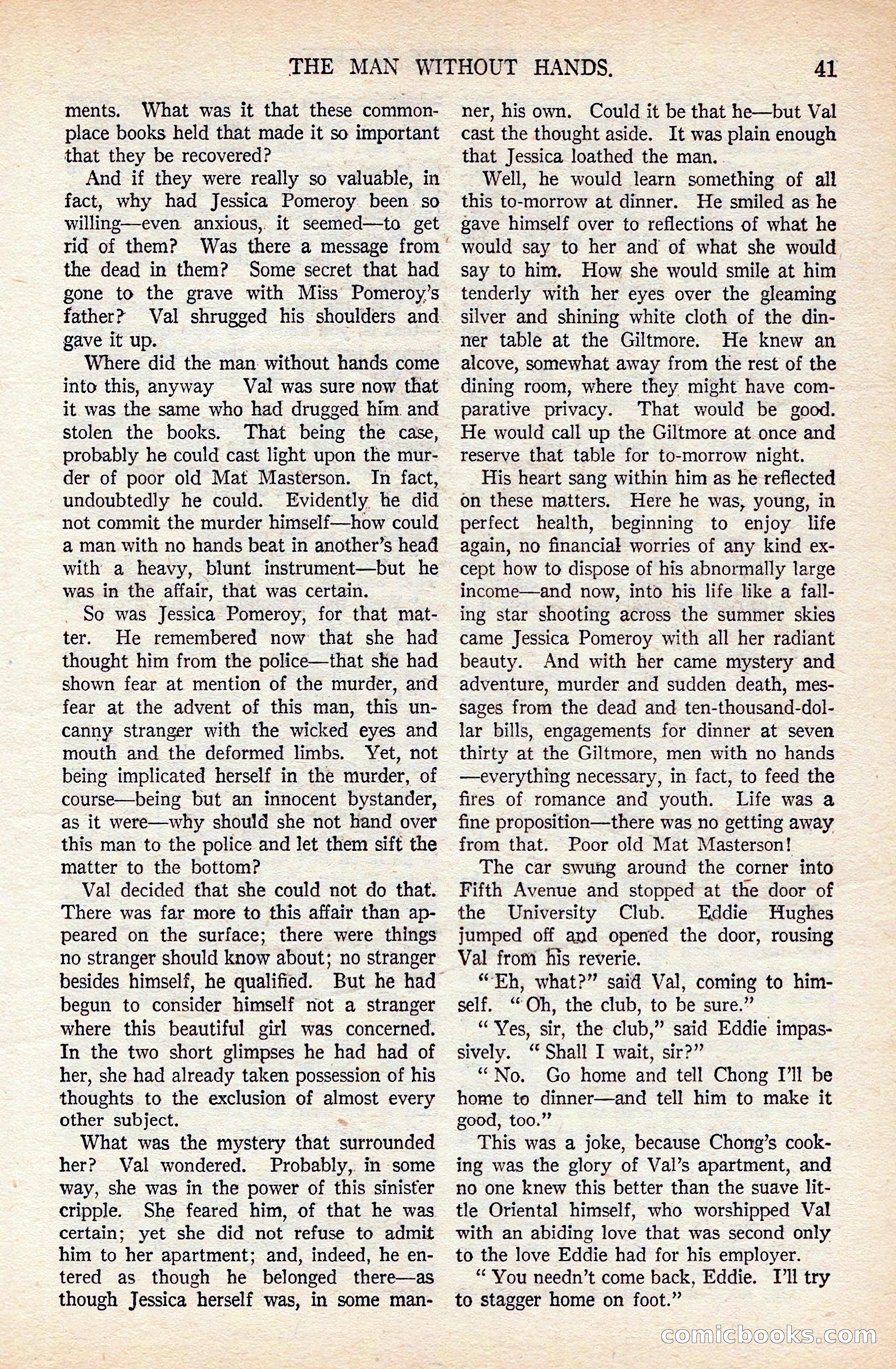
A restored page from Pulp Fiction, 1923. Page through the whole issue in the reader above.
📄 Transcribed text from this page (OCR, searchable)
Machine-transcribed from the original scan — historical spelling and the odd misread are preserved.
THE MAN WITHOUT HANDS. ments. What was it that these common- place books held that made it so important that they be recovered? And if they were really so valuable, in fact, why had Jessica Pomeroy been. so willing—even anxious,. it seemed—to get rid of them? the dead in them? Some secret that had gone to the grave with Miss Pomeroy’s father? Val shrugged his shoulders and gave it up. Where did the man without hands come into this, anyway Val was sure now that it was the same who had drugged him. and stolen the books. That being the case, probably he could cast light upon the mur- der of poor old Mat Masterson. In fact, undoubtedly he could. Evidently he did not commit the murder himself—how could a man with no hands beat in another’s head with a heavy, blunt instrument—but he was in the affair, that was certain. _ So was Jessica Pomeroy, for that mat- ter. He remembered now that she had thought him from the police—that she had shown fear at mention of the murder, and fear at the advent of this man, this un- canny stranger with the wicked eyes and mouth and the deformed limbs. Yet, not being implicated herself in the murder, of course—being but an innocent bystander, as it were—why should she not hand over this man to the police and let them sift the matter to the bottom? Val decided that she could not do that. There was far more to this affair than ap- peared on the surface; there were things no stranger should know about; no stranger besides himself, he qualified. But he had begun to consider himself not a stranger where this beautiful girl was concerned. In the two short glimpses he had had of her, she had already taken possession of his thoughts to the exclusion of almost every other subject. What was the mystery that sreunded her? Val wondered. Probably, in some way, she was in the power of this sinister cripple. She feared him, of that he was certain; yet she did not refuse to admit him to her apartment; and, indeed, he en- tered as though he belonged there—as though Jessica herself was, in some man- Was there a message from Al ner, his own. Could it be that he—but Val cast the thought aside. It was plain enough that Jessica loathed the man. . Well, he would learn something of all this to-morrow at dinner. He smiled as he gave himself over to reflections of what he would say to her and of what she would say to him. How she would smile at him tenderly with her eyes over the gleaming silver and shining white cloth of the din- ner table at the Giltmore. He knew an alcove, somewhat away from the rest of the dining room, where they might have com- parative privacy. That would be good. He would call up the Giltmore at. once and reserve that table for to-morrow night. His heart sang within him as he reflected on these matters. Here he was, young, in perfect health, beginning to enjoy life again, no financial worries of any kind ex- cept how to dispose of his abnormally large income—and now, into his life like a fall- ing star shooting across the summer skies came Jessica Pomeroy with all her radiant beauty. And with her came mystery and adventure, murder and sudden death, mes- sages from the dead and ten-thousand-dol- lar bills, engagements for dinner at seven thirty at the Giltmore, men with no hands —everything necessary, in fact, to feed the fires of romance and youth. Life was a fine proposition—there was no getting away from that. Poor old Mat Masterson! The car swung around the corner into Fifth Avenue and stopped at the door of the University Club. Eddie Hughes jumped off and opened the door, rousing Val frora his reverie. “Eh, what?” said Val, coming to him- self. “Oh, the club, to be sure.” — “Yes, sir, the club,” said Eddie impas- sively. ‘ Shall I wait, sir?” “No. Go home and tell Chong I'll be home to dinner—and tell him to make it good, too.” This was a joke, because Chong’s cook- ing was the glory of Val’s apartment, and no one knew this better than the suave lit- tle Oriental himself, who worshipped Val with an abiding love that was second only to the love Eddie had for his employer. “You needn’t come back, Eddie. ll try to stagger home on foot.” EGoOmicswooksaco