
Pulp Fiction, 1923 · page 73 of 176
Argosy All-Story Weekly — page 73: what you’re looking at
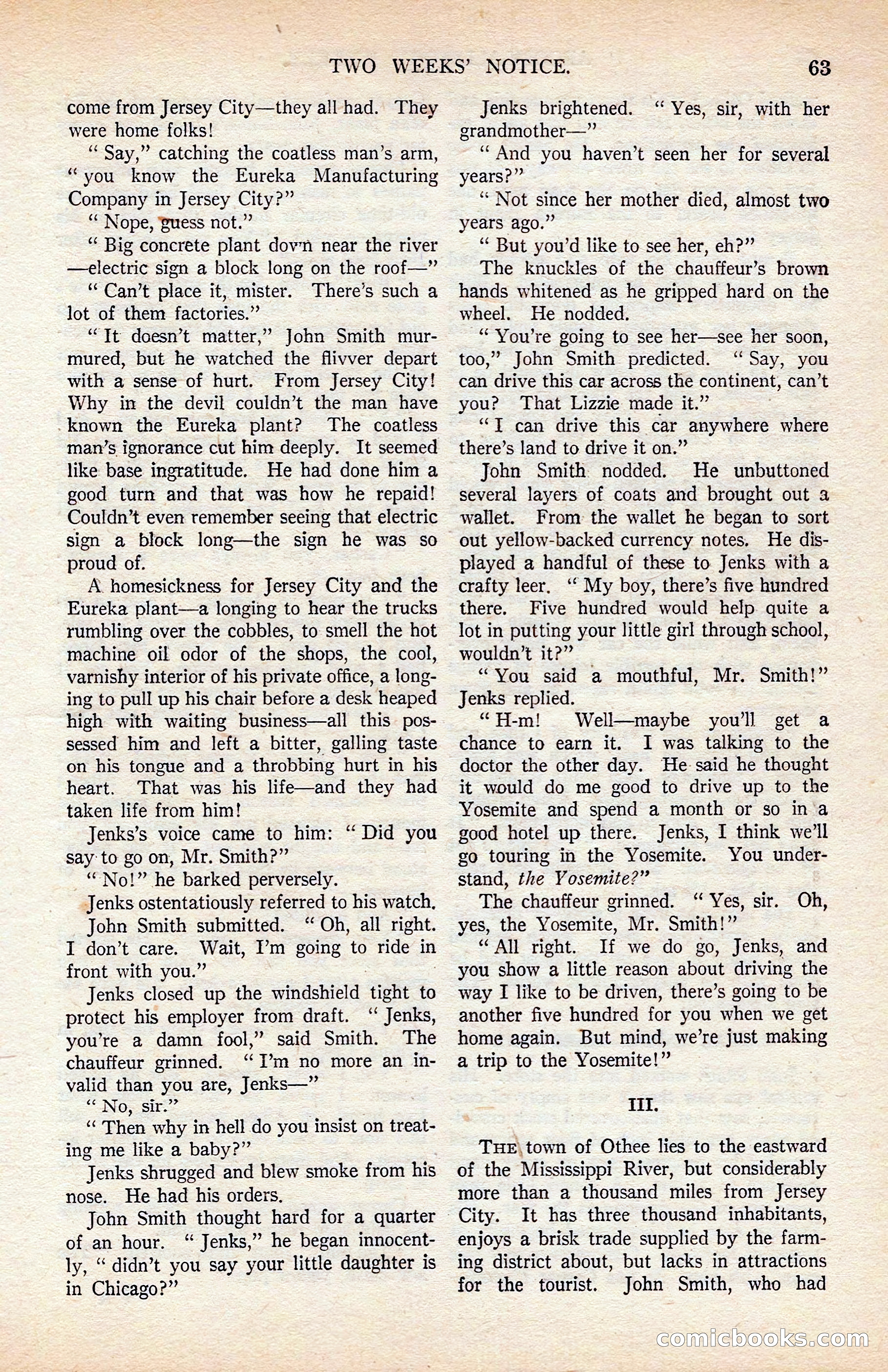
A restored page from Pulp Fiction, 1923. Page through the whole issue in the reader above.
📄 Transcribed text from this page (OCR, searchable)
Machine-transcribed from the original scan — historical spelling and the odd misread are preserved.
TWO WEEKS’ come from Jersey City—they all had. They were home folks! “Say,” catching the coatless man’s arm, “you know the Eureka Manufacturing Company in Jersey City?” ““ Nope, @uess not.” ‘“* Big concrete plant dovn near the river —electric sign a block long on the roof—”’ ‘’ Can’t place it, mister. There’s such a lot of them factories.” ‘It doesn’t matter,” John Smith mur- mured, but he watched the flivver depart with a sense of hurt. From Jersey City! Why in the devil couldn’t the man have -known the Eureka plant? The coatless man’s ignorance cut him deeply. It seemed like base ingratitude. He had done him a good turn and that was how he repaid! Couldn’t even remember seeing that electric sien a block long—the sign he was so proud of. A. homesickness for Jersey City and the Eureka plant—a longing to hear the trucks rumbling over the cobbles, to smell the hot machine oil odor of the shops, the cool, varnishy interior of his private office, a long- ing to pull up his chair before a desk heaped high with waiting business—all this pos- sessed him and left a bitter, galling taste on his tongue and a throbbing hurt in his heart. That was his life—and they had taken life from him! Jenks’s voice came to him: say to go on, Mr. Smith?” “No!” he barked perversely. Jenks ostentatiously referred to his watch, John Smith submitted. ‘Oh, all right. I don’t care. wee I’m going to ride in front with you.” Jenks closed up the windshield tight to protect his employer from draft. “ Jenks, you’re 2 damn fool,” said Smith. The chauffeur grinned. “I’m no more an in- valid than you are, Jenks—” “No, sir.’ ms Then why in hell do you insist on treat- ing me like a baby?” Jenks shrugged and blew smoke from his nose. He had his orders. John Smith thought hard for a quarter of an hour. “ Jenks,” he began innocent- ly, “ didn’t you say your little daughter is in Chicago?” “Did you PCI NOTICE, 63 Jenks brightened. grandmother—” ‘“And you haven’t seen her for several years?” ‘Not since her mother died, almost two years ago.” ‘“* But you'd like to see her, eh?” The knuckles of the chauffeur’s brown hands whitened as he gripped hard on the wheel. He nodded. “You're going to see her—see her soon, 00,” John Smith predicted. “Say, you can drive this car across the continent, can’t you? That Lizzie made it.” “T can drive this car PEP where there’s land to drive it on.’ John Smith nodded. He unbuttoned several layers of coats and brought out a wallet. From the wallet he began to sort out yellow-backed currency notes. He dis- played a handful of these to Jenks with a crafty leer. ‘‘ My boy, there’s five hundred there. Five hundred would help quite a lot in putting your little girl through school, wouldn’t it?” “You said a mouthful, Mr. Jenks replied. “ H-m! “Yes, sir, with her Smith!” Well—maybe you'll get a chance to earn it. I was talking to the doctor the other day. He said he thought it would do me good to drive up to the Yosemite and spend a month or so in’a good hotel up there. Jenks, I think we'll go touring in the Yosemite. You under- stand, the Yosemite?” The chauffeur grinned. “ Yes, sir. yes, the Yosemite, Mr. Smith!” “All right. If we do go, Jenks, and you show a little reason about driving the way I like to be driven, there’s going to be another five hundred for you when we get home again. But mind, we’re just making a trip to the Yosemite!” Oh, fil. TuE\ town of Othee lies to the eastward of the Mississippi River, but considerably more than a thousand miles from Jersey It has three thousand inhabitants, enjoys a brisk trade supplied by the farm- ing district about, but lacks in attractions for the tourist. John Smith, who had COMmMiclnooOokKs (©)