
Pulp Fiction, 1923 · page 75 of 176
Argosy All-Story Weekly — page 75: what you’re looking at
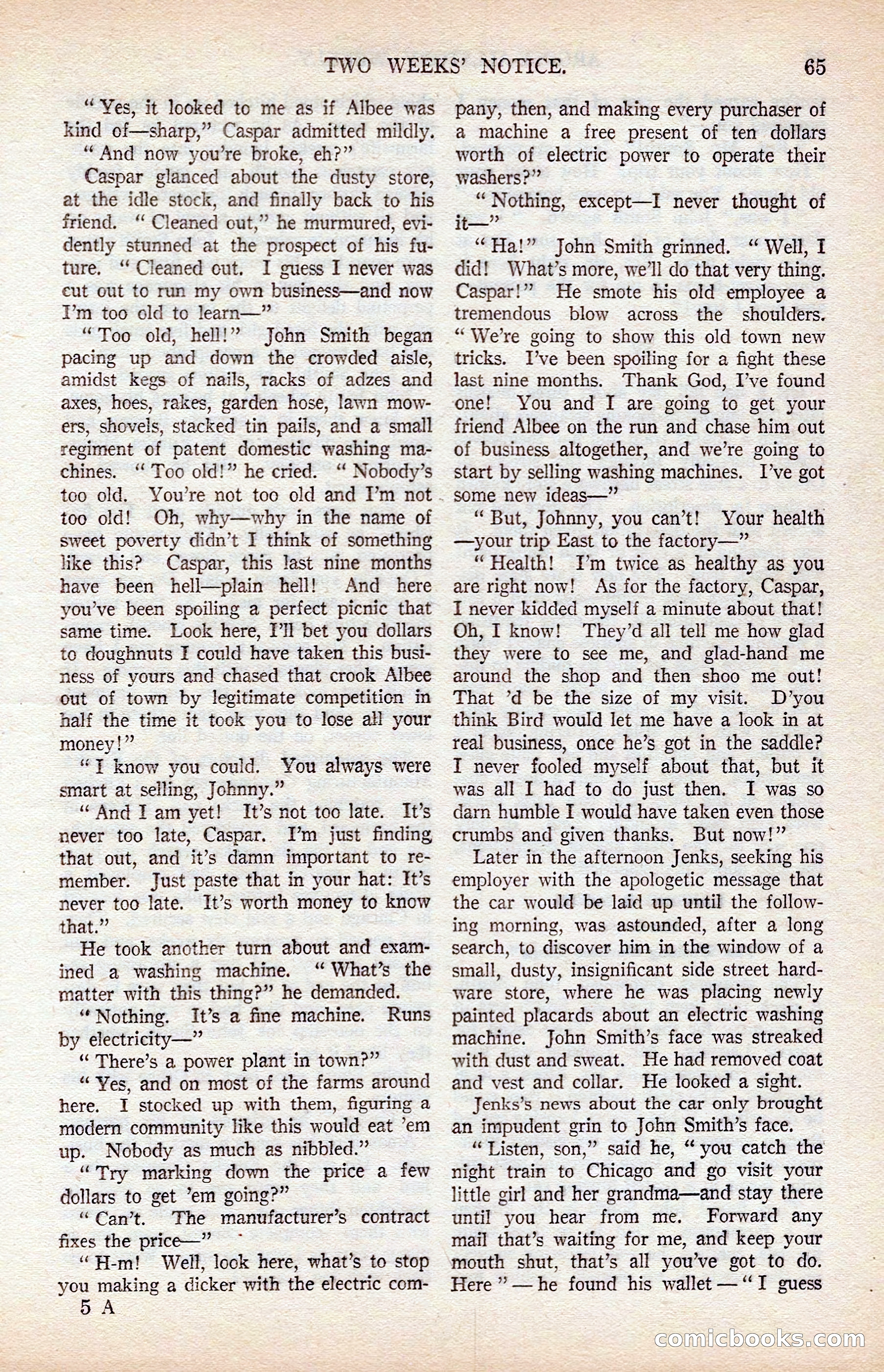
A restored page from Pulp Fiction, 1923. Page through the whole issue in the reader above.
📄 Transcribed text from this page (OCR, searchable)
Machine-transcribed from the original scan — historical spelling and the odd misread are preserved.
TWO WEEKS’ NOTICE. “Yes, it looked to me as if Albee was kind of—sharp,” Caspar admitted mildly. “And now you’re broke, eh?” Caspar glanced about the dusty store, at the idle stock, and finally back to his friend. ‘ Cleaned cut,” he murmured, evi- dently stunned at the prospect of his fu- ture. “‘ Cleaned out. I guess I never was eut out to run my own business—and now V’m too old to learn—” “Too old, hell!” John Smith began pacing up and down the crowded aisle, amidst kegs of nails, racks of adzes and axes, hoes, rakes, garden hose, lawn mow- ers, shovels, stacked tin pails, and a small regiment of patent domestic washing ma- chines. ‘ Too old!” he cried. “ Nobody’s tco old. You’re not too old and I’m not . too old! Oh, why—why in the name of sweet poverty didn’t I think of something like this? Caspar, this last nine months have been hell—plain hell! And here you’ve been spoiling a perfect picnic that same time. Look here, PI bet you dollars to doughnuts F could have taken this busi- ness of yours and chased that crook Albee out of town by legitimate competition m half the time it tock you to lose all your money!” “¥ know you could. You always were smart at selling, Johnny.” “And I am yet! It’s not too late. It’s never too late, Caspar. I’m just finding that out, and it’s damn important to re- member. Just paste that in your hat: It’s never too late. It’s worth money to know that.” He took another turn about and exam- ined a washing machine. “ What’s the matter with this thing?” he demanded. “Nothing. It’s a fine machine. Runs by electricity—” “ There’s a power plant in town?” “Ves, and on most of the farms around here. I stocked up with them, figuring a modern community like this would eat ’em up. Nobody as much as nibbled.” “Try marking down the price a few dollars to get ’em going?” “Can't. The manufacturer’s contract fixes the price—” “H-m! Well, lock here, what’s to stop you making a dicker with the electric com- 5 A 65 pany, then, and making every purchaser of a machine a free present of ten dollars worth of electric power to operate their washers?” “ Nothing, except—I never thought of 1”? “Hla!” John Smith grinned. “ Well, I did! What’s more, we’ll do that very thing. Caspar!” He smote his old employee a tremendous blow across the shoulders. “We're going to show this old town new tricks. I’ve been spoiling for a fight these last nine months. Thank God, I’ve found one! You and I are going to get your friend Albee on the run and chase him out of business altogether, and we’re going to start by selling washing machines. I’ve got some new ideas—” “But, Johnny, you can’t! Your health —your trip East to the factory—” “Health! Pm twice as healthy as you are right now! As for the factory, Caspar, I never kidded myself a minute about that! Oh, I know! They’d all tell me how glad they were to see me, and glad-hand me around the shop and then shoo me out! That ’d be the size of my visit. D’you think Bird would let me have a look in at real business, once he’s got in the saddle? T never fooled myself about that, but it was all I had to do just then. I was so darn humble I would have taken even those crumbs and given thanks. But now!” Later in the afternoon Jenks, seeking his employer with the apologetic message that the car would be laid up until the follow- ing morning, was astounded, after a long search, to discover him in the window of a small, dusty, insignificant side street hard- ware store, where he was placing newly painted placards about an electric washing machine. John Smith’s face was streaked with dust and sweat. He had removed coat and vest and collar. He looked a sight. Jenks’s news about the car only brought an impudent grin to John Smith’s face. ‘Listen, son,” said he, “you catch the night train to Chicago and go visit your little girl and her grandma—and stay there until you hear from me. Forward any mail that’s waiting for me, and keep your mouth shut, that’s all you’ve got to do. Here ” — he found his wallet — ‘I guess O CoOmmcoaooks (c@)