
Pulp Fiction, 1923 · page 82 of 176
Argosy All-Story Weekly — page 82: what you’re looking at
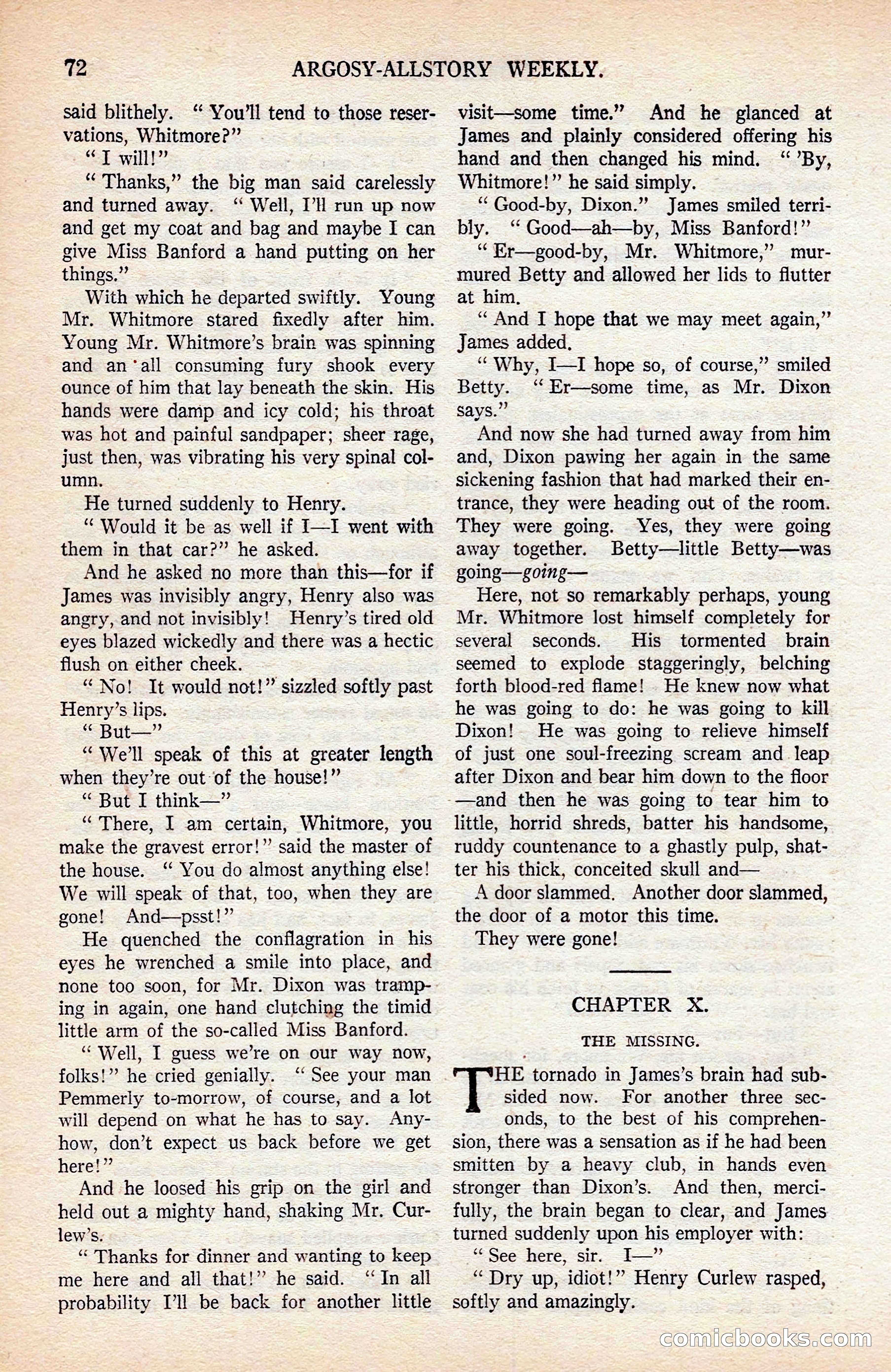
A restored page from Pulp Fiction, 1923. Page through the whole issue in the reader above.
📄 Transcribed text from this page (OCR, searchable)
Machine-transcribed from the original scan — historical spelling and the odd misread are preserved.
72 ARGOSY-ALLSTORY WEEKLY. said blithely. ‘“ You'll tend to those reser- vations, Whitmore?” wen E will!” “Thanks,” the big man said carelessly and turned away. ‘ Well, I’ run up now and get my coat and bag and maybe I can give Miss Banford a hand putting on her things.” With which he departed swiftly. Young Mr. Whitmore stared fixedly after him. Young Mr. Whitmore’s brain was spinning and an‘all consuming fury shook every ounce of him that lay beneath the skin. His hands were damp and icy cold; his throat was hot and painful sandpaper; sheer rage, just then, was vibrating his very spinal col- umn. He turned suddenly to Feary. “Would it be as well if I—I went with them in that car?” he asked. And he asked no more than this—for if James was invisibly angry, Henry also was angry, and not invisibly! Henry’s tired old eyes blazed wickedly and there was a hectic flush on either cheek. “No! It would not!” sizzled softly past Henry’s lips. “ We'll speak of this at greater length when they’re out of the house!” “ But I think—” “There, I am certain, Whitmore, you make the gravest error!” said the master of the house. ‘ You do almost anything else! We will speak of that, too, when they are gone! And—psst!” He quenched the conflagration in his eyes he wrenched a smile into place, and none too soon, for Mr. Dixon was tramp- ing in again, one hand clutching the timid little arm of the so-called Miss Banford. “Well, I guess we’re on our way now, folks!” he cried genially. “See your man Pemmerly to-morrow, of course, and a lot will depend on what he has to say. Any- how, don’t expect us back before we get here!” And he loosed his grip on the girl and held out a mighty hand, shaking Mr. Cur- lew’s. “ Thanks for dinner and wanting to keep me here and all that!” he said. “In all probability T’ll be back for another little visit—some time.’”? And he glanced at James and plainly considered offering his hand and then changed his mind. “ ’By, Whitmore!”’ he said simply. “* Good-by, Dixon.”’ James smiled terri- bly. ‘ Good—ah—by, Miss Banford!” “ Er—good-by, Mr. Whitmore,” mur- mured Betty and allowed her lids to flutter at him. ““ And I hope that we may meet again,” James added, ‘““ Why, I—I hope so, of course,” smiled Betty. ‘‘ Er—some time, as Mr. Dixon Says.” And now she had turned away fort him and, Dixon pawing her again in the same sickening fashion that had marked their en- trance, they were heading out of the room. They were going. Yes, they were going away together. Betty—little Betty—was going—going— Here, not so remarkably perhaps, young Mr. Whitmore lost himself completely for several seconds. His tormented brain seemed to explode staggeringly, belching forth blood-red flame! . He knew now what he was going to do: he was going to kill Dixon! He was going to relieve himself of just one soul-freezing scream and. leap after Dixon and bear him down to the floor -—and then he was going to tear him to little, horrid shreds, batter his handsome, ruddy countenance to a ghastly pulp, shat- ter his thick, conceited skull and— A door slammed. Another door slammed, the door of a motor this time. They were gone! CHAPTER X. THE MISSING. HE tornado in James’s brain had sub- sided now. For another three sec- onds, to the best of his comprehen- sion, there was a sensation as if he had been smitten by a heavy club, in hands even stronger than Dixon’s. And then, merci- fully, the brain began to clear, and James turned suddenly upon his employer with: “See here, sir. I—” “Dry up, idiot!” Henry Curlew rasped, softly and amazingly. COMmMicooolkSse©