
Pulp Fiction, 1923 · page 107 of 196
Argosy All-Story Weekly — page 107: what you’re looking at
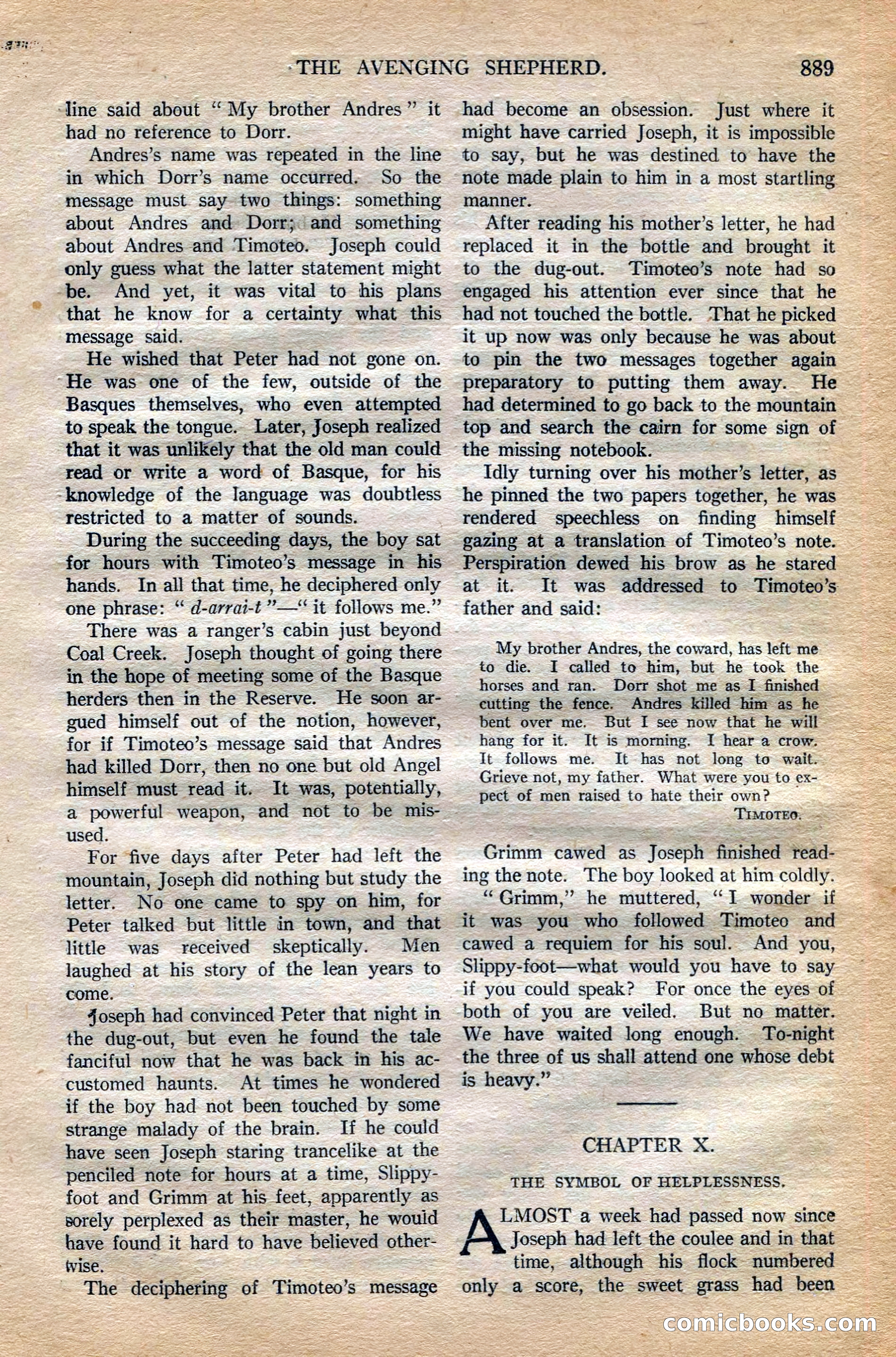
A restored page from Pulp Fiction, 1923. Page through the whole issue in the reader above.
📄 Transcribed text from this page (OCR, searchable)
Machine-transcribed from the original scan — historical spelling and the odd misread are preserved.
~THE AVENGING ‘line said about “ My brother Andres” it had no reference to Dorr. Andres’s name was repeated in the line in which Dorr’s name occurred. So the message must say two things: something about Andres and Dorr;. and something about Andres and Timoteo. Joseph could only guess what the latter statement might -be. And yet, it was vital to his plans that he know for a certainty what this message said. He wished that Peter had not gone on. “He was one of the few, outside of the Basques themselves, who even attempted to speak the tongue. Later, Joseph realized that it was unlikely that the old man could read or write a word of Basque, for his -knowledge of the language was doubtless restricted to a matter of sounds. During the succeeding days, the boy sat for hours with Timoteo’s message in his hands. In all that time, he deciphered only one phrase: “ d-arrai-t ”—“ it follows me.” There was a ranger’s cabin just beyond - Coal Creek. Joseph thought of going there in the hope of meeting some of the Basque herders then in the Reserve. gued himself out of the notion, however, for if Timoteo’s message said that Andres had killed Dorr, then no one but old Angel himself must read it. It was, potentially, a powerful. weapon, and not to be mis- | used. For five days after Peter had left the mountain, Joseph did nothing but study the letter. No one came to spy on him, for Peter talked but little in town, and that little was received skeptically. Men laughed at his story of the lean years to come. — 4oseph had convinced Peter that night in the dug-out, but even he found the tale fanciful now that he was back in his ac- customed haunts. At times he wondered if the boy had not been touched by some strange malady of the brain. If he could have seen Joseph staring trancelike at the penciled note for hours at a time, Slippy- foot and Grimm at his feet, apparently as sorely perplexed as their master, he wouid have sand it hard to have believed other- wise. The deciphering of Timoteo’s message He soon ar- — SHEPHERD. 889 had become an obsession. Just where it might have carried Joseph, it is impossible to say, but he was destined to have the note made plain to him in a most startling — manner. After reading his mother’s letter, he had — replaced it in the bottle and brought it to the dug-out. Timoteo’s note had so engaged his attention ever since that he had not touched the bottle. That he picked it up now was only because he was about to pin the two messages together again preparatory to putting them away. He — had determined to go back to the mountain top and search the cairn for some mee of the missing notebook. Idly turning over his mother’s ete as he pinned the two papers together, he was rendered speechless on finding himself gazing at a translation of Timoteo’s note. Perspiration dewed his brow as he stared _ It was addressed to Timoteo’ Ss at — it. father and said: My brother Andres, the coward, has left me to die. I called te him, but he took the horses and ran.. Dorr shot me as I finished cutting the fence. bent over me. hang for it. It follows me. It-has not long to wait. Grieve not, my father. What were you to ex-— pect of men raised to hate their own? TIMOTEO. See Grimm cawed as Josenh finished ‘eld ing the note. The boy looked at him coldly. “ Grimm,” he muttered, cawed a requiem for his soul. And you, Slippy-foot—what would you have to say if you could speak? both of you are veiled. But no matter. “Andres killed him as he _ But I see now that he will — It is morning. I hear a crow. — “IT wonder if it was you who followed Timoteo and For once the eyes of — = We have waited long enough. To-night the three of us shall attend one whose debt —_ is heavy.” CHAPTER X. THE SYMBOL OF HELPLESSNESS, LMOST a week had passed now since Joseph had left the coulee and in that time, although his flock- numbered — only a score, the sweet grass had been oO Pence, Se er YF “com Eboo Gi =on