
Pulp Fiction, 1923 · page 140 of 178
Argosy All-Story Weekly — page 140: what you’re looking at
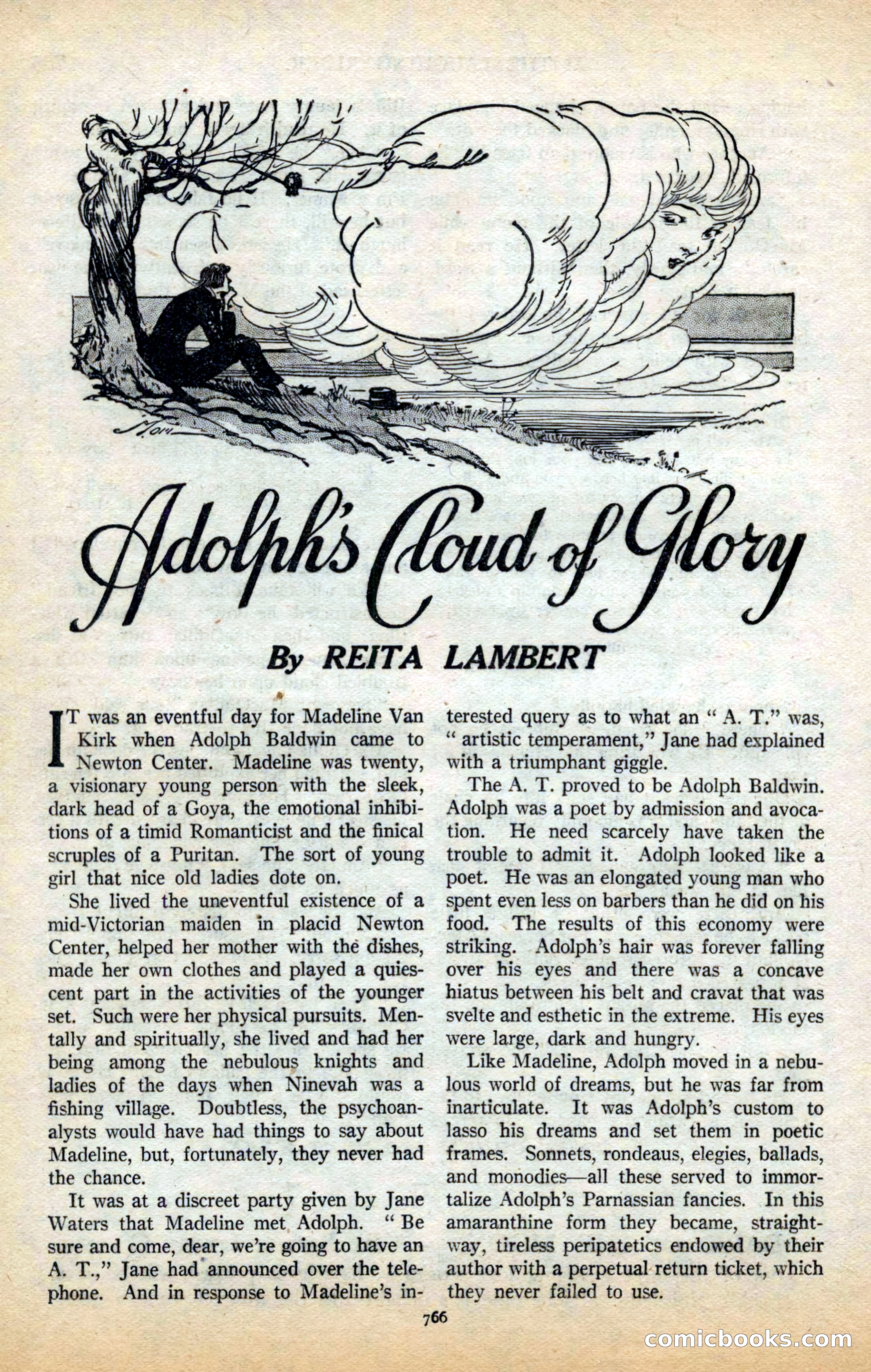
A restored page from Pulp Fiction, 1923. Page through the whole issue in the reader above.
📄 Transcribed text from this page (OCR, searchable)
Machine-transcribed from the original scan — historical spelling and the odd misread are preserved.
By REITA T was an eventful day for Madeline Van | Kirk when Adolph Baldwin came to Newton Center. Madeline was twenty, a visionary young person with the sleek, dark head of a Goya, the emotional inhibi- tions of a timid Romanticist and the finical scruples of a Puritan. The sort of young girl that nice old ladies dote on, She lived the uneventful existence of a mid-Victorian maiden in placid Newton Center, helped her mother with thé dishes, made her own clothes and played a quies- cent part in the activities of the younger set. Such were her physical pursuits. Men- tally and spiritually, she lived and had her being among the nebulous knights and ladies of the days when Ninevah was a fishing village. Doubtless, the psychoan- alysts would have had things to say about Madeline, but, fortunately, they never had the chance. It was at a discreet party given by Jane Waters that Madeline met, Adolph. “ Be sure and come, dear, we’re going to have an A. T.,” Jane had announced over the tele- phone. And in response to Madeline’s in- LAMBERT terested query as to what an “ A. T.” was, “artistic temperament,” Jane had explained with a triumphant giggle. The A. T. proved to be Adolph Baldwin. Adolph was a poet by admission and avoca- tion. He need scarcely have taken the trouble to admit it. Adolph looked like a poet. He was an elongated young man who spent even less on barbers than he did on his food. . The results of this economy were striking. Adolph’s hair was forever falling over his eyes and there was a concave hiatus between his belt and cravat that was svelte and esthetic in the extreme. His eyes were large, dark and hungry. | Like Madeline, Adolph moved in a nebu- lous world of dreams, but he was far from inarticulate. It was Adolph’s custom to lasso his dreams and set them in poetic frames. Sonnets, rondeaus, elegies, ballads, and monodies—all these served to immor- talize Adolph’s Parnassian fancies. In this amaranthine form they became, straight- way, tireless peripatetics endowed by their author with a perpetual return ticket, which they never failed to use. 766 ECOMIEDOOKS. —-s a - — - - oe a as ~~ a * ~~ « — > om com