
Pulp Fiction, 1923 · page 142 of 178
Argosy All-Story Weekly — page 142: what you’re looking at
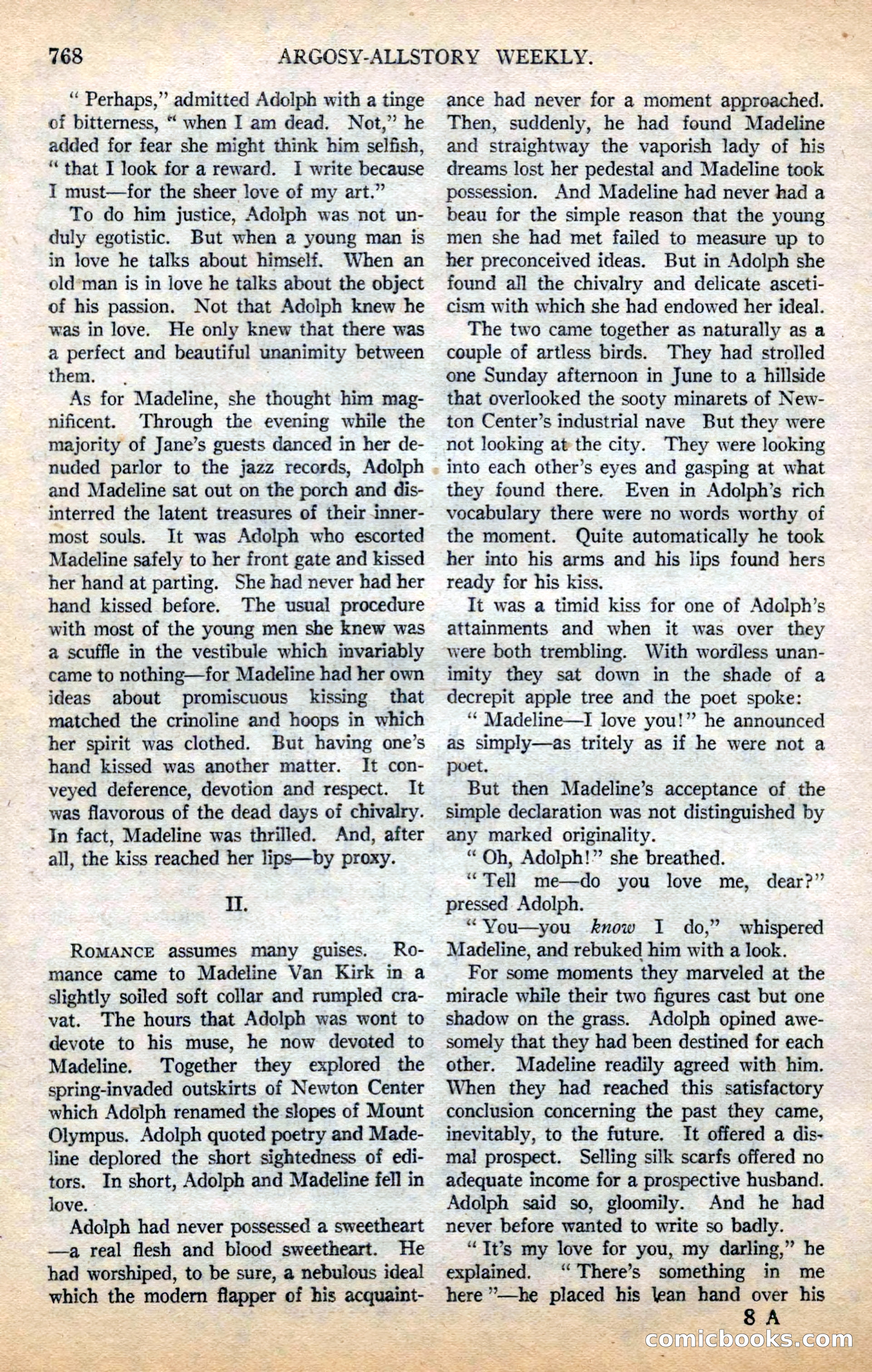
A restored page from Pulp Fiction, 1923. Page through the whole issue in the reader above.
📄 Transcribed text from this page (OCR, searchable)
Machine-transcribed from the original scan — historical spelling and the odd misread are preserved.
768 “Perhaps,” admitted Adolph with a tinge of bitterness, “ when I am dead. Not,’ he added for fear she might think him selfish, “that I look for a reward. I write because I must—for the sheer love of my art.” To do him justice, Adolph was not un- duly egotistic. But when a young man is in love he talks about himself. When an old*man is in love he talks about the object of his passion. Not that Adolph knew he was in love. He only knew that there was a perfect and beautiful unanimity between them. . , As for Madeline, she thought him mag- nificent. Through the evening while the majority of Jane’s guests danced in her de- nuded parlor to the jazz records, Adolph and Madeline sat out on the porch and dis- interred the latent treasures of their -inner- most souls. It was Adolph who escorted Madeline safely to her front gate and kissed her hand at parting. She had never had her hand kissed before. The usual procedure with most of the young men she knew was a scuffle in the vestibule which invariably came to nothing—for Madeline had her own ideas about promiscuous kissing that matched the crinoline and hoops in which her spirit was clothed. But having one’s hand kissed was another matter. It con- veyed deference, devotion and respect. It was flavorous of the dead days of chivalry. In fact, Madeline was thrilled. And, after ~ all, the kiss reached her lips—by proxy. I. ROMANCE assumes many guises. Ro- mance came to Madeline Van Kirk in a slightly soiled soft collar and rumpled cra- vat. The hours that Adolph was wont to devote to his muse, he now devoted to Madeline. Together they explored the spring-invaded outskirts of Newton Center which Adolph renamed the slopes of Mount Olympus. Adolph quoted poetry and Made- line deplored the short sightedness of edi- tors. In short, Adolph and Madeline fell in love. : Adolph had never possessed a sweetheart —a real flesh and blood sweetheart. He had worshiped, to be sure, a nebulous ideal which the modern flapper of his acquaint- ARGOSY-ALLSTORY WEEKLY. ance had never for a moment approached. Then, suddenly, he had found Madeline and straightway the vaporish lady of his dreams lost her pedestal and Madeline took possession. And Madeline had never had a beau for the simple reason that the young men she had met failed to measure up to her preconceived ideas. But in Adolph she found all the chivalry and delicate asceti- cism with which she had endowed her ideal. The two came together as naturally asa | couple of artless birds. They had strolled one Sunday afternoon in June to a hillside that overlooked the sooty minarets of New- ton Center’s industrial nave But they were not looking at the city. They were looking - into each other’s eyes and gasping at what they found there. Even in Adolph’s rich vocabulary there were no words worthy of the moment. Quite automatically he took her into his arms and his lips found hers ready for his kiss. It was a timid kiss for one of Adolph’s attainments and when it was over they were both trembling. With wordless unan- imity they sat down in the shade of a decrepit apple tree and the poet spoke: ‘* Madeline—I love you!” he announced as simply—as tritely as if he were not a t. But then Madeline’s acceptance of the simple declaration was not distinguished by any marked originality. “ Oh, Adolph!” she breathed. “Tell me—do you love me, dear?” pressed Adolph. “‘You—you know I do,” whispered Madeline, and rebuked him with a look. For some moments they marveled at the miracle while their two figures cast but one shadow on the grass. Adolph opined awe- somely that they had been destined for each other. Madeline readily agreed with him. When they had reached this satisfactory conclusion concerning the past they came, inevitably, to the future. It offered a dis- mal prospect. Selling silk scarfs offered no adequate income for a prospective husband. Adolph said so, gloomily. And he had never before wanted to write so badly. “Tt’s my love for you, my darling,” he =s explained. ‘“ There’s something in me here ”—he placed his lean hand over his |