
Pulp Fiction, 1923 · page 144 of 178
Argosy All-Story Weekly — page 144: what you’re looking at
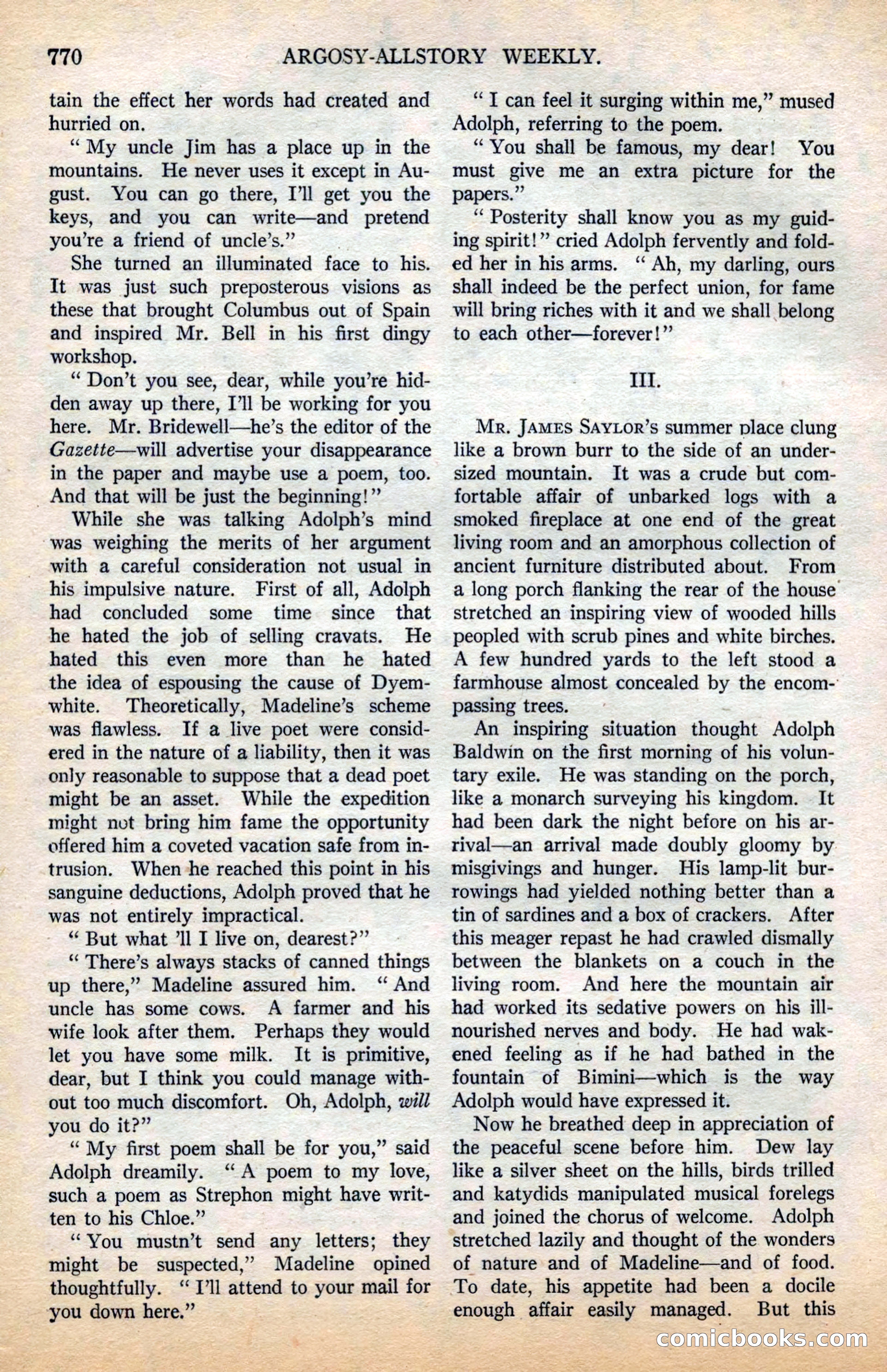
A restored page from Pulp Fiction, 1923. Page through the whole issue in the reader above.
📄 Transcribed text from this page (OCR, searchable)
Machine-transcribed from the original scan — historical spelling and the odd misread are preserved.
770 tain the effect her words had created and hurried on. “My uncle Jim has a place up in the mountains. He never uses it except in Au- gust. You can go there, I’ll get you the keys, and you can write—and pretend you're a friend of uncle’s.” | She turned an illuminated face to his. It was just such preposterous visions as these that brought Columbus out of Spain and inspired Mr. Bell in his first dingy workshop. “Don’t you see, dear, while you’re hid- den away up there, I’ll be working for you here. Mr. Bridewell—he’s the editor of the Gazette—will advertise your disappearance in the paper and maybe use a poem, too. _ And that will be just the beginning!” While she was talking Adolph’s mind was weighing the merits of her argument with a careful consideration not usual in his impulsive nature. First of all, Adolph had concluded some time since that he hated the job of selling cravats. He hated this even more than he hated the idea of espousing the cause of Dyem- white. Theoretically, Madeline’s scheme was flawless. If a live poet were consid- ered in the nature of a liability, then it was only reasonable to suppose that a dead poet might be an asset. While the expedition might not bring him fame the opportunity offered him a coveted vacation safe from in- trusion. When he reached this point in his sanguine deductions, Adolph proved that he was not entirely impractical. “ But what ’Il I live on, dearest?” “ There’s always stacks of canned things up there,” Madeline assured him. “ And uncle has some cows. A farmer and his wife look after them. Perhaps they would let you have some milk. It is primitive, dear, but I think you could manage with- out too much discomfort. Oh, Adolph, wll you do it?” “My first poem shall be for you,” said Adolph dreamily. ‘‘ A poem to my love, such a poem as Strephon might have writ- ten to his Chloe.” “You mustn’t send any letters; they might be suspected,’ Madeline opined thoughtfully. ‘ I’ll attend to your mail for ‘you down here.” ) | ARGOSY-ALLSTORY WEEKLY. “TI can feel it surging within me,” mused Adolph, referring to the poem. “You shall be famous, my dear! You must give me an extra picture for the papers.” ‘“ Posterity shall know you as my guid- ing spirit!” cried Adolph fervently and fold- ed her in his arms. ‘ Ah, my darling, ours shall indeed be the perfect union, for fame will bring riches with it and we shall belong to each other—forever!” IIT. Mr. JAMES SAYLOR’s summer place clung like a brown burr to the side of an under- sized mountain. It was a crude but com- fortable affair of unbarked logs with a smoked fireplace at one end of the great living room and an amorphous collection of ancient furniture distributed about. From a long porch flanking the rear of the house stretched an inspiring view of wooded hills peopled with scrub pines and white birches. A few hundred yards to the left stood a farmhouse almost concealed by the encom- passing trees. An inspiring situation thought Adolph Baldwin on the first morning of his volun- tary exile. He was standing on the porch, like a monarch surveying his kingdom. — It had been dark the night before on his ar- rival—an arrival made doubly gloomy by misgivings and hunger. His lamp-lit bur- rowings had yielded nothing better than a tin of sardines and a box of crackers. After this meager repast he had crawled dismally between the blankets on a couch in the living room. And here the mountain air had worked its sedative powers on his ill- nourished nerves and body. He had wak- ened feeling as if he had bathed in the fountain of Bimini—which is the way Adolph would have expressed it. Now he breathed deep in appreciation of the peaceful scene before him. Dew lay like a silver sheet on the hills, birds trilled and katydids manipulated musical forelegs and joined the chorus of welcome. Adolph stretched lazily and thought of the wonders of nature and of Madeline—and of food. To date, his appetite had been a docile enough affair easily managed. But this Eomirebooks. cor