
Pulp Fiction, 1923 · page 147 of 178
Argosy All-Story Weekly — page 147: what you’re looking at
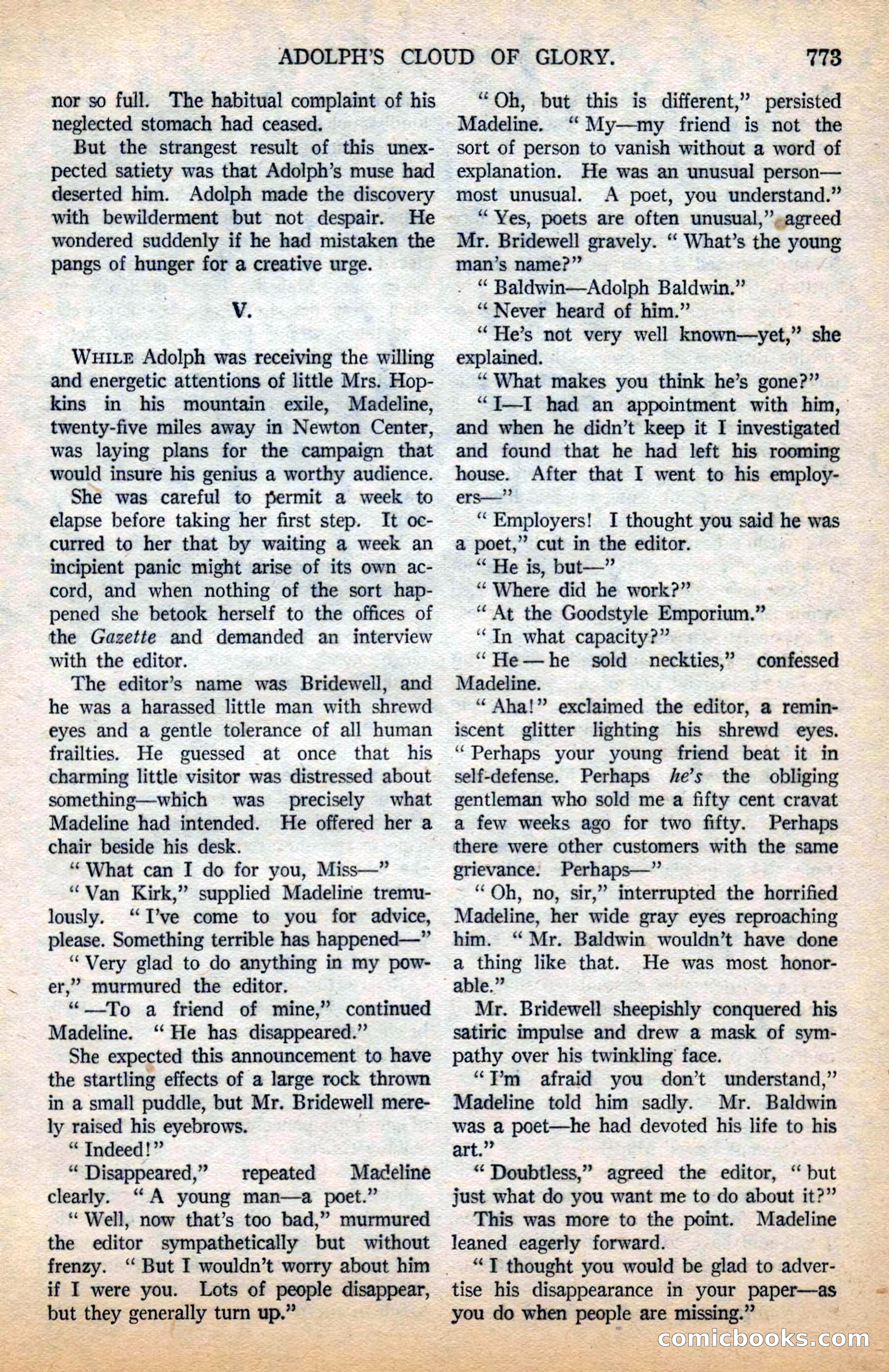
A restored page from Pulp Fiction, 1923. Page through the whole issue in the reader above.
📄 Transcribed text from this page (OCR, searchable)
Machine-transcribed from the original scan — historical spelling and the odd misread are preserved.
ne —, = ogee os aes ota oo Lone a ee Sere SS ie ADOLPH’S CLOUD OF GLORY. nor so full. The habitual complaint of his neglected stomach had ceased. But the strangest result of this unex- pected satiety was that Adolph’s muse had deserted him. Adolph made the discovery with bewilderment but not despair. He wondered suddenly if he had mistaken the pangs of hunger for a creative urge. V. Wuite Adolph was receiving the willing and energetic attentions of little Mrs. Hop- kins in his mountain exile, Madeline, twenty-five miles away in Newton Center, was laying plans for the campaign that would insure his genius a worthy audience. She was careful to permit a week to elapse before taking her first step. It oc- curred to her that by waiting a week an incipient panic might arise of its own ac- cord, and when nothing of the sort hap- pened she betook herself to the offices of the Gazette and demanded an interview with the editor. The editor’s name was Bridewell, and he was a harassed little man with shrewd eyes and a gentle tolerance of all human frailties. He guessed at once that his charming little visitor was distressed about something—which was precisely what Madeline had intended. He offered her a chair beside his desk. “What can I do for you, Miss—” “Van Kirk,” supplied Madeline tremu- lously. “I’ve come to you for advice, please. Something terrible has happened—” “Very glad to do anything in my pow- er,”” murmured the editor. “__To a friend of mine,” continued Madeline. ‘‘ He has disappeared.” She expected this announcement to have the startling effects of a large rock thrown in a small puddle, but Mr. Bridewell mere- ly raised his eyebrows. “ Indeed!” “Disappeared,” repeated Madeline clearly. “A young man—a poet.” “Well, now that’s too bad,” murmured the editor sympathetically but without frenzy. if I were you. Lots of people disappear, ae Soe! pase Bs turn uP. » “ But I wouldn’t worry about him | you do when people are missing.” | € 773 “Oh, but this is different,’ persisted Madeline. “ My—my friend is not the sort of person to vanish without a word of explanation. He was an unusual person— most unusual. A poet, you understand.” “Yes, poets are often unusual,” »agreed Mr. Bridewell gravely. “‘ What’s the young man’s name?” . “ Baldwin—Adolph Baldwin.” “Never heard of him.” “He’s not very well known—yet,” she explained. “What makes you think he’s gone?” “T—I had an appointment with him, and when he didn’t keep it I investigated and found that he had left his rooming house. After that I went to his employ- ers—” S Employers! I thought you said he was a poet,” cut in the editor. “He is, but—” . Where did he work?” “At the Goodstyle Emporium.” ‘“In what capacity?” “He—he sold neckties,” Madeline. “ Aha!” exclaimed the editor, a remin- iscent glitter lighting his shrewd eyes. “Perhaps your young friend beat it in self-defense. Perhaps se’s the obliging gentleman who sold me a fifty cent cravat a few weeks ago for two fifty. Perhaps there were other customers with the same grievance. Perhaps—” “Oh, no, sir,” interrupted the horrified Madeline, her wide gray eyes reproaching him. “ Mr. Baldwin wouldn’t have done a thing like that. He was most honor- confessed able.” Mr. Bridewell sheepishly conquered his satiric impulse and drew a mask of sym- pathy over his twinkling face. “Tm afraid you don’t understand,” Madeline told him sadly. Mr. Baldwin was a poet—he had devoted his life to his art.”’ “ Doubtless,” agreed the editor, “ but just what do you want me to do about it?” This was more to the point. Madeline leaned eagerly forward. “J thought you would be glad to adver- _ tise his disappearance in your paper—as