
Pulp Fiction, 1923 · page 21 of 178
Argosy All-Story Weekly — page 21: what you’re looking at
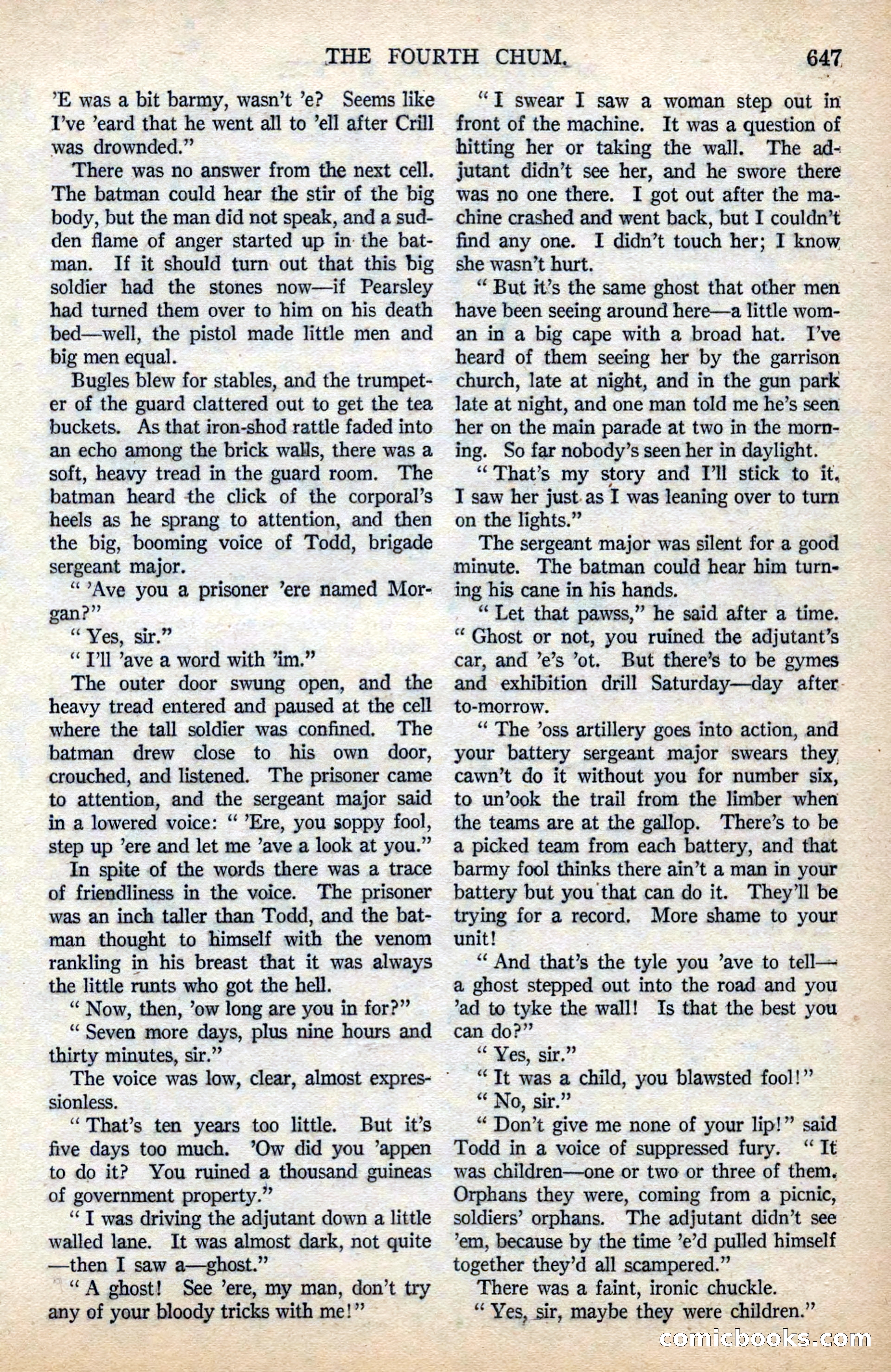
A restored page from Pulp Fiction, 1923. Page through the whole issue in the reader above.
📄 Transcribed text from this page (OCR, searchable)
Machine-transcribed from the original scan — historical spelling and the odd misread are preserved.
THE FOURTH CHUM, ’E was a bit barmy, wasn’t ’e? Seems like I’ve ’eard that he went all to ’ell after Crill was drownded.” There was no answer from the next cell. The batman could hear the stir of the big body, but the man did not speak, and a sud- den flame of anger started up in: the bat- man. If it should turn out that this big soldier had the stones now—if Pearsley had turned them over to him on his death bed—well, the pistol made little men and big men equal. Bugles blew for stables, and the trumpet- er of the guard clattered out to get the tea buckets. As that iron-shod rattle faded into an echo among the brick walls, there was a soft, heavy tread in the guard room. The batman heard the click of the corporal’s heels as he sprang to attention, and then the big, booming voice of Todd, brigade sergeant major. “Ave you a prisoner ’ere named Mor- gan?” “Yes, sir.” “Tl "ave a word with ’im.” The outer door swung open, and the heavy tread entered and paused at the cell where the tall soldier was confined. The batman drew close to his own door, crouched, and listened. The prisoner came to attention, and the sergeant major said in a lowered voice: “ ’Ere, you soppy fool, step up ’ere and let me ’ave a look at you.” In spite of the words there was a trace of friendliness in the voice. The prisoner was an inch taller than Todd, and the bat- man thought to himself with the venom rankling in his breast that it was always the little runts who got the hell. “ Now, then, ’ow long are you in for?” “Seven more days, plus nine hours and thirty minutes, sir.” The voice was low, clear, almost expres- © sionless. “ That’s ten years too little. But it’s five days too much. ’Ow did you ’appen to do it? You ruined a thousand guineas of government property.” ‘‘T was driving the adjutant down a little walled lane. It was almost dark, not quite —then I saw a—ghost.” “A ghost! See ’ere, my man, don’t try any of your bloody tricks with me!” 647 “T swear I saw a woman step out in front of the machine. It was a question of hitting her or taking the wall. The ad- jutant didn’t see her, and he swore there was no one there. I got out after the ma- chine crashed and went back, but I couldn’t find any one. I didn’t touch her; I know she wasn’t hurt. “ But it’s the same ghost that other men have been seeing around here—a little wom- an in a big cape with a broad hat. I’ve heard of them seeing her by the garrison church, late at night, and in the gun park late at night, and one man told me he’s seen her on the main parade at two in the morn- ing. So far nobody’s seen her in daylight. ‘““That’s my story and I'll stick to it, T saw her just.as I was leaning over to turn on the lights.” ? The sergeant major was silent for a good minute. The batman could hear him turn- ing his cane in his hands. “Let that pawss,” he said after a time. “ Ghost or not, you ruined the adjutant’s car, and ’e’s ’ot. But there’s to be gymes and exhibition drill Saturday—day after- to-morrow. “ The ’oss artillery goes into action, and your battery sergeant major swears they cawn’t do it without you for number six, to un’ook the trail from the limber when the teams are at the gallop. ‘There’s to be a picked team from each battery, and that barmy fool thinks there ain’t a man in your battery but you that can do it. They'll be trying for a record. More shame to your unit! | “‘ And that’s the tyle you ’ave to tell— a ghost stepped out into the road and you ‘ad to tyke the wall! Is that the best you ~ can do?” “* Yes, sir.” “Tt was a child, you blawsted fool!” “< No, sir.” “ Don’t give me none of your lip!” said Todd in a voice of suppressed fury. “It was children—one or two or three of them. Orphans they were, coming from a picnic, soldiers’ orphans. The adjutant didn’t see ‘em, because by the time ’e’d pulled himself together they’d all scampered.” There was a faint, ironic chuckle. “Yes, sir, maybe they were children.” Gomichbooks com)