
Pulp Fiction, 1923 · page 49 of 178
Argosy All-Story Weekly — page 49: what you’re looking at
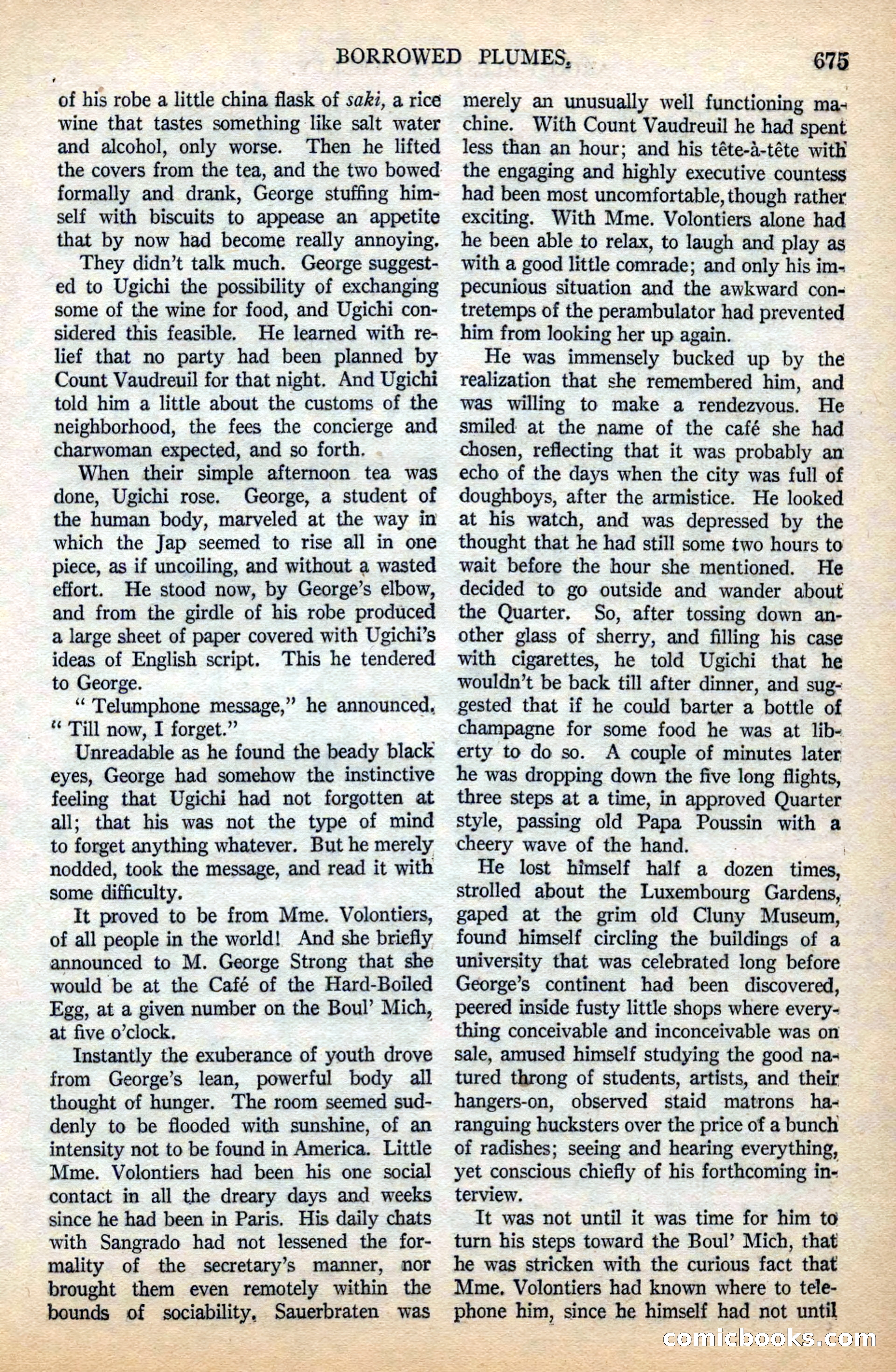
A restored page from Pulp Fiction, 1923. Page through the whole issue in the reader above.
📄 Transcribed text from this page (OCR, searchable)
Machine-transcribed from the original scan — historical spelling and the odd misread are preserved.
BORROWED PLUMES, of his robe a little china flask of saki, a rice wine that tastes something like salt water and alcohol, only worse. Then he lifted the covers from the tea, and the two bowed. formally and drank, George stuffing him- self with biscuits to appease an appetite that by now had become really annoying, They didn’t talk much. George suggest- ed to Ugichi the possibility of exchanging some of the wine for food, and Ugichi con- sidered this feasible. He learned with re- lief that no party had been planned by Count Vaudreuil for that night. And Ugichi told him a little about the customs of the neighborhood, the fees the concierge and charwoman expected, and so forth. When their simple afternoon tea was done, Ugichi rose. George, a student of the human body, marveled at the way in which the Jap seemed to rise all in one piece, as if uncoiling, and without a wasted effort. He stood now, by George’s elbow, and from the girdle of his robe produced a large sheet of paper covered with Ugichi’s ideas of English script. This he tendered to George. “Telumphone message,” he announced, * Till now, I forget.” Unreadable as he found the beady black eyes, George had somehow the instinctive feeling that Ugichi had not forgotten at all; that his was not the type of mind to forget anything whatever. But he merely nodded, took the message, and read it with some difficulty. It proved to be from Mme. Volontiers, of all people in the world! And she briefly announced to M. George Strong that she would be at the Café of the Hard-Boiled Egg, at a given number on the Boul’ Mich, at five o’clock. Instantly the exuberance of youth drove from George’s lean, powerful body all thought of hunger. The room seemed sud- denly to be flooded with sunshine, of an intensity not to be found in America. Little Mme. Volontiers had been his one social contact in all the dreary days and weeks since he had been in Paris. His daily chats with Sangrado had not lessened the for- mality of the secretary’s manner, nor brought them even remotely within the bounds of sociability, Sauerbraten was 675 merely an unusually well functioning ma- chine. With Count Vaudreuil he had spent less than an hour; and his téte-4-téte with the engaging and highly executive countess had been most uncomfortable, though rather exciting. With Mme. Volontiers alone had he been able to relax, to laugh and play as with a good little comrade; and only his im- pecunious situation and the awkward con- tretemps of the perambulator had prevented him from looking her up again. He was immensely bucked up by the realization that she remembered him, and was willing to make a rendezvous. He ~ smiled at the name of the café she had chosen, reflecting that it was probably an echo of the days when the city was full of doughboys, after the armistice. He looked at his watch, and was depressed by the thought that he had still some two hours to wait before the hour she mentioned. He decided to go outside and wander about the Quarter. So, after tossing down an- other glass of sherry, and filling his case with cigarettes, he told Ugichi that he wouldn’t be back till after dinner, and sug- gested that if he could barter a bottle of champagne for some food he was at lib- erty to do so. A couple of minutes later he was dropping down the five long flights, three steps at a time, in approved Quarter style, passing old Papa Poussin with a cheery wave of the hand. He lost himself half a dozen times: strolled about the Luxembourg Gardens, gaped at the grim old Cluny Museum, found himself circling the buildings of a university that was celebrated long before George’s continent had been discovered, peered inside fusty little shops where every- thing conceivable and inconceivable was on sale, amused himself studying the good na- tured throng of students, artists, and their hangers-on, observed staid matrons ha- ranguing hucksters over the price of a bunch of radishes; seeing and hearing everything, yet conscious chiefly of his forthcoming in- terview. It was not until it was time for him to turn his steps toward the Boul’ Mich, that he was stricken with the curious fact that Mme. Volontiers had known where to tele- phone him, since he himself had not until Eomicbooks co