
Pulp Fiction, 1923 · page 62 of 178
Argosy All-Story Weekly — page 62: what you’re looking at
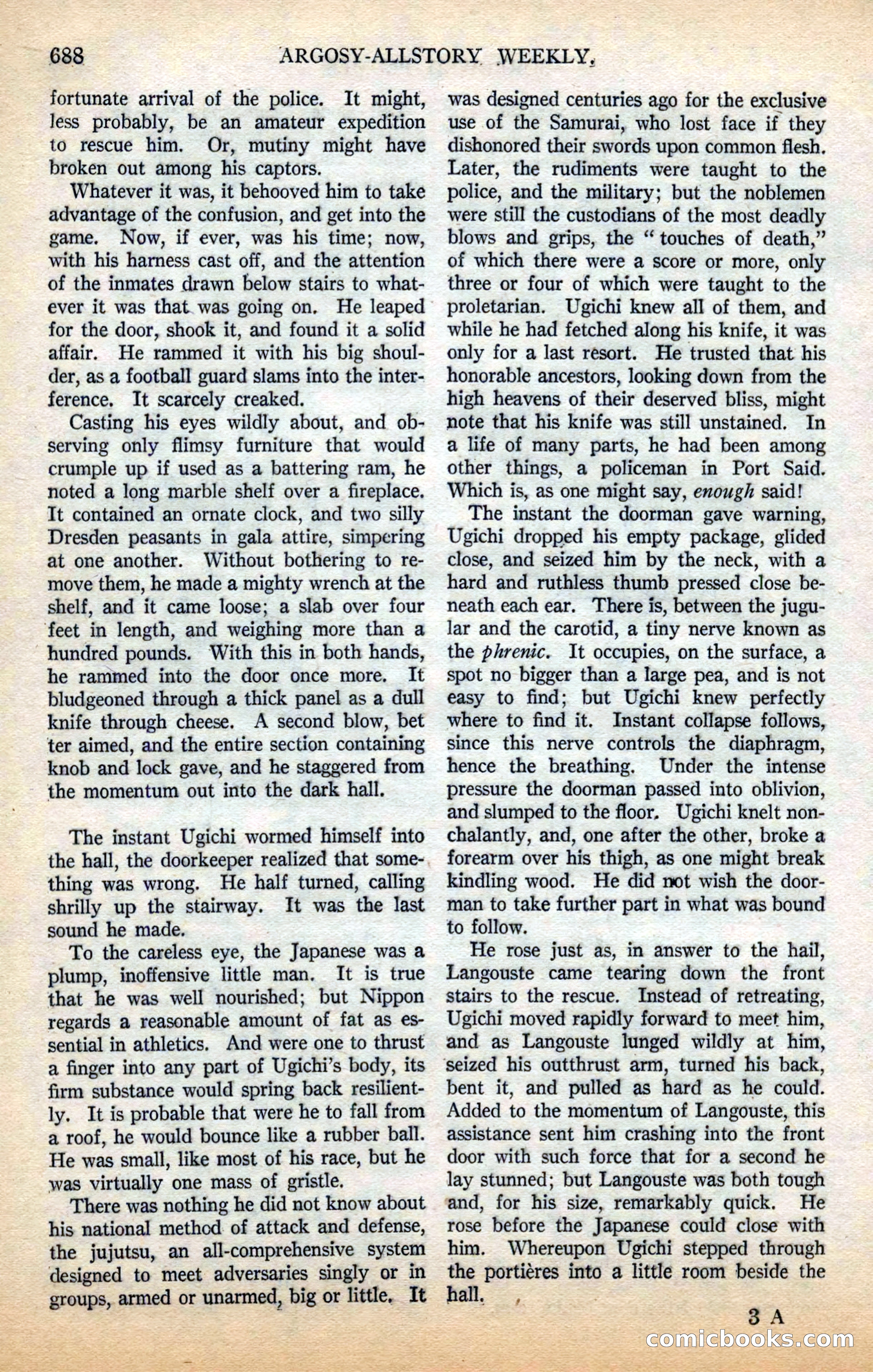
A restored page from Pulp Fiction, 1923. Page through the whole issue in the reader above.
📄 Transcribed text from this page (OCR, searchable)
Machine-transcribed from the original scan — historical spelling and the odd misread are preserved.
688 fortunate arrival of the police. It might, Jess probably, be an amateur expedition to rescue him. Or, mutiny might have broken out among his captors. Whatever it was, it behooved him to take advantage of the confusion, and get into the game. Now, if ever, was his time; now, with his harness cast off, and the attention of the inmates drawn below stairs to what- ever it was that. was going on. He leaped for the door, shook it, and found it a solid affair. He rammed it with his big shoul- der, as a football guard slams into the inter- ference. It scarcely creaked. Casting his eyes wildly about, and ob- serving only flimsy furniture that would crumple up if used as a battering ram, he noted a long marble shelf over a fireplace. It contained an ornate clock, and two silly Dresden peasants in gala attire, simpering at one another. Without bothering to re- move them, he made a mighty wrench at the shelf, and it came loose; a slab over four feet in length, and weighing more than a hundred pounds. With this in both hands, he rammed into the door once more, It bludgeoned through a thick panel as a dull knife through cheese. A second blow, bet ter aimed, and the entire section containing knob and lock gave, and he staggered from the momentum out into the dark hall. The instant Ugichi wormed himself into the hall, the doorkeeper realized that some- thing was wrong. He half turned, calling shrilly up the stairway. It was the last sound he made. To the careless eye, the Japanese was a plump, inoffensive little man. It is true that he was well nourished; but Nippon regards a reasonable amount of fat as es- sential in athletics. And were one to thrust a finger into any part of Ugichi’s body, its firm substance would spring back resilient- ly. It is probable that were he to fall from a roof, he would bounce like a rubber ball. He was small, like most of his race, but he was virtually one mass of gristle. There was nothing he did not know about his national method of attack and defense, the jujutsu, an all-comprehensive system designed to meet adversaries singly or in groups, armed or unarmed, big or little. It ARGOSY-ALLSTORY WEEKLY, was designed centuries ago for the exclusive use of the Samurai, who lost face if they dishonored their swords upon common flesh. Later, the rudiments were taught to the police, and the military; but the noblemen were still the custodians of the most deadly blows and grips, the “ touches of death,” of which there were a score or more, only three or four of which were taught to the proletarian. Ugichi knew all of them, and while he had fetched along his knife, it was only for a last resort. He trusted that his honorable ancestors, looking down from the high heavens of their deserved bliss, might note that his knife was still unstained. In a life of many parts, he had been among other things, a policeman in Port Said. Which is, as one might say, exough said! The instant the doorman gave warning, Ugichi dropped his empty package, glided close, and seized him by the neck, with a hard and ruthless thumb pressed close be- neath each ear. There is, between the jugu- lar and the carotid, a tiny nerve known as the phrenic. It occupies, on the surface, a spot no bigger than a large pea, and is not easy to find; but Ugichi knew perfectly where to find it. Instant collapse follows, since this nerve controls the diaphragm, hence the breathing. Under the intense pressure the doorman passed into oblivion, and slumped to the floor. Ugichi knelt non- chalantly, and, one after the other, broke a forearm over his thigh, as one might break kindling wood. He did not wish the door- man to take further part in what was bound to follow. He rose just as, in answer to the hail, Langouste came tearing down the front stairs to the rescue. Instead of retreating, Ugichi moved rapidly forward to meet him, and as Langouste lunged wildly at him, seized his outthrust arm, turned his back, bent it, and pulled as hard as he could. Added to the momentum of Langouste, this assistance sent him crashing into the front door with such force that for a second he lay stunned; but Langouste was both tough and, for his size, remarkably quick. He rose before the Japanese could close with him. Whereupon Ugichi stepped through the portiéres into a little room beside the hall, | | 3 A — mx. ~ <=S4 IS oe nme Rg nn ot Se