
Pulp Fiction, 1923 · page 69 of 178
Argosy All-Story Weekly — page 69: what you’re looking at
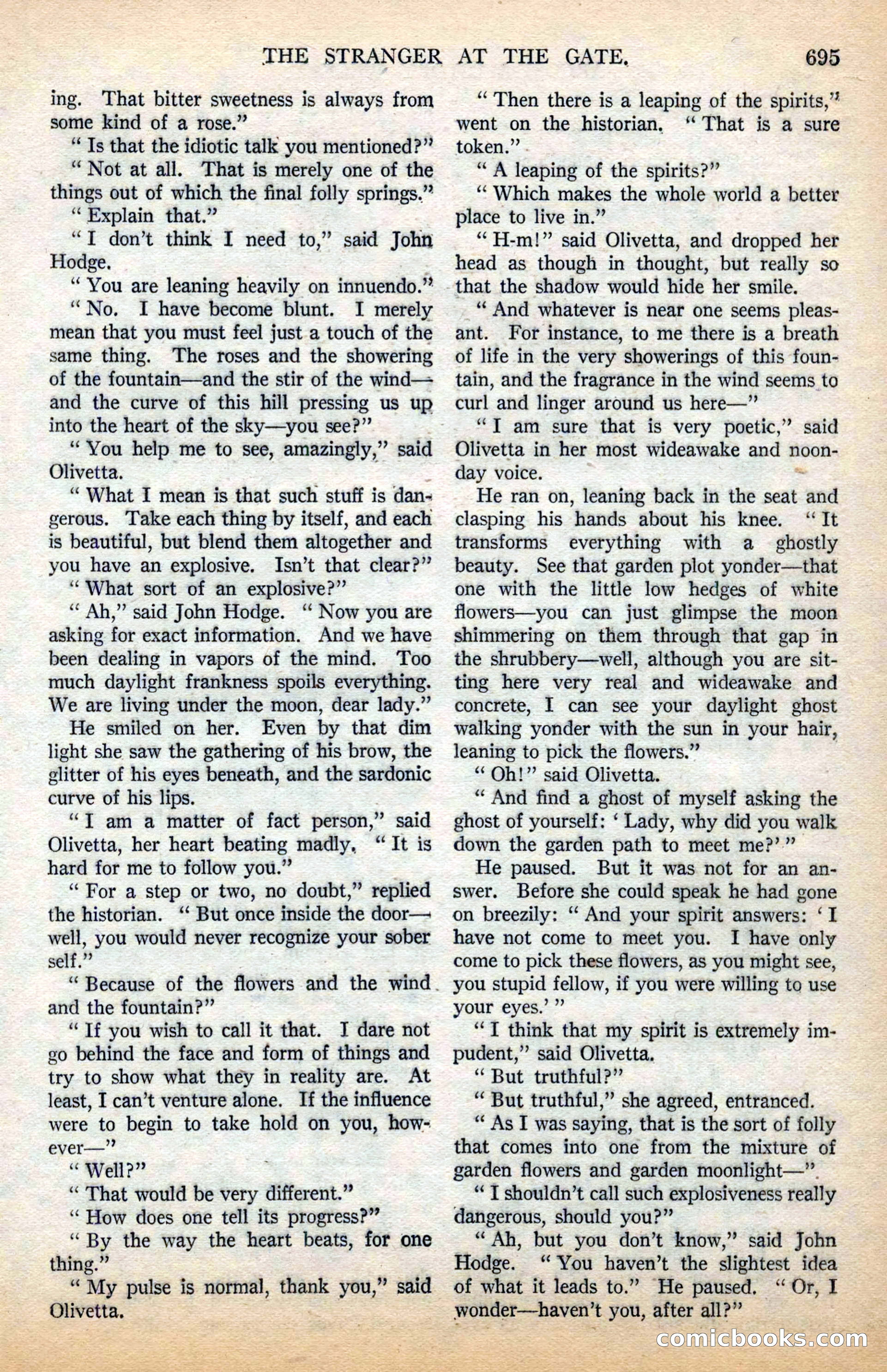
A restored page from Pulp Fiction, 1923. Page through the whole issue in the reader above.
📄 Transcribed text from this page (OCR, searchable)
Machine-transcribed from the original scan — historical spelling and the odd misread are preserved.
THE STRANGER ing. That bitter sweetness is always from some kind of a rose.” Ts that the idiotic talk you mentioned?” “Not at all. That is merely one of the things out of which the final folly springs.” “ Explain that.” “T don’t think I need to,” said John Hodge. 3 “You are leaning heavily on innuendo.” “No. I have become blunt. I merely mean that you must feel just a touch of the same thing. The roses and the showering of the fountain—and the stir of the wind— and the curve of this hill pressing us up into the heart of the sky—you see?”’ ‘You help me to see, amazingly,” said Olivetta. “What I mean is that such stuff is dan- gerous. Take each thing by itself, and each is beautiful, but blend them altogether and you have an explosive. Isn’t that clear?” ‘What sort of an explosive?” ‘‘ Ah,” said John Hodge. ‘ Now you are asking for exact information. And we have been dealing in vapors of the mind. Too much daylight frankness spoils everything. We are living under the moon, dear lady.” He smiled on her. Even by that dim light she saw the gathering of his brow, the elitter of his eyes beneath, and the sardonic curve of his lips. “T am a matter of fact person,” said Olivetta, her heart beating madly, “ It is hard for me to follow you.” “For a step or two, no doubt,” replied the historian. ‘‘ But once inside the door— well, you would never recognize your sober self.” “ Because of the flowers and the wind. and the fountain?” “Tf you wish to call it that. J dare not go behind the face and form of things and try to show what théy in reality are. At least, I can’t venture alone. If the influence were to begin to take hold on you, how- ever— = Wail” “ That would be very different.” “How does one tell its progress?” “ By the way the heart beats, for one thing.” “My pulse is normal, thank you, ” said Olivetta. Va AT THE GATE, “Then there is a leaping of the spirits,” went on the historian. “ That is a sure token.” . “A leaping of the spirits?” ‘Which makes the whole world a better place to live in.” “H-m!” said Olivetta, and dropped her head as though in thought, but really so that the shadow would hide her smile. ‘“* And whatever is near one seems pleas- ant. For instance, to me there is a breath of life in the very showerings of this foun- tain, and the fragrance in the wind seems to curl and linger around us here—” “IT am sure that is very poetic,” said Olivetta in her most wideawake and noon- day voice. = He ran on, leaning back in the seat and clasping his hands about his knee. “ It transforms everything with a_ ghostly beauty. See that garden plot yonder—that one with the little low hedges of white flowers—you can just glimpse the moon shimmering on them through that gap in the shrubbery—well, although you are sit- ting here very real and wideawake and concrete, I can see your daylight ghost walking yonder with the sun in your hair, leaning to pick the flowers.” “Oh!” said Olivetta. “And find a ghost of myself asking the ghost of yourself: ‘ Lady, why did you walk down the garden path to meet me?’” He paused. But it was not for an an- swer. Before she could speak he had gone on breezily: ‘ And your spirit answers: ‘ I have not come to meet you. I have only come to pick these flowers, as you might see, you stupid fellow, if you were willing to use your eyes.’ ” ‘“‘T think that my spirit is extremely im- pudent,” said Olivetta. “ But truthful?” “ But truthful,” she agreed, entranced. “ As I was saying, that is the sort of folly that comes into one from the mixture of garden flowers and garden moonlight—”. “T shouldn’t call such explosiveness really dangerous, should you?” “ Ah, but you don’t know,” said John Hodge. “ You haven’t the slightest idea 695 of what it leads to.” He paused, “Or, I wonder—haven’t you, after all?” Se