
Pulp Fiction, 1923 · page 88 of 178
Argosy All-Story Weekly — page 88: what you’re looking at
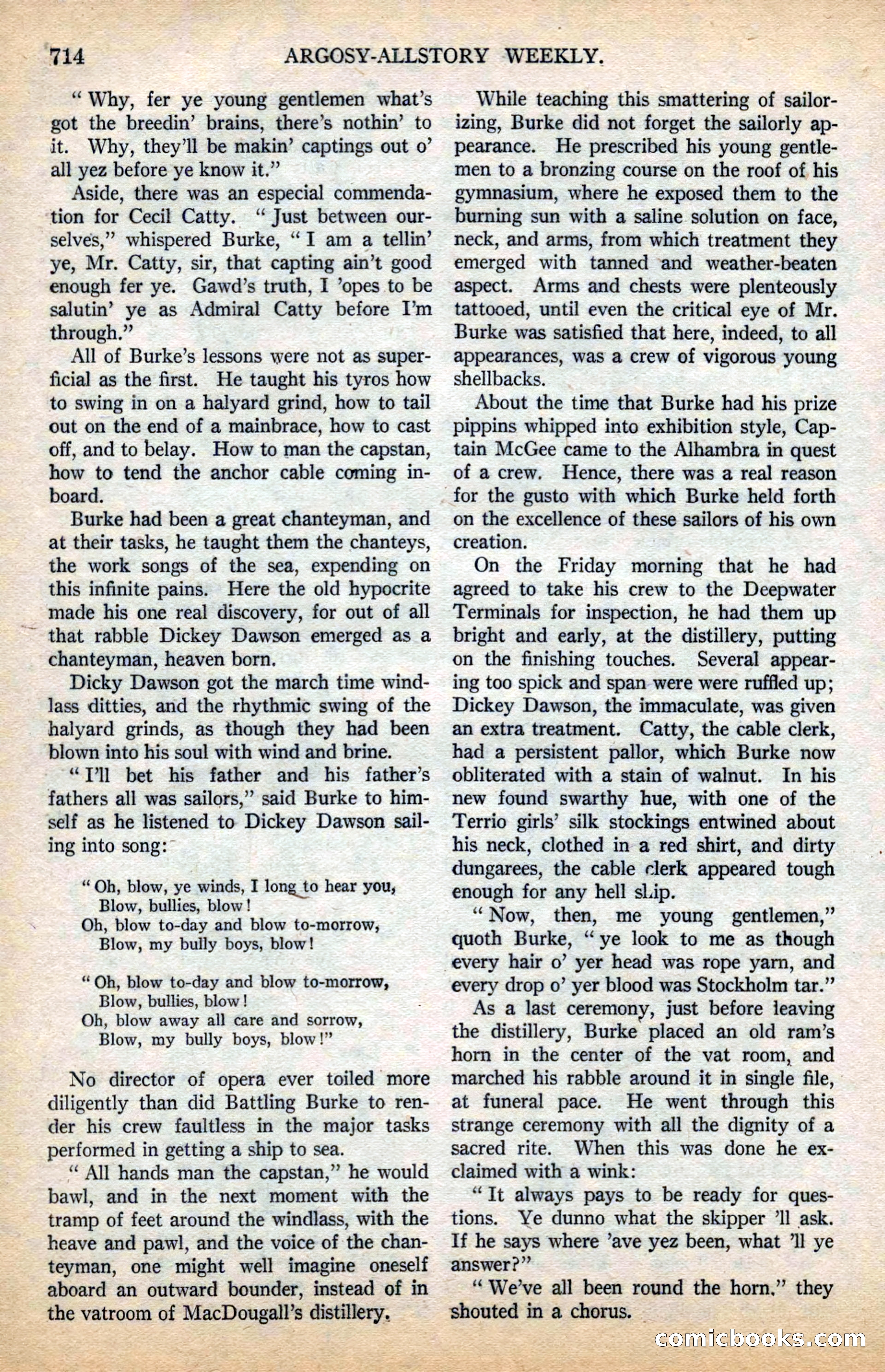
A restored page from Pulp Fiction, 1923. Page through the whole issue in the reader above.
📄 Transcribed text from this page (OCR, searchable)
Machine-transcribed from the original scan — historical spelling and the odd misread are preserved.
714 “Why, fer ye young gentlemen what’s got the breedin’ brains, there’s nothin’ to it. Why, they’ll be makin’ captings out 0’ all yez before ye know it.” Aside, there was an especial commenda- tion for Cecil Catty. “ Just between our- selves,” whispered Burke, “I am a tellin’ ye, Mr. Catty, sir, that capting ain’t good enough fer ye. Gawd’s truth, I ’opes to be salutin’ ye as Admiral Catty before I’m through.” All of Burke’s lessons were not as super- ficial as the first. He taught his tyros how to swing in on a halyard grind, how to tail out on the end of a mainbrace, how to cast off, and to belay. How to man the capstan, how to tend the anchor cable coming in- board. Burke had been a great chanteyman, and at their tasks, he taught them the chanteys, the work songs of the sea, expending on this infinite pains. Here the old hypocrite made his one real discovery, for out of all that rabble Dickey Dawson emerged as a chanteyman, heaven born. Dicky Dawson got the march time wind- lass ditties, and the rhythmic swing of the halyard grinds, as though they had been blown into his soul with wind and brine. “T’ll bet his father and his father’s fathers all was sailors,” said Burke to him- self as he listened to Dickey Dawson sail- ing into song: “Oh, blow, ye winds, I long to hear you, Blow, bullies, blow! Oh, blow to-day and blow to-morrow, Blow, my bully boys, blow! “Oh, blow to-day and blow to-morrow, Blow, bullies, blow! Oh, blow away all care and sorrow, Blow, my bully boys, blow!” No director of opera ever toiled more diligently than did Battling Burke to ren- der his crew faultless in the major tasks performed in getting a ship to sea. “ All hands man the capstan,” he would bawl, and in the next moment with the tramp of feet around the windlass, with the heave and pawl, and the voice of the chan- teyman, one might well imagine oneself aboard an outward bounder, instead of in the vatroom of MacDougall’s distillery. ARGOSY-ALLSTORY WEEKLY. While teaching this smattering of sailor- izing, Burke did not forget the sailorly ap- pearance. He prescribed his young gentle- men to a bronzing course on the roof of his gymnasium, where he exposed them to the burning sun with a saline solution on face, neck, and arms, from which treatment they emerged with tanned and weather-beaten aspect. Arms and chests were plenteously tattooed, until even the critical eye of Mr. Burke was satisfied that here, indeed, to all appearances, was a crew of vigorous young shellbacks. About the time that Burke had his prize pippins whipped into exhibition style, Cap- tain McGee came to the Alhambra in quest of a crew. Hence, there was a real reason for the gusto with which Burke held forth on the excellence of these sailors of his own creation. On the Friday morning that he had agreed to take his crew to the Deepwater Terminals for inspection, he had them up bright and early, at the distillery, putting on the finishing touches. Several appear- ing too spick and span were were ruffled up; Dickey Dawson, the immaculate, was given an extra treatment. Catty, the cable clerk, had a persistent pallor, which Burke now obliterated with a stain of walnut. In his new found swarthy hue, with one of the Terrio girls’ silk stockings entwined about his neck, clothed in a red shirt, and dirty dungarees, the cable clerk appeared tough enough for any hell sLip. ‘““Now, then, me young gentlemen,” quoth Burke, “ye look to me as though every hair o’ yer head was rope yarn, and every drop o’ yer blood was Stockholm tar.” As a last ceremony, just before leaving the distillery, Burke placed an old ram’s horn in the center of the vat room, and marched his rabble around it in single file, at funeral pace. He went through this strange ceremony with all the dignity of a sacred rite. When this was done he ex- claimed with a wink: “Tt always pays to be ready for ques- tions. Ye dunno what the skipper ’ll ask. If he says where ’ave yez been, what ‘Il ye answer?”’ “We've all been round the horn,” a shouted in a chorus. - @ = = nee <Si: