
Pulp Fiction, 1923 · page 92 of 178
Argosy All-Story Weekly — page 92: what you’re looking at
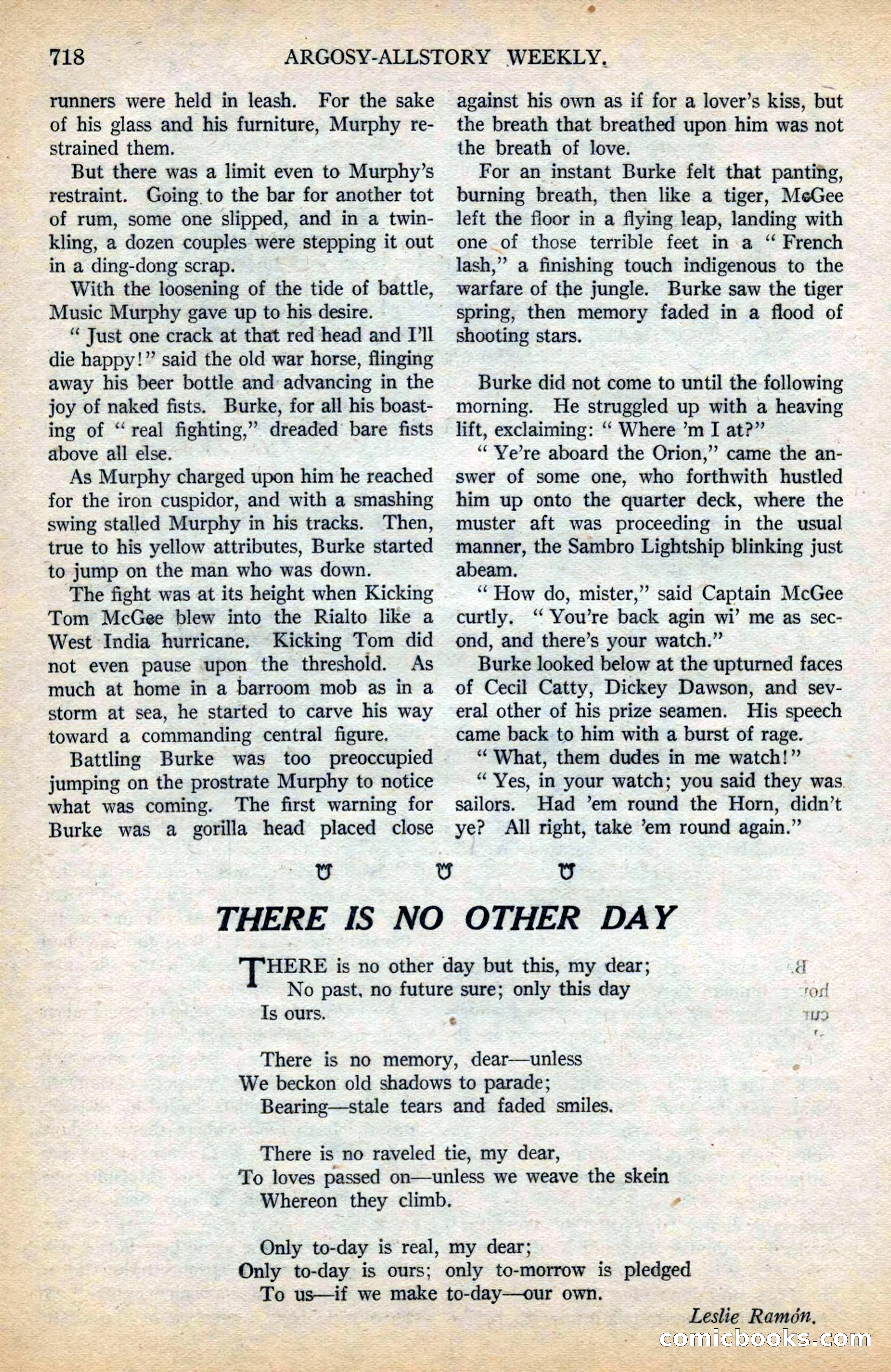
A restored page from Pulp Fiction, 1923. Page through the whole issue in the reader above.
📄 Transcribed text from this page (OCR, searchable)
Machine-transcribed from the original scan — historical spelling and the odd misread are preserved.
718 runners were held in leash. For the sake of his glass and his furniture, Murphy re- strained them. But there was a limit even to Murphy’s restraint. Going to the bar for another tot of rum, some one slipped, and in a twin- kling, a dozen couples were stepping it out in a ding-dong scrap. With the loosening of the tide of battle, Music Murphy gave up to his desire. “ Just one crack at that red head and Ill die happy!” said the old war horse, flinging away his beer bottle and advancing in the joy of naked fists. Burke, for all his boast- ing of “real fighting,” dreaded bare fists above ail else. As Murphy charged upon him he reached for the iron cuspidor, and with a smashing swing stalled Murphy in his tracks. Then, true to his yellow attributes, Burke started to jump on the man who was down. The fight was at its height when Kicking Tom McGee blew into the Rialto like a West India hurricane. Kicking Tom did not even pause upon the threshold. As much at home in a barroom mob as in a storm at sea, he started to carve his way toward a commanding central figure. Battling Burke was too preoccupied jumping on the prostrate Murphy to notice what was coming. The first warning for Burke was a gorilla head placed close U “* ARGOSY-ALLSTORY WEEKLY. against his own as if for a lover’s kiss, but the breath that breathed upon him was not the breath of love. For an instant Burke felt that panting, burning breath, then like a tiger, MeGee left the floor in a flying leap, landing with one of those terrible feet in a ‘ French lash,” a finishing touch indigenous to the warfare of the jungle. Burke saw the tiger spring, then memory faded in a flood of shooting stars. Burke did not come to until the following morning. He struggled up with a heaving lift, exclaiming: “‘ Where ’m I at?” ‘“Ve’re aboard the Orion,” came the an- swer of some one, who forthwith hustled him up onto the quarter deck, where the muster aft was proceeding in the usual manner, the Sambro Lightship blinking just abeam. ‘““ How do, mister,” said Captain McGee curtly. ‘“‘ You’re back agin wi’ me as sec- ond, and there’s your watch.” Burke looked below at the upturned faces of Cecil Catty, Dickey Dawson, and sev- eral other of his prize seamen. His speech came back to him with a burst of rage. “What, them dudes in me watch!” “ Yes, in your watch; you said they was. sailors. Had ’em round the Horn, didn’t ye? All right, take ’em round again.” U THERE IS NO OTHER DAY "T HERE is no other day but this, my dear; a No past, no future sure; only this day Is ours. % FOr { THD There is no memory, dear—unless We beckon old shadows to parade; Bearing—stale tears and faded smiles. There is no raveled tie, my dear, To loves passed on—unless we weave the skein Whereon they climb. i Only to-day is real, my dear; Only to-day is ours; only to-morrow is pledged To us—if we make to-day—our own. Leslie Ramon, comichbooks.;.com