
Pulp Fiction, 1923 · page 19 of 176
Argosy All-Story Weekly — page 19: what you’re looking at
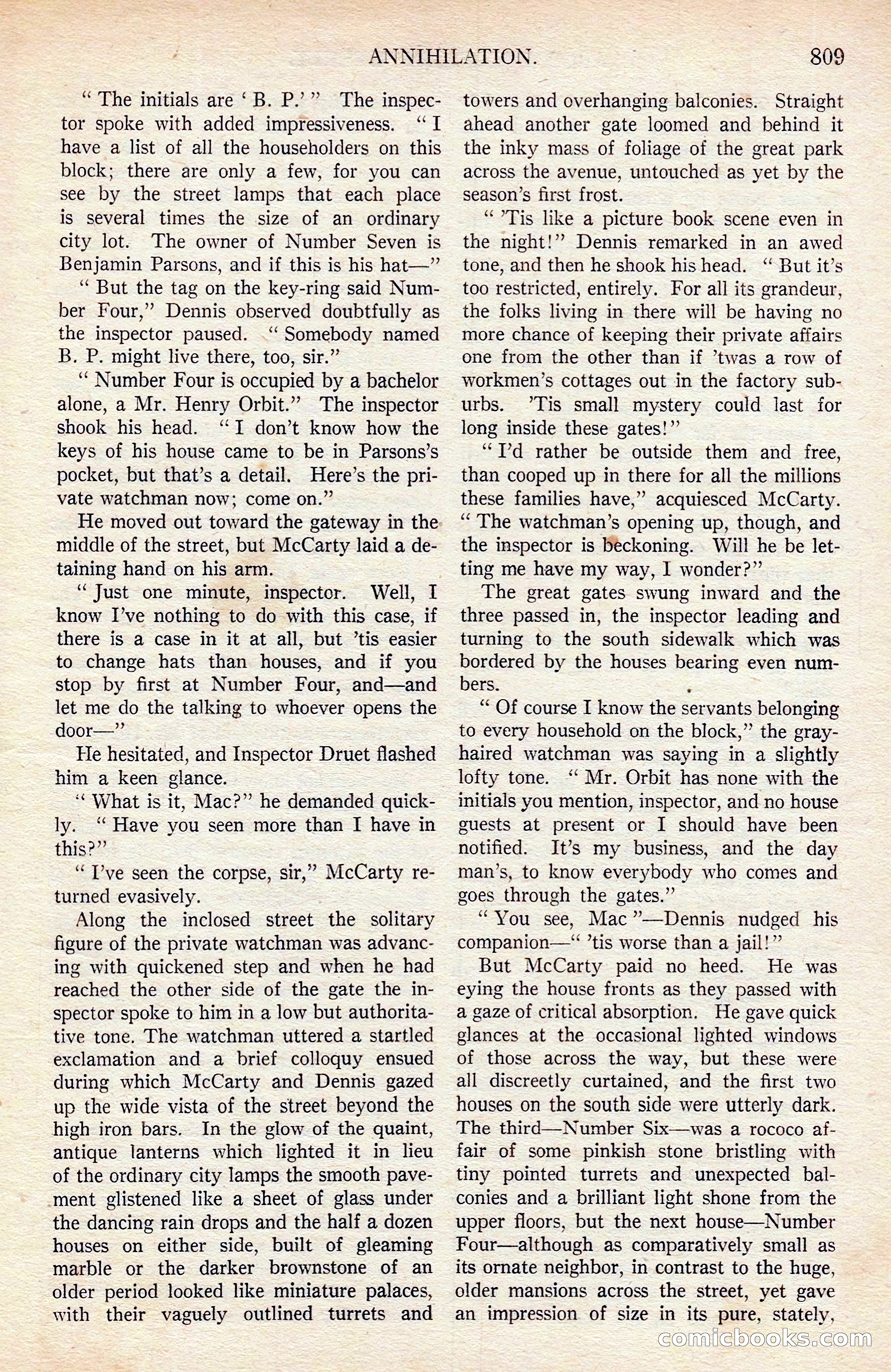
A restored page from Pulp Fiction, 1923. Page through the whole issue in the reader above.
📄 Transcribed text from this page (OCR, searchable)
Machine-transcribed from the original scan — historical spelling and the odd misread are preserved.
ANNIHILATION. 809 ‘“ The initials are ‘B. P.’” The inspec- towers and overhanging balconies. Straight tor spoke with added impressiveness. “I have a list of all the householders on this block; there are only a few, for you can see by the street lamps that each place Is several times the size of an ordinary city lot. The owner of Number Seven is Benjamin Parsons, and if this is his hat—” ‘“ But the tag on the key-ring said Num- ber Four,’ Dennis observed doubtfully as the inspector paused. ‘“‘ Somebody named B. P. might live there, too, sir.” ‘“ Number Four is occupied by a bachelor alone, a Mr. Henry Orbit.” The inspector shook his head. “I don’t know how the keys of his house came to be in Parsons’s pocket, but that’s a detail. Here’s the pri- vate watchman now; come on.” He moved out toward the gateway in the middle of the street, but McCarty laid a de- taining hand on his arm. ‘“Just one minute, inspector. Well, I know I’ve nothing to do with this case, if there is a case in it at all, but ’tis easier to change hats than houses, and if you stop by first at Number Four, and—and let me do the talking to whoever opens the door—”’ He hesitated, and Inspector Druet flashed him a keen glance. ‘“ What is it, Mac?” he demanded quick- ly. “‘ Have you seen more than I have in this?” ‘“T’ve seen the corpse, sir,” McCarty re- turned evasively. Along the inclosed street the solitary figure of the private watchman was advanc- ing with quickened step and when he had reached the other side of the gate the in- spector spoke to him in a low but authorita- tive tone. The watchman uttered a startled exclamation and a brief colloquy ensued during which McCarty and Dennis gazed up the wide vista of the street beyond the high iron bars. In the glow of the quaint, antique lanterns which lighted it in lieu of the ordinary city Jamps the smooth pave- ment glistened like a sheet of glass under the dancing rain drops and the half a dozen houses on either side, built of gleaming marble or the darker brownstone of an older period looked like miniature palaces, with their vaguely outlined turrets and ahead another gate loomed and behind it the inky mass of foliage of the great park across the avenue, untouched as yet by the season’s first frost. “Tis like a picture book scene even in the night!” Dennis remarked in an awed tone, and then he shook his head. ‘ But it’s too restricted, entirely. For all its grandeur, the folks living in there will be having no more chance of keeping their private affairs one from the other than if *twas a row of workmen’s cottages out in the factory sub- urbs. ’Tis small mystery could last for long inside these gates!” “I'd rather be outside them and free, than cooped up in there for all the millions these families have,” acquiesced McCarty. “The watchman’s opening up, though, and the inspector is beckoning. Will he be let- ting me have my way, I wonder?” The great gates swung inward and the three passed in, the inspector leading and turning to the south sidewalk which was bordered by the houses bearing even num- bers. ; “Of course I know the servants belonging to every household on the block,” the gray- haired watchman was saying in a slightly lofty tone. “Mr. Orbit has none with the initials you mention, inspector, and no house guests at present or I should have been notified. It’s my business, and the day man’s, to know everybody who comes and goes through the gates.” “You see, Mac ”—Dennis nudged his companion—“ ’tis worse than a jail!” But McCarty paid no heed. He was eying the house fronts as they passed with a gaze of critical absorption. He gave quick glances at the occasional lighted windows of those across the way, but these were all discreetly curtained, and the first two houses on the south side were utterly dark. The third—Number Six—was a rococo af- fair of some pinkish stone bristling with tiny pointed turrets and unexpected bal- conies and a brilliant light shone from the upper floors, but the next house—Number Four—although as comparatively small as its ornate neighbor, in contrast to the huge, older mansions across the street, yet gave an impression of size in its pure, stately, COMME OOOKS CO