
Pulp Fiction, 1923 · page 75 of 176
Argosy All-Story Weekly — page 75: what you’re looking at
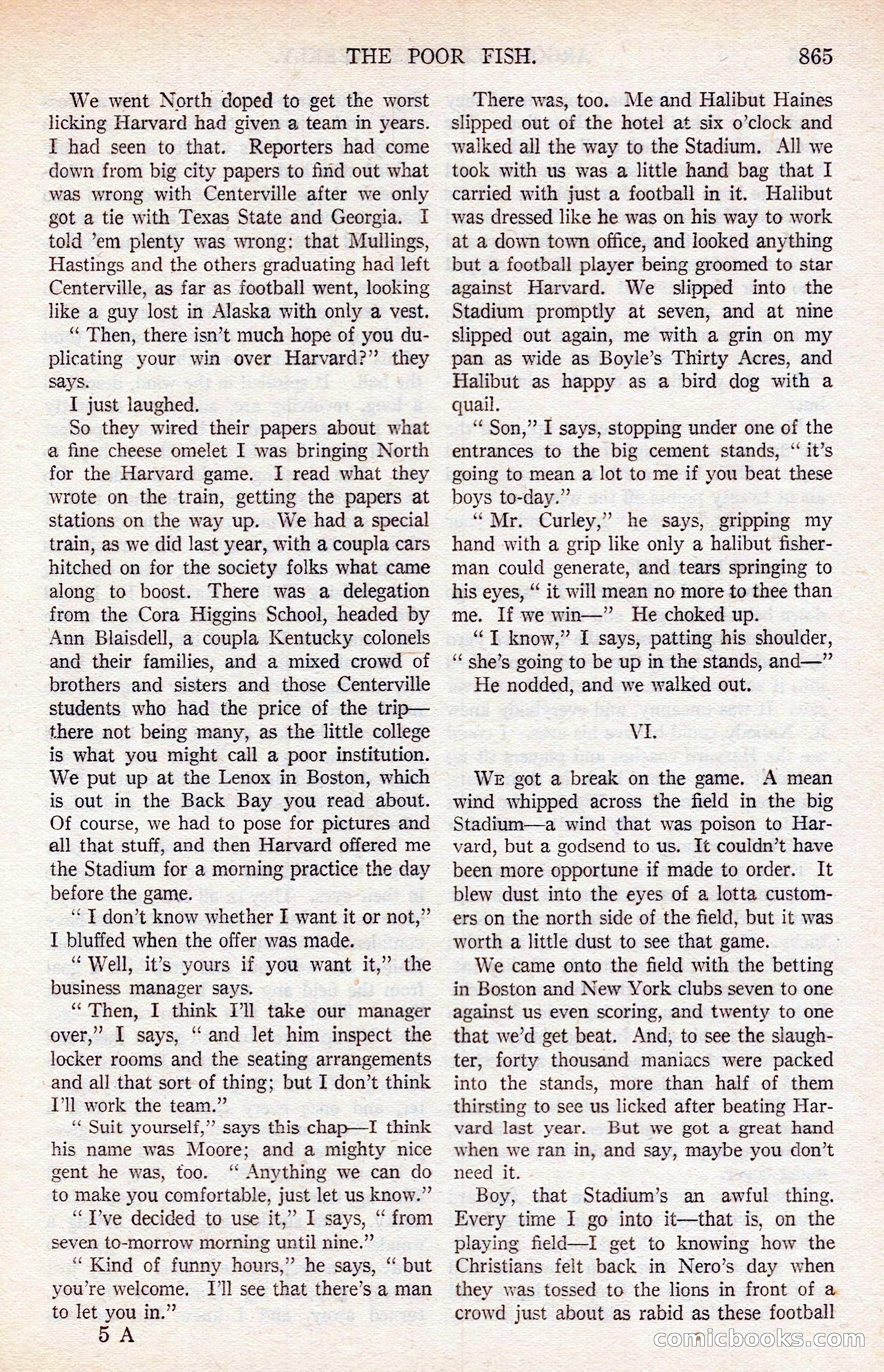
A restored page from Pulp Fiction, 1923. Page through the whole issue in the reader above.
📄 Transcribed text from this page (OCR, searchable)
Machine-transcribed from the original scan — historical spelling and the odd misread are preserved.
THE POOR FISH. We went North doped to get the worst licking Harvard had given a team in years. IT had seen to that. Reporters had come down from big city papers to find out what was wrong with Centerville after we only got a tie with Texas State and Georgia. I told ’°em plenty was wrong: that Mullings, Hastings and the others graduating had left Centerville, as far as football went, looking like a guy lost in Alaska with only a vest. “Then, there isn’t much hope of you du- plicating your win over Harvard?” they says. T just laughed. So they wired their papers about what a fine cheese omelet I was bringing North for the Harvard game. I read what they wrote on the train, getting the papers at stations on the way up. We had a special train, as we did last year, with a coupla cars hitched on for the society folks what came along to boost. There was a delegation from the Cora Higgins School, headed by Ann Blaisdell, a coupla Kentucky colonels and their families, and a mixed crowd of brothers and sisters and those Centerville students who had the price of the trip— there not being many, as the little college is what you might call a poor institution. We put up at the Lenox in Boston, which is out in the Back Bay you read about. Of course, we had to pose for pictures and all that stuff, and then Harvard offered me the Stadium for a morning practice the day before the game. ‘“ } don’t know whether I want it or not,” I bluffed when the offer was made. “Well, it’s yours if you want it,” the business manager says. “Then, I think Tl take our manager over,’ I says, “and let him inspect the locker rooms and the seating arrangements and all that sort of thing; but I don’t think I'll work the team.” ‘““ Suit yourself,” says this chap—I think his name was Moore; and a mighty nice gent he was, too. “ Anything we can do to make you comfortable, just let us know.” “T’ve decided to use it,” I says, “ from seven to-morrow morning until nine.” “Kind of funny hours,” he says, “ but you're welcome. I'll see that there’s a man to let you in.” Oo A 865 There was, too. Me and Halibut Haines slipped out of the hotel at six o’clock and walked all the way to the Stadium. All we took with us was a little hand bag that I carried with just a football in it. Halibut was dressed like he was on his way to work at a down town office, and looked anything but a football player being groomed to star against Harvard. We slipped into the Stadium promptly at seven, and at nine slipped out again, me with a grin on my pan as wide as Boyle’s Thirty Acres, and Halibut as happy as a bird dog with a quail. “ Son,” I says, stopping under one of the entrances to the big cement stands, “‘ it’s going to mean a lot to me if you beat these boys to-day.” “Mr. Curley,” he says, gripping my hand with a grip like only a halibut fisher- man could generate, and tears springing to his eyes, ‘ it will mean no more fo thee than me. If we win—” He choked up. ““T know,” I says, patting his shoulder, ‘ she’s going to be up in the stands, and—” He nodded, and we walked out. VIE. WE got a break on the game. A mean wind whipped across the field in the big Stadium—a wind that was poison to Har- vard, but a godsend to us. It couldn’t have been more opportune if made to order. It blew dust into the eyes of a lotta custom- ers on the north side of the field, but it was worth a little dust to see that game. We came onto the field with the betting in Boston and New York clubs seven to one against us even scoring, and twenty to one that we’d get beat. And, to see the slaugh- ter, forty thousand maniacs were packed into the stands, more than half of them thirsting to see us licked after beating Har- vard last year. But we got a great hand when we ran in, and say, maybe you don’t need it. Boy, that Stadium’s an awful thing. Every time I go into it—that is, on the playing field—I get to knowing how the Christians felt back in Nero’s day when they was tossed to the lions in front of a crowd just about as rabid as these football COnnicloooks.c© in