
Pulp Fiction, 1923 · page 86 of 176
Argosy All-Story Weekly — page 86: what you’re looking at
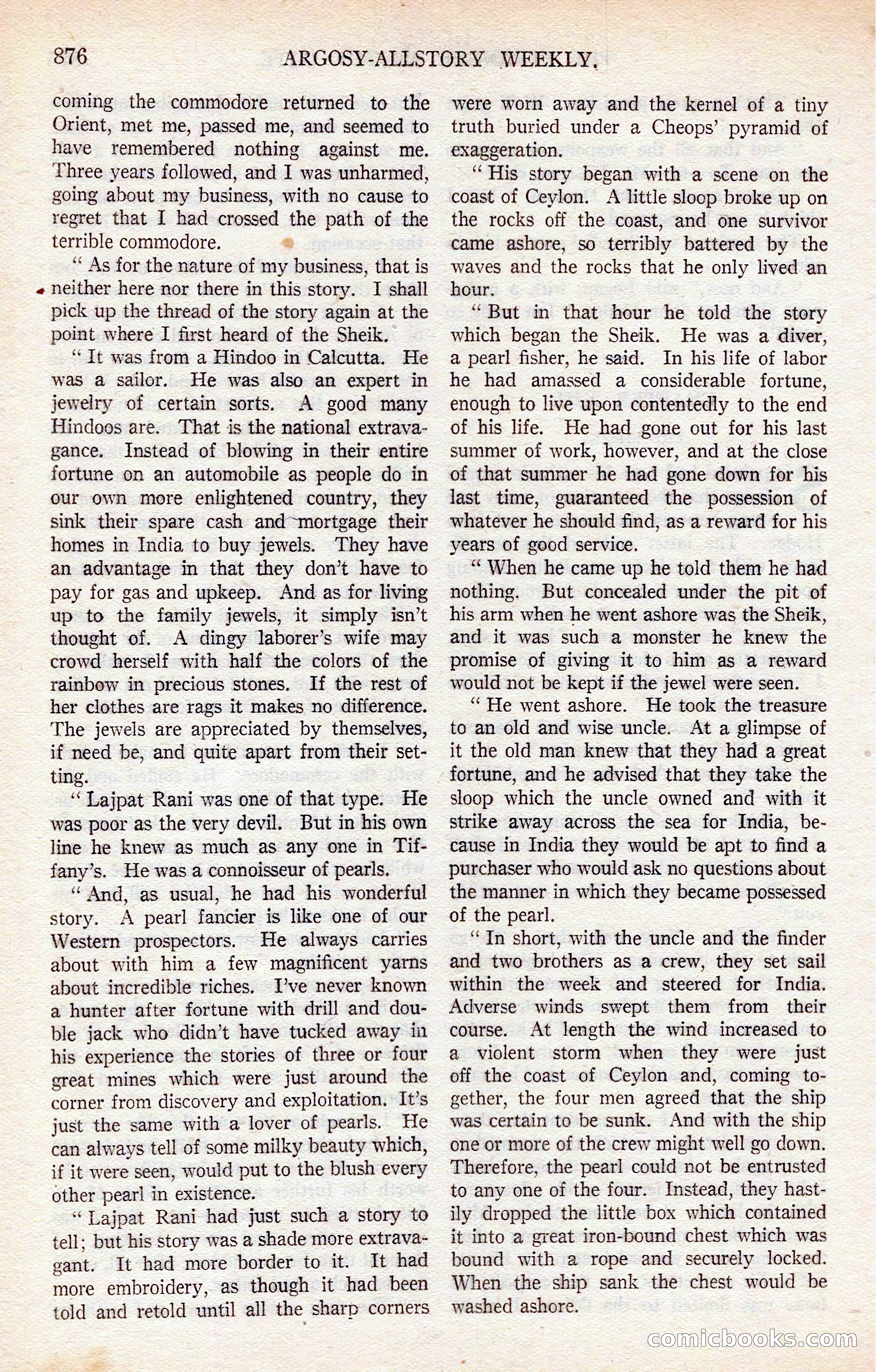
A restored page from Pulp Fiction, 1923. Page through the whole issue in the reader above.
📄 Transcribed text from this page (OCR, searchable)
Machine-transcribed from the original scan — historical spelling and the odd misread are preserved.
4 876 coming the commodore returned to the Orient, met me, passed me, and seemed to have remembered nothing against me. Three years followed, and I was unharmed, going about my business, with no cause to regret that I had crossed the path of the terrible commodore. cS ‘* As for the nature of my business, that is neither here nor there in this story. I shall pick up the thread of the story again at the point where I first heard of the Sheik. “It was from a Hindoo in Calcutta. He was a sailor. He was also an expert in jewelry of certain sorts. A good many Hindoos are. That is the national extrava- gance. Instead of blowing in their entire fortune on an automobile as people do in our own more enlightened country, they sink their spare cash and~mortgage their homes in India to buy jewels. They have an advantage in that they don’t have to pay for gas and upkeep. And as for living up to the family jewels, it simply isn’t thought of. A dingy laborer’s wife may crowd herself with half the colors of the rainbow in precious stones. If the rest of her clothes are rags it makes no difference. The jewels are appreciated by themselves, if need be, and quite apart from their set- ting. ‘‘Lajpat Rani was one of that type. He was poor as the very devil. But in his own line he knew as much as any one in Tif- fany’s. He was a connoisseur of pearls. “And, as usual, he had his wonderful story. A pearl fancier is like one of our Western prospectors. He always carries about with him a few magnificent yarns about incredible riches. I’ve never known a hunter after fortune with drill and dou- ble jack who didn’t have tucked away in his experience the stories of three or four great mines which were just around the corner from discovery and exploitation. It’s just the same with a lover of pearls. He can always tell of some milky beauty which, if it were seen, would put to the blush every other pearl in existence. “Lajpat Rani had just such a story to tell: but his story was a shade more extrava- gant. It had more border to it. It had more embroidery, as though it had been told and retold until all the sharp corners ARGOSY-ALLSTORY WEEKLY, were worn away and the kernel of a tiny truth buried under a Cheops’ pyramid of exaggeration. “His story began with a scene on the coast of Ceylon. A little sloop broke up on the rocks off the coast, and one survivor came ashore, so terribly battered by the waves and the rocks that he only lived an hour. | “But in that hour he told the story which began the Sheik. He was a diver, a pearl fisher, he said. In his life of labor he had amassed a considerable fortune, enough to live upon contentedly to the end of his life. He had gone out for his last summer of work, however, and at the close of that summer he had gone down for his last time, guaranteed the possession of whatever he should find, as a reward for his years of good service. “When he came up he told them he had nothing. But concealed under the pit of his arm when he went ashore was the Sheik, and it was such a monster he knew the promise of giving it to him as a reward would not be kept if the jewel were seen. “He went ashore. He took the treasure to an old and wise uncle. At a glimpse of it the old man knew that they had a great fortune, and he advised that they take the sloop which the uncle owned and with it strike away across the sea for India, be- cause in India they would be apt to find a purchaser who would ask no questions about the manner in which they became possessed of the pearl. ‘In short, with the uncle and the finder and two brothers as a crew, they set sail within the week and steered for India. Adverse winds swept them from their course. At length the wind increased to a violent storm when they were just off the coast of Ceylon and, coming to- gether, the four men agreed that the ship was certain to be sunk. And with the ship one or more of the crew might well go down. Therefore, the pearl could not be entrusted to any one of the four. Instead, they hast- ily dropped the little box which contained it into a great iron-bound chest which was bound with a rope and securely locked. When the ship sank the chest would be washed ashore. Ccomicooo SCO)