
Pulp Fiction, 1924 · page 144 of 172
Argosy All-Story Weekly, April 19, 1924 — page 144: what you’re looking at
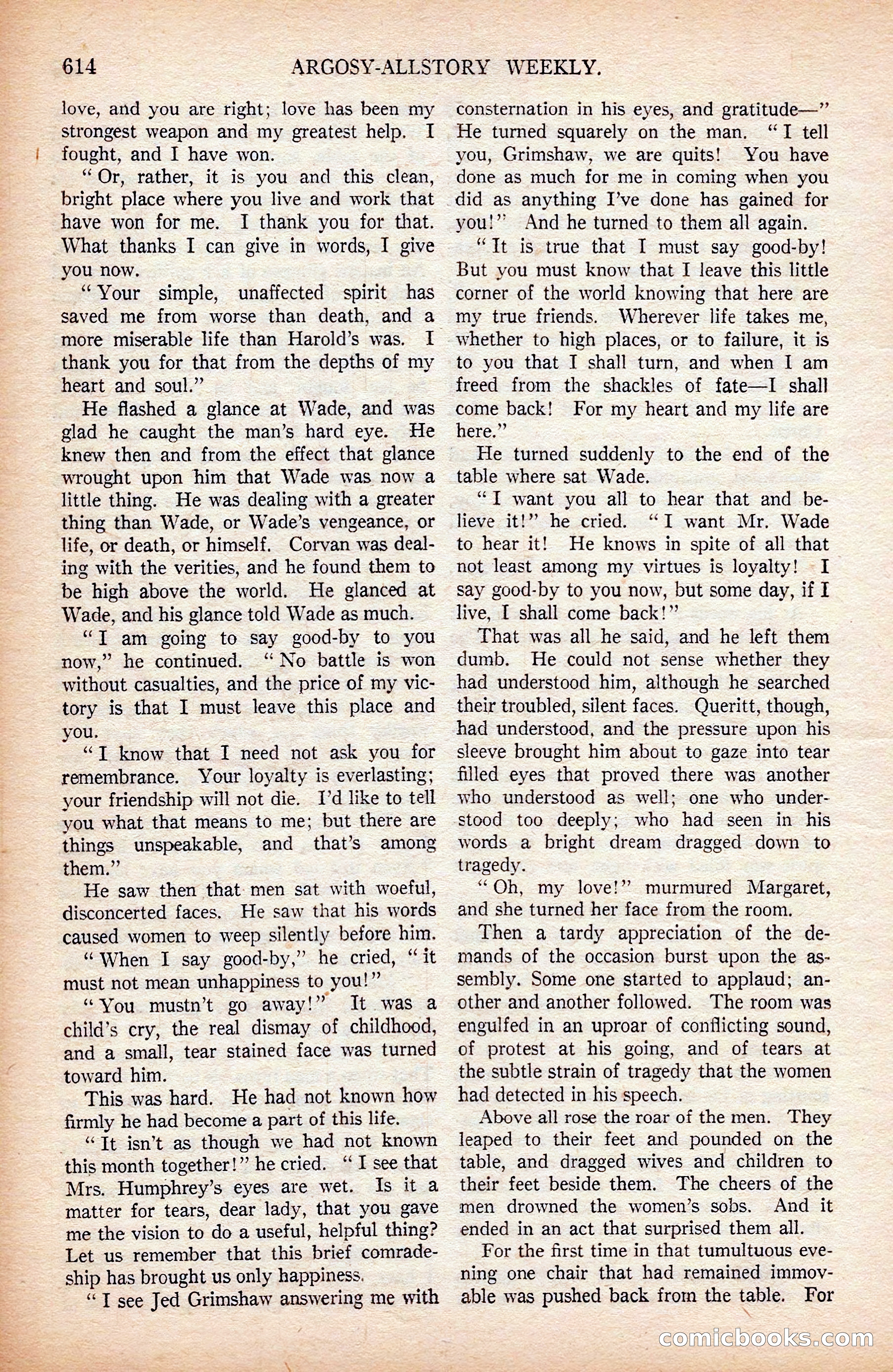
A restored page from Pulp Fiction, 1924. Page through the whole issue in the reader above.
📄 Transcribed text from this page (OCR, searchable)
Machine-transcribed from the original scan — historical spelling and the odd misread are preserved.
614 love, and you are right; love has been my strongest weapon and my greatest help. I fought, and I have won. “Or, rather, it is you and this clean, bright place where you live and work that have won for me. I thank you for that. What thanks I can give in words, I give you now. “Your simple, unaffected spirit has saved me from worse than death, and a more miserable life than Harold’s was. I thank you for that from the depths of my heart and soul.” He flashed a glance at Wade, and was glad he caught the man’s hard eye. He knew then and from the effect that glance wrought upon him that Wade was now a little thing. He was dealing with a greater thing than Wade, or Wade’s vengeance, or life, or death, or himself. Corvan was deal- ing with the verities, and he found them to be high above the world. He glanced at Wade, and his glance told Wade as much. “JT am going to say good-by to you now,” he continued. ‘“ No battle is won without casualties, and the price of my vic- tory is that I must leave this place and you. “JT know that I need not ask you for remembrance. Your loyalty is everlasting; your friendship will not die. I'd like to tell you what that means to me; but there are things unspeakable, and that’s among them.”’ He saw then that: men sat with woeful, disconcerted faces. He saw that his words caused women to weep silently before him. “When I say good-by,” he cried, “it must not mean unhappiness to you!” “Vou mustn’t go away!” It was a child’s cry, the real dismay of childhood, and a small, tear stained face was turned toward him. This was hard. He had not known how firmly he had become a part of this life. “Tt isn’t as though we had not known this month together!” he cried. “ I see that Mrs. Humphrey’s eyes are wet. Is it a matter for tears, dear lady, that you gave me the vision to do a useful, helpful thing? Let us remember that this brief comrade- ship has brought us only happiness. “T see Jed Grimshaw answering me with ARGOSY-ALLSTORY WEEKLY. consternation in his eyes, and gratitude—”’ He turned squarely on the man. “TI tell you, Grimshaw, we are quits! You have done as much for me in coming when you did as anything I’ve done has gained for you!” And he turned to them all again. “It is true that I must say good-by! But you must know that I leave this little corner of the world knowing that here are my true friends. Wherever life takes me, whether to high places, or to failure, it is to you that I shall turn, and when I am freed from the shackles of fate—lI shall come back! For my heart and my life are here.”’ He turned suddenly to the end of the table where sat Wade. “JT want you all to hear that and _ be- lieve it!” he cried. “I want Mr. Wade to hear it! He knows in spite of all that not least among my virtues is loyalty! I say good-by to you now, but some day, if I live, I shall come back!”’ That was all he said, and he left them dumb. He could not sense whether they had understood him, although he searched their troubled, silent faces. Queritt, though, had understood, and the pressure upon his sleeve brought him about to gaze into tear filled eyes that proved there was another who understood as well; one who under- stood too deeply; who had seen in his words a bright dream dragged down to tragedy. “Oh, my love!”? murmured Margaret, and she turned her face from the room, Then a tardy appreciation of the de- mands of the occasion burst upon the as- sembly. Some one started to applaud; an- other and another followed. The room was engulfed in an uproar of conflicting sound, of protest at his going, and of tears at the subtle strain of tragedy that the women had detected in his speech. Above all rose the roar of the men. They leaped to their feet and pounded on the table, and dragged wives and children to their feet beside them. The cheers of the men drowned the women’s sobs. And it ended in an act that surprised them all. For the first time in that tumultuous eve- ning one chair that had remained immov- able was pushed back from the table. For Eomichdoo S (S@ S