
Pulp Fiction, 1924 · page 151 of 172
Argosy All-Story Weekly, April 19, 1924 — page 151: what you’re looking at
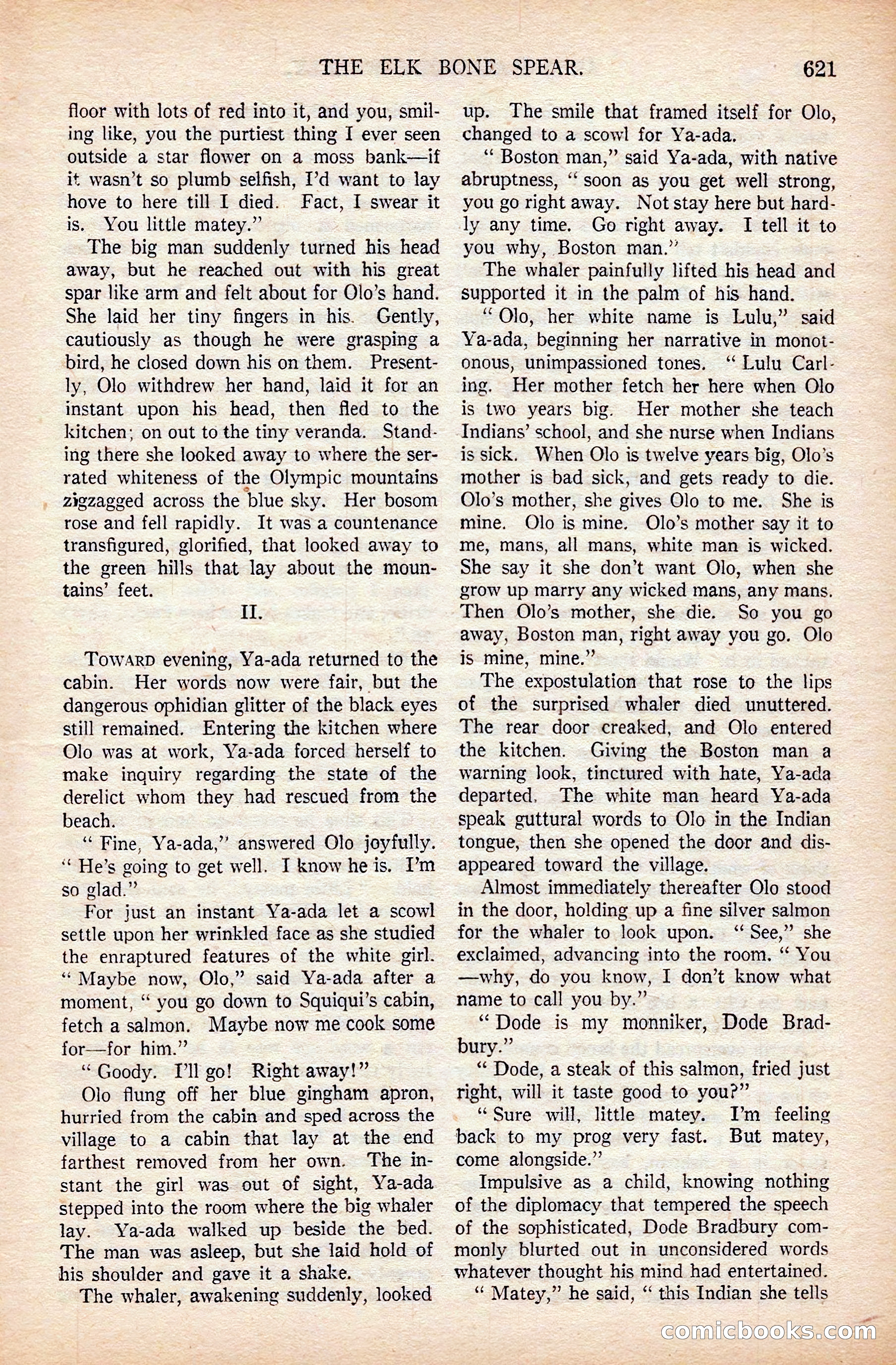
A restored page from Pulp Fiction, 1924. Page through the whole issue in the reader above.
📄 Transcribed text from this page (OCR, searchable)
Machine-transcribed from the original scan — historical spelling and the odd misread are preserved.
THE ELK BONE SPEAR. floor with lots of red into it, and you, smil- ing like, you the purtiest thing I ever seen outside a star flower on a moss bank—if if wasn’t so plumb selfish, I’d want to lay hove to here till I died. Fact, I swear it is. You little matey.” The big man suddenly turned his head away, but he reached out with his great spar like arm and felt about for Olo’s hand. She laid her tiny fingers in his. Gently, cautiously as though he were grasping a bird, he closed down his on them. Present- ly, Olo withdrew her hand, laid it for an instant upon his head, then fled to the kitchen; on out to the tiny veranda. Stand- ing there she looked away to where the ser- rated whiteness of the Olympic mountains zigzageed across the blue sky. Her bosom rose and fell rapidly. It was a countenance transfigured, glorified, that looked away to the green hills that lay about the moun- tains’ feet. Il. Towarp evening, Ya-ada returned to the cabin. Her words now were fair, but the dangerous ophidian glitter of the black eyes still remained. Entering the kitchen where Olo was at work, Ya-ada forced herself to make inquiry regarding the state of the derelict whom they had rescued from the beach. ‘“ Fine, Ya-ada,”’ answered Olo joyfully. ‘“He’s going to get well. I know heis. ?’m so glad.” For just an instant Ya-ada let a scowl settle upon her wrinkled face as she studied the enraptured features of the white girl. “Maybe now, Olo,” said Ya-ada after a moment, “ you go down to Squiqui’s cabin, fetch a salmon. Maybe now me cook some for—for him.” “Goody. Ill go! Right away!” Olo flung off her blue gingham apron, hurried from the cabin and sped across the village to a cabin that lay at the end farthest removed from her own. ‘The in- stant the girl was out of sight, Ya-ada stepped into the room where the big whaler lay. Ya-ada walked up beside the bed. The man was asleep, but she laid hold of his shoulder and gave it a shake. The whaler, awakening suddenly, looked 621 up. The smile that framed itself for Olo, changed to a scowl for Ya-ada. ** Boston man,” said Ya-ada, with native abruptness, “soon as you get well strong, you go right away. Notstay here but hard- | ly any time. Go right away. I tell it to you why, Boston man.” The whaler painfully lifted his head and supported it in the palm of his hand. “Olo, her white name is Lulu,” said Ya-ada, beginning her narrative in monot- onous, unimpassioned tones. ‘‘ Lulu Carl- ing. Her mother fetch her here when Olo is two years big. Her mother she teach Indians’ school, and she nurse when Indians is sick. When Olo is twelve years big, Olo’s mother is bad sick, and gets ready to die. Olo’s mother, she gives Olo to me. She is mine. Olo is mine. Olo’s mother say it to me, mans, all mans, white man is wicked. She say it she don’t want Olo, when she grow up marry any wicked mans, any mans. Then Olo’s mother, she die. So you go away, Boston man, right away you go. Olo is mine, mine.” The expostulation that rose to the lips of the surprised whaler died unuttered. The rear door creaked, and Olo entered the kitchen. Giving the Boston man a warning Jook, tinctured with hate, Ya-ada departed. The white man heard Ya-ada speak guttural words to Olo in the Indian tongue, then she opened the door and dis- appeared toward the village. Almost immediately thereafter Olo stood in the door, holding up a fine silver salmon for the whaler to look upon. ‘* See,” she exclaimed, advancing into the room. ‘“* You —why, do you know, I don’t know what name to call you by.” “Dode is my monniker, Dode Brad- bury.” *“* Dode, a steak of this salmon, fried just right, will it taste good to you?” “ Sure will, little matey. Tm feeling back to my prog very fast. But matey, come alongside.” Impulsive as a child, knowing nothing of the diplomacy that tempered the speech of the sophisticated, Dode Bradbury com- monly blurted out in unconsidered words whatever thought his mind had entertained. ‘“‘ Matey,” he said, ‘‘ this Indian she tells Connicldoolks.conn