
Pulp Fiction, 1924 · page 153 of 172
Argosy All-Story Weekly, April 19, 1924 — page 153: what you’re looking at
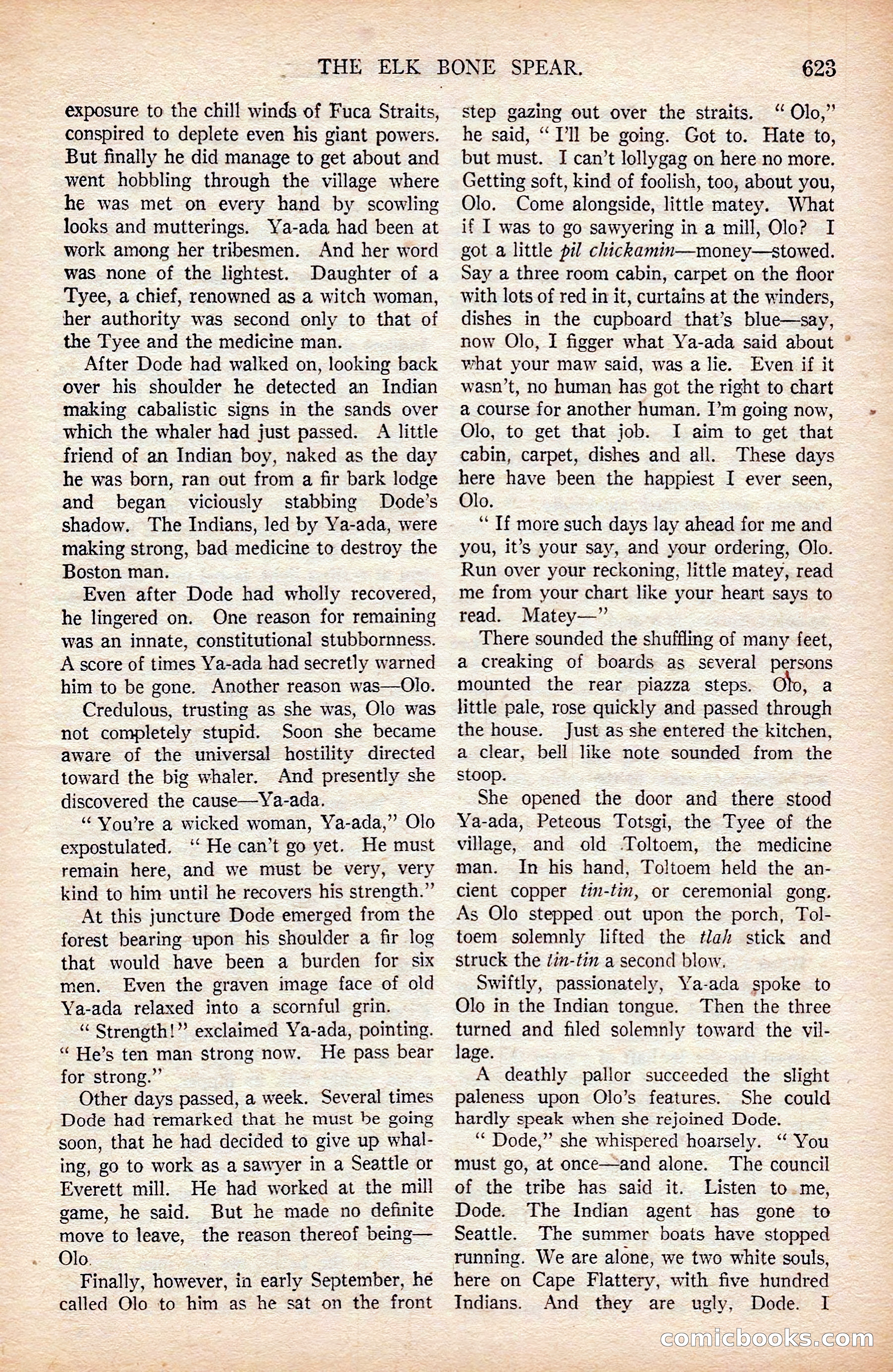
A restored page from Pulp Fiction, 1924. Page through the whole issue in the reader above.
📄 Transcribed text from this page (OCR, searchable)
Machine-transcribed from the original scan — historical spelling and the odd misread are preserved.
THE ELK BONE SPEAR. exposure to the chill winds of Fuca Straits, conspired to deplete even his giant powers. But finally he did manage to get about and went hobbling through the village where he was met on every hand by scowling looks and mutterings. Ya-ada had been at work among her tribesmen. And her word was none of the lightest. Daughter of a Tyee, a chief, renowned as a witch woman, her authority was second only to that of the Tyee and the medicine man. After Dode had walked on, looking back over his shoulder he detected an Indian making cabalistic signs in the sands over which the whaler had just passed. A little friend of an Indian boy, naked as the day he was born, ran out from a fir bark lodge and began viciously stabbing Dode’s shadow. The Indians, led by Ya-ada, were making strong, bad medicine to destroy the Boston man. Even after Dode had wholly recovered, he lingered on. One reason for remaining was an innate, constitutional stubbornness. A score of times Ya-ada had secretly warned him to be gone. Another reason was—Olo. Credulous, trusting as she was, Olo was not completely stupid. ‘Soon she became aware of the universal hostility directed toward the big whaler. And presently she discovered the cause—Ya-ada. “ Youre a wicked woman, Ya-ada,” Olo expostulated. ‘‘ He can’t go yet. He must remain here, and we must be very, very kind to him until he recovers his strength.” At this juncture Dode emerged from the forest bearing upon his shoulder a fir log that would have been a burden for six men. Even the graven image face of old Ya-ada relaxed into a scornful grin. “Strength!” exclaimed Ya-ada, pointing. “ He’s ten man strong now. He pass bear for strong.”’ Other days passed, a week. Several times Dode had remarked that he must be going soon, that he had decided to give up whal- ing, go to work as a sawyer in a Seattle or Everett mill. He had worked at the mill game, he said. But he made no definite move to leave, the reason thereof beng— Olo. . 3 Finally, however, in early September, he called Olo to him as he sat on the front 625 step gazing out over the straits. ‘ Olo,”’ he said, “I'll be going. Got to. Hate to, but must. JI can’t lollygag on here no more. Getting soft, kind of foolish, too, about you, Olo. Come alongside, little matey. What if I was to go sawyering in a mill, Olo? I got a little pil chickamin—money—stowed. Say a three room cabin, carpet on the floor with lots of red in it, curtains at the winders, dishes in the cupboard that’s blue—say, now Olo, I figger what Ya-ada said about what your maw said, was a lie. Even if it wasn’t, no human has got the right to chart a course for another human. I’m going now, Olo, to get that job. I aim to get that cabin, carpet, dishes and all. These days here have been the happiest I ever seen, Olo. ‘“ Tf more such days lay ahead for me and you, it’s your say, and your ordering, Olo. Run over your reckoning, little matey, read me from your chart like your heart says to read. Matey—”’ There sounded the shuffling of many feet, a creaking of boards as several persons mounted the rear piazza steps. 0, a little pale, rose quickly and passed through the house. Just as she entered the kitchen, a clear, bell like note sounded from the Stoop. She opened the door and there stood Ya-ada, Peteous Totsgi, the Tyee of the village, and old Toltoem, the medicine man. In his hand, Toltoem held the an- cient copper f7#-tin, or ceremonial gong. As Olo stepped out upon the porch, Tol- toem solemnly lifted the tla) stick and struck the éin-tin a second blow, Swiftly, passionately, Ya-ada spoke to Olo in the Indian tongue. Then the three turned and filed solemnly toward the vil- lage. A deathly pallor succeeded the slight paleness upon Olo’s features. She could hardly speak when she rejoined Dode. ‘“ Dode,” she whispered hoarsely. “‘ You must go, at once—and alone. The council of the tribe has said it. Listen to me, Dode. The Indian agent has gone to Seattle. The summer boats have stopped running. We are alone, we two white souls, here on Cape Flattery, with five hundred Indians. And they are ugly, Dode. I (COPMIE OOOKS4eO)