
Pulp Fiction, 1924 · page 24 of 172
Argosy All-Story Weekly, April 19, 1924 — page 24: what you’re looking at
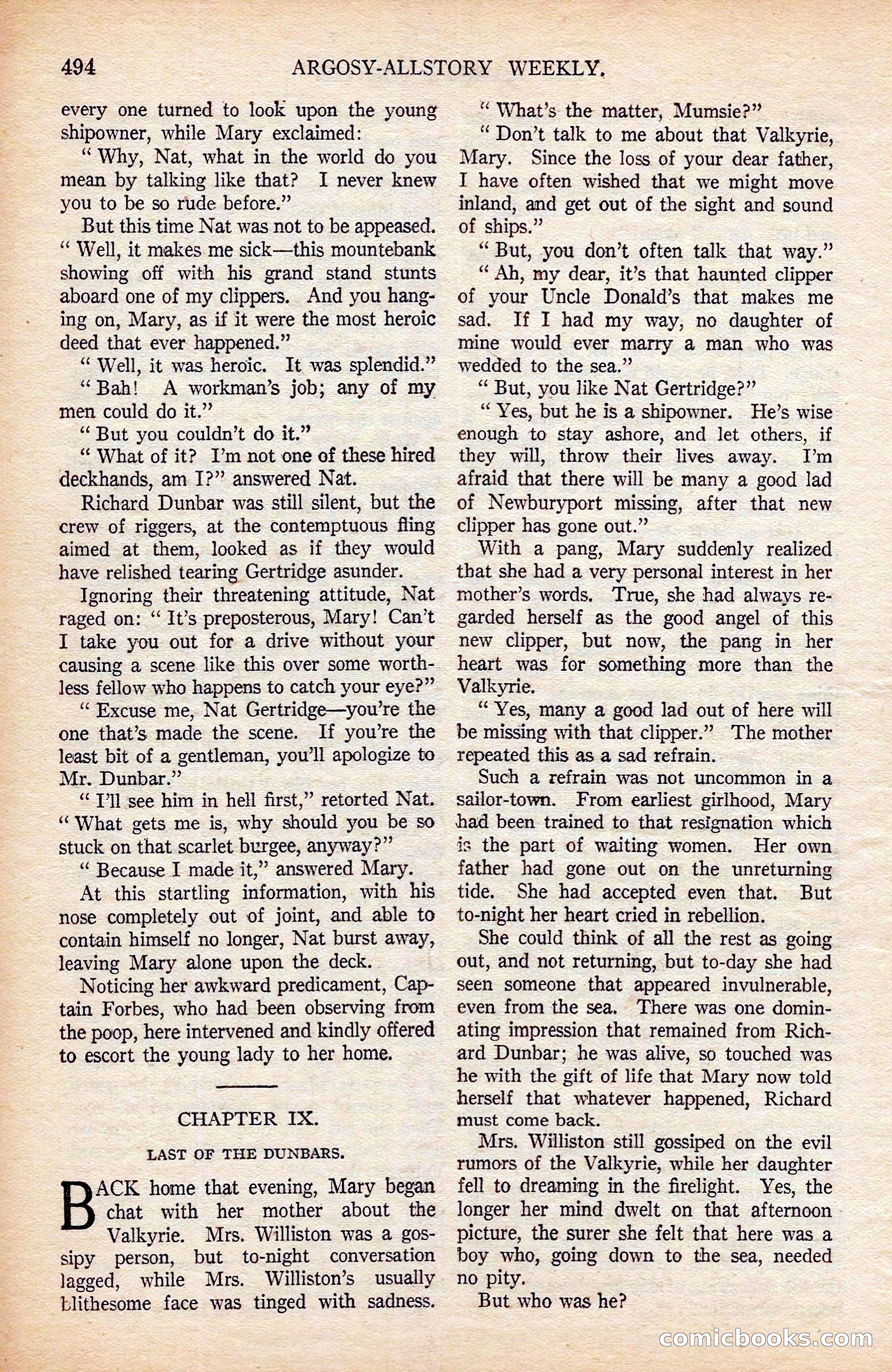
A restored page from Pulp Fiction, 1924. Page through the whole issue in the reader above.
📄 Transcribed text from this page (OCR, searchable)
Machine-transcribed from the original scan — historical spelling and the odd misread are preserved.
494 every one turned to look upon the young shipowner, while Mary exclaimed: ‘Why, Nat, what in the world do you mean by talking like that? I never knew you to be so rude before.” But this time Nat was not to be appeased. ‘Well, it makes me sick—this mountebank showing off with his grand stand stunts aboard one of my clippers. And you hang- ing on, Mary, as if it were the most heroic deed that ever happened.” “Well, it was heroic. It was splendid.” “Bah! A workman’s job; any of my men could do it.” ‘But you couldn’t do it.” “ What of it? I’m not one of these hired deckhands, am I?” answered Nat. Richard Dunbar was still silent, but the crew of riggers, at the contemptuous fling aimed at them, looked as if they would have relished tearing Gertridge asunder. Ignoring their threatening attitude, Nat raged on: “ It’s preposterous, Mary! Can’t I take you out for a drive without your causing a scene like this over some worth- less fellow who happens to catch your eye?” “Excuse me, Nat Gertridge—you’re the one that’s made the scene. If you’re the - least bit of a gentleman, you'll apologize te Mr. Dunbar.” “ T']] see him in hell first,” retorted Nat. “What gets me is, why should you be so stuck on that scarlet burgee, anyway?” “ Because I made it,” answered Mary. At this startling information, with his nose completely out of joint, and able to contain himself no longer, Nat burst away, leaving Mary alone upon the deck. . Noticing her awkward predicament, Cap- tain Forbes, who had been observing from the poop, here intervened and kindly offered to escort the young lady to her home. CHAPTER IX. LAST OF THE DUNBARS. ACK home that evening, Mary began chat with her mother about the Valkyrie. Mrs. Williston was a gos- sipy person, but to-night conversation lagged, while Mrs. Williston’s usually Llithesome face was tinged with sadness. ARGOSY-ALLSTORY WEEKLY, “ What’s the matter, Mumsie?” ‘Don’t talk to me about that Valkyrie, Mary. Since the loss of your dear father, I have often wished that we might move inland, and get out of the sight and sound of ships.” “ But, you don’t often talk that way.” ‘Ah, my dear, it’s that haunted clipper of your Uncle Donald’s that makes me sad. If I had my way, no daughter of mine would ever marry a man who was wedded to the sea.” “ But, you like Nat Gertridge?”’ “Yes, but he is a shipowner. He’s wise enough to stay ashore, and let others, if they will, throw their lives away. I’m afraid that there will be many a good lad of Newburyport missing, after that new clipper has gone out.” With a pang, Mary suddenly realized that she had a very personal interest in her mother’s words, True, she had always re- garded herself as the good angel of this new clipper, but now, the pang in her heart was for something more than the Valkyrie. “Yes, many a good lad out of here will be missing with that clipper.” The mother repeated this as a sad refrain. Such a refrain was not uncommon in a Sailor-town. From earliest girlhood, Mary had been trained to that resignation which is the part of waiting women. Her own father had gone out on the unreturning tide. She had accepted even that. But to-night her heart cried in rebellion. She could think of all the rest as going out, and not returning, but to-day she had seen someone that appeared invulnerable, even from the sea. There was one domin- ating impression that remained from Rich- ard Dunbar; he was alive, so touched was he with the gift of life that Mary now told herself that whatever happened, Richard must come back. Mrs. Williston still gossiped on the evil rumors of the Valkyrie, while her daughter fell to dreaming in the firelight. Yes, the longer her mind dwelt on that afternoon picture, the surer she felt that here was a boy who, going down to the sea, needed no pity. But who was he? Gomichbook (S@)